


In the Pentateuch, God reveals himself through three names: Elohim, El Shadday, and Yahweh. Each name is associated with a different covenant (Noahic, Abrahamic, Mosaic) and is accompanied by a covenantal sign (rainbow, circumcision, sabbath).
By discerning this pattern, we can be better readers of the Old Testament. At times, God will reveal himself under a certain name to indicate a relationship. For example, in Psalms 42–83, the psalmists overwhelmingly use the name Elohim for God because the psalms concern God’s relationship to the world. Indeed, God, Elohim, created heaven and earth (Gen 1:1).
This is just one example of why discerning God’s names matters. At the same time, we should not overinterpret the significance of different names. Genesis 4:26 speaks of people calling upon the name of Yahweh; and this is way before God reveals himself as Yahweh to Moses in the burning bush (Exod 3:14). I have written on that topic here; for the rest of the article, I want to discern patterns of God’s name in the Pentateuch in order to sharpen our grasp of the text, elucidate its meaning, and know better the God who reveals himself in Scripture.
Names in General
Names in the Bible reveal something about the person that they name. Adam’s name represents him as being from the ground, adamah (Gen 2:7). Eve’s name means that she is the mother of all living (Gen 3:20). So when speaking about God’s names in Scripture, we can think of them as revealing something true about God’s character. This would be true of names like El Shadday, Elohim, and Yahweh alongisde the various other names for God in Scripture.
Covenants & Signs
In the Bible, God makes covenants with individuals, creatures, or peoples. A covenant is a binding agreement that has a sign that symbolizes that agreement. For example, God promised by covenant never to destroy the earth with a flood of water again and gave the sign of the rainbow to signify that promise (Gen 9:11, 13).
It is my argument that specific names of God have a particular tie to both a covenant and its sign in the Pentateuch. Again, this does not mean God ceases to be Yahweh just because the name Elohim better fits the Noahic covenant. It only means that a specific name of God better fits a covenant, one in which God’s character can be seen more clearly.
Theodore Lewis, in his The Origin and Character of God, schematizes this relationship, and I follow his basic line of thinking.
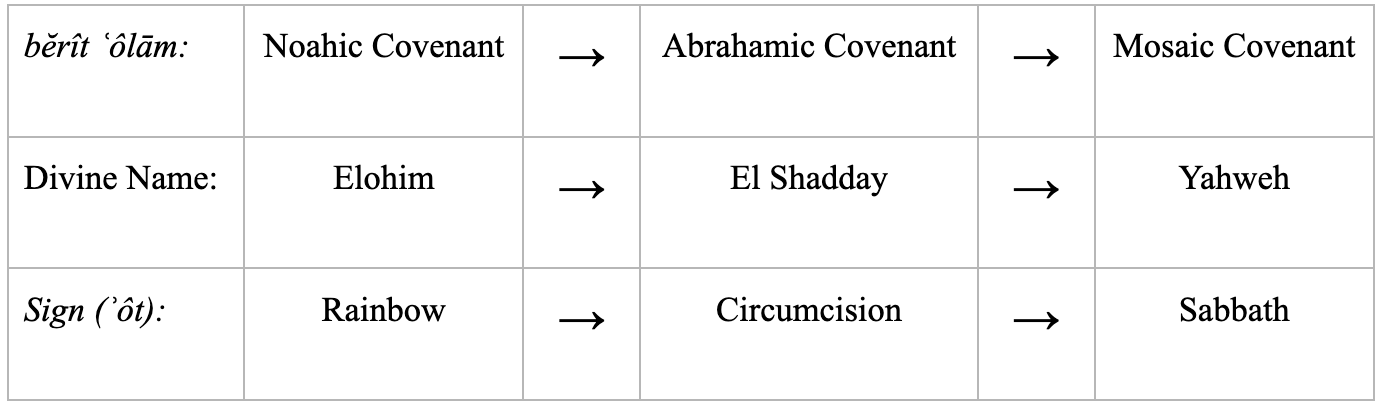
Adapted from Theodore J. Lewis, The Origin and Character of God (2020), 225, fig. 6.2.
Noahic Covenant, Elohim, and the Rainbow
In Genesis 9, God makes a covenant with Noah in which he reveals himself as Elohim and gives the sign of a rainbow:
8 Then Elohim said to Noah and to his sons with him, 9 “Behold, I establish my covenant with you and your offspring after you ... 11 I establish my covenant with you, that never again shall all flesh be cut off by the waters of the flood, and never again shall there be a flood to destroy the earth.” 12 And Elohim said, “This is the sign of the covenant that I make between me and you and every living creature that is with you, for all future generations: 13 I have set my bow in the cloud, and it shall be a sign of the covenant between me and the earth. …16 When the bow is in the clouds, I will see it and remember the everlasting covenant between Elohim and every living creature of all flesh that is on the earth.” 17 Elohim said to Noah, “This is the sign of the covenant that I have established between me and all flesh that is on the earth.”
God’s name here repeatedly is Elohim because his covenant has to do with all creation. Likewise, Genesis 1 uses the name Elohim to speak of God creating heaven and earth. That said, Genesis 2:4 still identifies Elohim with Yahweh; but the focus is on the name Elohim. Here, we see a similar pattern.
Further, the covenant is made with the whole creation: “with you and your offspring after you, and with every living creature that is with you, the birds, the livestock, and every beast of the earth with you, as many as came out of the ark; it is for every beast of the earth” (Gen 9:9–10). So the covenant is a universal covenant with the created order of both rational creatures and non-rational animals.
Hence, the name Elohim particularly fits here. As well, the covenant is called “the everlasting covenant,” which is signified by the “bow” (Gen 9:16). We shall see again and again that God’s covenants have eternality as their characteristic. This, I think, has larger implications for the power and permanence of God.
Abrahamic Covenant, El Shadday, and Circumcision
In Genesis 17, God reveals himself to be El Shadday and makes an eternal covenant with Abraham, whose sign is circumcision:
When Abram was ninety-nine years old Yahweh appeared to Abram and said to him, “I am El Shadday; walk before me, and be blameless, 2 that I may make my covenant between me and you, and may multiply you greatly.” … 7 And I will establish my covenant between me and you and your offspring after you throughout their generations for an everlasting covenant, to be God to you and to your offspring after you. … 10 This is my covenant, which you shall keep, between me and you and your offspring after you: Every male among you shall be circumcised. 11 You shall be circumcised in the flesh of your foreskins, and it shall be a sign of the covenant between me and you.”
El Shadday covenants with Abraham to bless his offspring and the world through his offspring. The covenant, once again, is an everlasting covenant. And circumcision is its sign.
The transition in names from Elohim to El Shadday seems to mark a relational change from God’s universal relation with the cosmos (Elohim) to his relationship with the family of Abraham (El Shadday). Later, God would reveal himself as Yahweh as his special name for the people of Israel.
As Exodus 6:2–3 recounts: “I am Yahweh. I appeared to Abraham, to Isaac, and to Jacob, as El Shadday, but by my name Yahweh I did not make myself known to them.” Again, this does not mean God was not Yahweh in Genesis nor that he never used the name Yahweh; rather, it speaks to how God reveals himself in specific covenants: Elohim, El Shadday, and finally Yahweh.
As to the meaning of El Shadday, the later Greek and Latin tradition rendered El Shadday “God Almighty.” But most admit that we do not know the precise meaning of the term. Some think it means God of the steppes, mountains, or some other like designation.
Whatever else, the name indicates God’s power to work in and through the family of Abraham to bring blessing to a world suffering under the curse of sin and corruption. El Shadday would later rename Jacob Isra-El after him, signifying that El is the God of Israel (cf. Gen 33:20).
Mosaic Covenant, Yahweh, and Sabbath
The third key covenant in the Pentateuch occurs in Exodus when God reveals himself as Yahweh and makes a covenant with Moses/Israel. The covenant occurs primarily in Exodus 19–24, but two other places give helpful summaries.
First, Exodus 6:2–3, as noted above, shows that God now reveals himself as Yahweh even though he used to reveal himself to the Patriarchs as El Shadday. Second, Exodus 31:16–17 speaks of the Sabbath as the sign of the eternal covenant:
Therefore the people of Israel shall keep the Sabbath, observing the Sabbath throughout their generations, as a covenant forever. It is a sign forever between me and the people of Israel that in six days Yahweh made the heavens and the earth, and on the seventh day he rested and was refreshed.
The phrase “covenant forever” translates the Hebrew phrase bĕrît ʿôlām, which is the same phrase rendered “everlasting covenant” in Genesis 9:16 and 17:7.
As to the meaning of the name, likely we can find something of it when God reveals his name to Moses in Exodus 3:13–15:
13 Then Moses said to God, “If I come to the people of Israel and say to them, ‘The God of your fathers has sent me to you,’ and they ask me, ‘What is his name?’ what shall I say to them?” 14 God said to Moses, “I am who I am.” And he said, “Say this to the people of Israel: ‘I am has sent me to you.’ ” 15 God also said to Moses, “Say this to the people of Israel: ‘Yahweh, the God of your fathers, the God of Abraham, the God of Isaac, and the God of Jacob, has sent me to you.’ This is my name forever, and thus I am to be remembered throughout all generations.”
The key phrase here, “I am who I am,” renders the Hebrew ehyeh asher ehyeh. It is an unusual construction, but one that seems to specifically define who God is. He is the one who is, the existent one. Perhaps the name draws into itself the implication that God exists and brings others into existence (Elohim) and is the same El Shadday who walked with the Patriarchs.
In any case, I tend to see the name Yahweh as following the Hebrew verb hyh/hwh, which signifies God’s basic characteristic of existence, his permanence. The sabbath then becomes the sign of the eternal covenant made with Israel.
Conclusion
God is Elohim, El Shadday, Yahweh, El Roi, El Olam, Adonai, and a host of other names in Holy Scripture. These names reveal something about God, and some of them have particular associations with covenants and signs.
I tend to see God revealing himself as Elohim in relation to the world, El Shadday to the Patriarchs, and Yahweh to Israel. These names are not exclusive to these categories or covenants, but are specially related to each category through a covenant and sign.
The upshot is that we can read Scripture more coherently, more clearly discern the meanings of God’s names, and be drawn into the character of God.
Also, you can audit my class on the Old Testament this Fall by clicking the button below.
Yes, the names of God in Scripture reveal something about Him to us. Nathan Stone observed, “Indeed we cannot say all that the mysterious word God means to us until we know more about Him."
Presumably, one could then conclude that the name given to the incarnate Son - Jesus - is because it aligns in particular with the force of the new covenant and it’s force as the covenant of Yahweh’s salvation.