


God said to Moses, “I appeared to Abraham, to Isaac, and to Jacob as El Shadday, but I did not make known my name Yahweh to them” in Exodus 6:3. After Exodus 3:14 and 34:6–7, this may be the most important revelation of God in the book of Exodus. It tells us that God’s pre-Exodus name was El Shadday, but he now reveals himself with the name Yahweh to Moses, and thus to Israel.
The last word, Israel, is important since God (El) names Jacob Isra-el because he is El or El Shadday. Indeed, in Genesis 35 Jacob calls the place where El meets him “El-bethel” (Gen 35:7), and then El renames Jacob Isra-el (Gen 35:10) before identifying himself in the next verse as “El Shadday” (Gen 35:11: אֲנִי אֵל שַׁדַּי).
So here Jacob calls the place of El “El-Bethel,” is named Isra-el, and God proclaims, “I am El Shadday,” all within a few verses of each other (35:7, 10, 11). Unfortunately, these connections that help make sense of Exodus 6:3 are glossed over in many translations that render El Shadday as God Almighty.
While both words are fair translations in and of themselves, they mask the reality that El means God but refers to the specific God who created heaven and earth, El; and the title Shadday, although difficult to pin down exactly, does seem to indicate God’s almightiness, at least that is how the Septuagintal translators took it when they used the Greek word pantokrator to render the Hebrew word shadday.
But El is clearly a name just as Yahweh is in some places. The generic word for God is elohim, whereas El less commonly refers to God in general and, in places like Genesis 35 and Exodus 6, refers to an appellation.
Why El before Yahweh?
So why did God reveal himself first as El before Yahweh? And why do passages like Genesis 14:22 mention the name Yahweh when he did not reveal himself as Yahweh until Exodus 3? The second answer is much easier than the first, and I will opine on it in due time. But first let me discuss the initial question of why El before Yahweh.
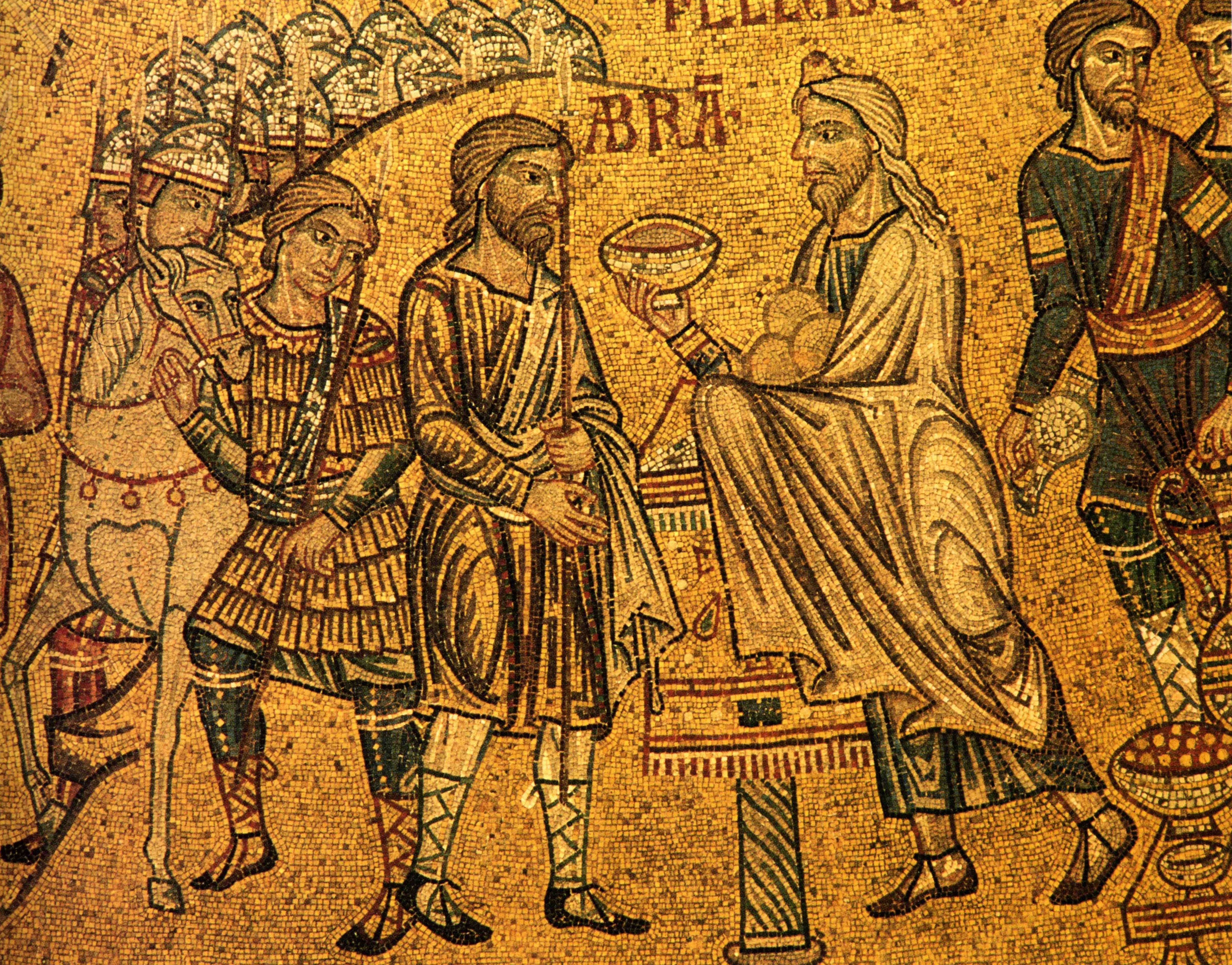
The best place to answer this question is Genesis 14:17–24, where we encounter Melchizedek, who is called priest of El Elyon throughout the narrative. My translation of this passage goes:
“[17] Then the melek of Sodom went out to meet Abram when Abram returned from smiting Chedorlaomer and the kings who accompanied him at the Valley of Shaveh, that is, “the valley of the king.” [18] Now, Melchi-Zedek, king of Salem, brought out bread and wine. (He was a priest to El Elyon). [19] So Melchi-Zedek blessed him, and he said, ‘May Abram be blessed by El Elyon, the creator of heaven and earth! [20] And may El Elyon be blessed, who delivered your enemies into your hand!’ So Abram gave Melchi-Zedek a tenth of all the spoils.
[21] So the melek of Sodom said to Abram, ‘Give me the people, but you keep the property for yourself.’ [22] Abram replied to the melek of Sodom, ‘I will raise my hand to Yahweh, El Elyon, who created heaven and earth: [23] ‘I will not take a cord or a sandal strand nor would I take anything from you,’ so that you may not say, ‘I have made Abram rich.’ [24] I will take nothing except what the young men ate and the portion for the young men, who came with me. Let Aner, Eshcol, and Mamre take their portion.”
In this passage, we observe three remarkable points. First, the God whom Abraham serves, the one who created heaven and earth, is El Elyon.
Second, Melchi-Zedek of Salem, whose name means king of righteousness and whose city signifies “peace,” serves El Elyon as a priest-king. This suggests the obvious point that when Abram came to the Promised Land, others besides him knew God who created heaven and earth. It further points to the expected reality that some people and places preserved God’s original revelation of himself and presumably other forms of continuous revelation (nature, dreams, etc.).
Herman Bavinck makes a similar argument in his essay, “Common Grace.” He believes that all religion takes its form from an original revelation of God, but becomes corrupt over time. That may be; and it would explain why cities in the environs of Israel worshipped El in their pantheon. But by contrast, both Melchi-Zedek and Israelite worship centre on the one God of Israel, El who is also known as Yahweh.
Third, and perhaps difficult for us to accept, because of Exodus 6:3, Abraham calls El Elyon, Yahweh, and identifies this one God as the creator of heaven and earth. Hence, the many titles and names for God in Scripture do not testify to various entities but rather various ways to describe God.
I will pause for a moment on answering how this might be the case, and instead here focus on my answer for why El precedes Yahweh as the way God made himself known. I suspect the answer has to do with El being a common name for God in his original revelation of himself to the Fathers and world. Yahweh is God’s specific name that describes who he is as Israel’s God.
When Moses asks God, “Who shall I say sent me,” God answers “say I AM WHO I AM has sent you” (Exod 3:13, 14). The verb “I am” in Hebrew ehyeh (1st person singular) sounds like yahweh, which approximates the third person singular form of hwh, an older byform of hyh (hence yhwh). The meaning of this name becomes clear during the Exodus, but it includes Yahweh being the God of the Fathers (Exod 3:13) who was known as El Shadday (Exod 6:3).
The texts in Exodus 3 and 6 need not mean that God never went by the name Yahweh at all; but rather, that Yahweh was the name that God specially revealed to Israel to describe who he is for them. He is I AM WHO I AM, the creator of heaven and earth, the one who is self-existent and magnificent (e.g., Exod 34:6–7).
By analogy, when Jesus comes, we stop calling God El or Yahweh, because we know him as our Father. That does not mean we must utterly cease calling him El or Yahweh, but only that we know him first as Father.
To oversimplify matters, God is El to all creation, Yahweh to the nation of Israel, and Father to his adopted family, the church. Obviously, the Father remains Yahweh and El, and so this is more of a question of a mode of revelation than of any essential difference in God. This schema is also only a general observation, one that has parallels. For example, Psalms 42–83 often concern the nations and almost exclusively use the name Elohim for God, not Yahweh. It is not because God has ceased to be Yahweh but largely has to do with the mode of revelation to the nations.
By the time Israel returns to Canaan, after around 400 years in Egypt, it appears that things have changed greatly. No Melchi-Zedek exists who worships El Elyon, who is Yahweh. Instead, revelation may have been corrupted to the point where the name El simply referred to one God amongst a pantheon of others, including the most famous Canaanite god: Baal.
So why do the Patriarchs use the name Yahweh?
We can imagine a number of reasons why this might be the case. First, we could simply say that the authors of Scripture did not aim to be accurate in recording the speech of biblical figures or were not theologically aware of the differences. But nobody who has spent time studying the text of the Pentateuch could make that claim in good conscience.
So, second, we might say that God revealed himself primarily as El to the patriarchs, even though the name Yahweh also existed secondarily. Evidence for this view is that Abraham evidently uses the name Yahweh (e.g., Gen 14:22). Further, the primacy of El seems guaranteed in the simple observation that Israel is so named Israel, as well as the various self-designations that God makes of himself as El Shadday (e.g., Gen 17:1; cf. 28:3; 48:3).
Consider also that when Jacob wrestled with God, he called the place Peni-el; and he called the place El-Bethel (Gen 35:7) before his name was changed to Israel (Gen 35:10). Jacob tells Joseph that God appeared to him as El Shadday in Luz (i.e., where Bethel was according to Gen 35:6) in Genesis 48:3. One last example (of which many more could be offered): when a pregnant Hagar flees from Sarai, she meets God, who names her son Ishma-el. She then calls God El Roi, El who sees.
A third possibility is that Moses knew that El was Yahweh and simply placed his name where appropriate in the Genesis narrative. My daughter knows me as Dad, but she may tell a story later in life where she calls me Wyatt in order to make sense to her audience. This is the same thing, the same reality.
Conclusion
The Bible is stranger than we imagine. English translations by necessity interpret the text, and we sometimes are left without God-given puzzles to solve. But the Bible has many such puzzles. God gave them to the curious so that our minds might be rewarded by seeking him.
While I write this article on God, I am aware that my solution to the puzzle is not mainstream. Most historians of the religion of Israel would find alternatives to mine above. Be that as it may, we cannot as Christian thinkers avoid the gifts that God gives us in Scripture such as is found in Exodus 6:3. It seems we have left the spade work on such questions to historians of Israelite religion. I would much rather see that work as an historical source for the work of understanding the theology of the Bible.
***
By the way, you can audit my course on the Old Testament this Fall by clicking the button below.
The names of God is a fascinating enlightening topic into how God reveals Himself.
I am very eager to be refreshed by a scholar. I do need to know how these things work in scheduling since I still do parish work here and there to figure if I can work around whatever. I wrote that request to registrar, FYI. Godspeed. Keep up the good work, and the Faith, and pass it on. JLR+