


You can no longer trust your eyes. AI-generated images and content increasingly mean that our senses are no longer reliable guides to reality. This loss could lead to cynicism all the way down, or it could motivate us to rediscover other ways of grasping reality.
In light of this, I want to point out two things: first, that the loss of certainty brought about by AI media is real; and second, that the possibility of discerning other paths to reality may now emerge.
To put it directly, in an age when images can no longer be trusted, knowledge must once again be grounded in first principles, testimony, and rightly ordered reason.
What We Have Lost
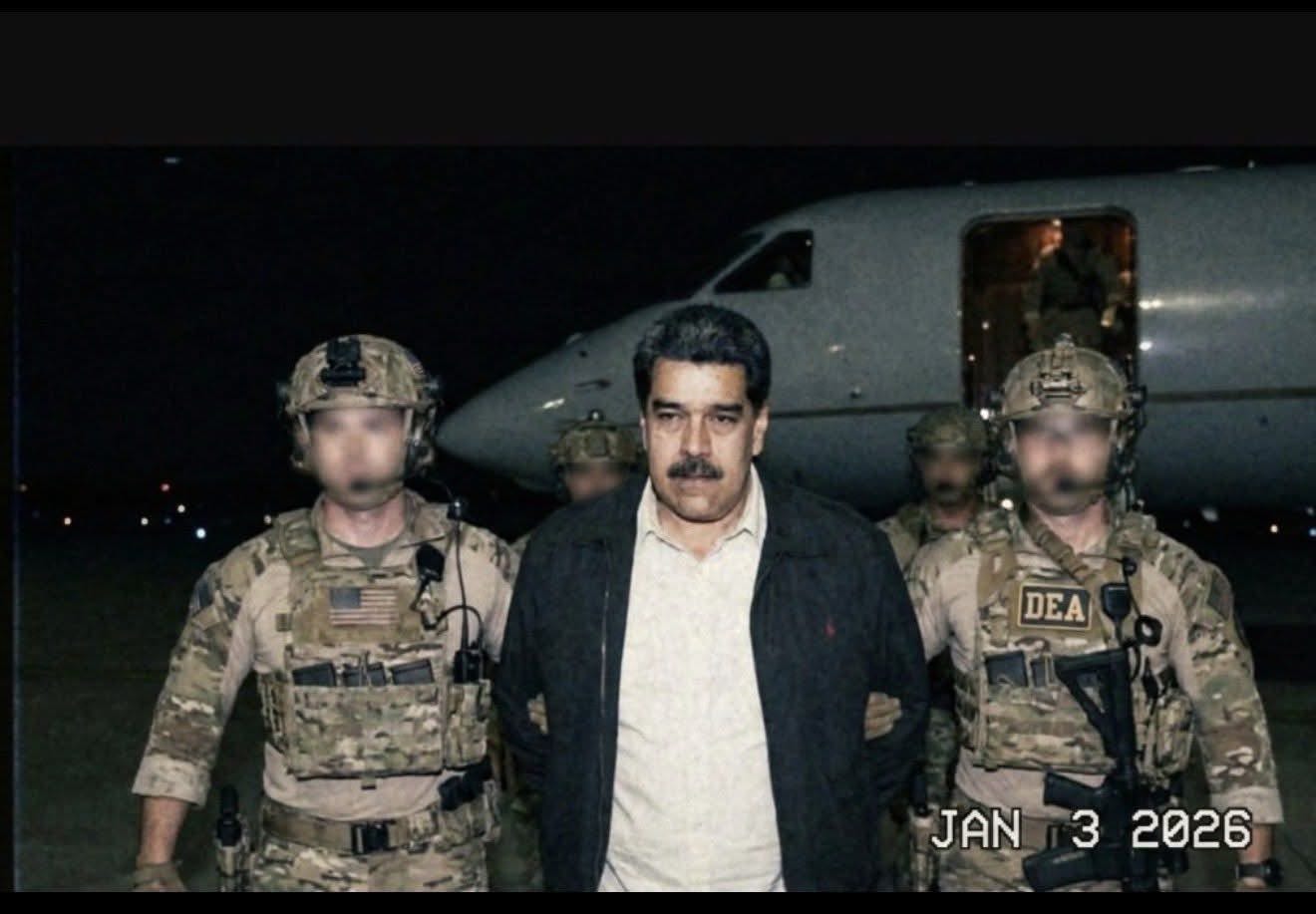
On January 3, 2026, the United States captured Nicolás Maduro in order to bring him to trial for his crimes. As one might expect, this action caused vigorous discussion. An image appeared that depicted Maduro being arrested, with two officers in military fatigues escorting him to an unknown destination. The image was likely created by Gemini, though one could not tell simply by looking at it.
This image, along with video content produced by AI, has flooded online media platforms. For those within intelligence agencies, or for those with access to insider information, such media would be known to be false.
But already in early 2026, it is almost impossible for the average person to tell. I expect the next few years will only reinforce that reality.
And so we can no longer trust our eyes to see what is real, nor our ears to hear what is real. Such things could, of course, be fabricated in the past; but fabrication was much harder and spread far more slowly than today.
With just a few button presses, we can now create entire media sets and spread them to millions of people. Propaganda propagates at lightning speed. Its scope, speed, and source differ markedly from earlier periods.
Digital media gives propaganda a global scope. The speed of the internet allows the world to see it instantly. And the source is often ordinary people: the meme lords and ladies of the internet.
This propaganda exists for clicks and attention more than anything else, though it can be co-opted for larger political purposes. Today’s politics is characterized by psycho-politics, not the older world of machinery, trench warfare, and newspapers. Attention, emotional attachment, and momentum now lead the way.
What Opportunity We Have
But this loss also provides an opportunity. We cannot recover what we have lost, at least not in the near future. But we may be pressed to ask other questions about what it means to discover knowledge.
Let me first make an observation before explaining what I mean. We learn facts by observing them. I see a tree. There is a tree. That is a fact. I may see hundreds of trees, and so I categorize this collection as a forest. That, too, is a fact, although some may quibble over the definition, depending on how many trees there are and other such details.
Within this forest, we may see something that looks like a seed. If we observe it being watered, cared for, and growing, we might infer that it is a seed of a tree. We might then infer that other seeds like this grow trees in the forest. This kind of knowledge is inductive and inferential. It is how much scientific knowledge operates today. We observe, categorize, and infer stable patterns in order to discern what we call scientific laws, or something like them.
Such laws are usually expected to be falsifiable—that is, capable of being disproved—in order to test their validity. Over time, we then integrate these laws into our broader body of knowledge.
What I have described may feel intuitive to most of us, at least to those accustomed to scientific reasoning. This method can be summed up in the phrase, “I’ll believe it when I see it.”
How We Know Things Non-Empirically
But we can recover other ways of knowing that we have forgotten. If we allow that many things we believe are non-inductive and also properly basic to our knowledge, then we admit that there are truths we cannot prove through sensory evidence.
I know that I cannot be both myself and not myself in the same way and at the same time. I cannot establish this inductively. What would I observe—that I have been myself every day so far, and therefore, as a law, I will remain myself tomorrow? Is this truth falsifiable? How would I test it? It simply is.
This is another kind of truth I believe. What is, I know to be. A thing is what it is. This law of identity is fairly obvious, but it again illustrates a kind of truth that we all affirm yet have not really proved. We simply assume it. Perhaps some philosopher has worked out a proof, but not the average person.
I raise these points simply to say this: we already know in non-empirical ways, even if we have not thought much about it.
But could there be other basic beliefs like this that we simply assume? I suspect that if we created an inventory of our beliefs, we would find that the vast majority belong to us by faith or testimony. Perhaps your mother or grandmother told you that spoiling a child will make that child unkind. That seems to you to be a sticky truth that just is, and as you look around the world, it does appear to match what we see.
Some truths are sticky. We simply believe them.
Why Arguments Matter More Than Ever
So we can use these sticky truths as general premises. We can then apply particular situations to them in order to see whether we can arrive at some kind of truth. We might say:
Spoiling children (a) often makes them unkind (b)
My child (c) is spoiled (a)
Therefore, my child (c) will likely be unkind (b)
The form here is this: a belongs to b; c belongs to a; therefore c belongs to b.
The conclusion is highly probable but not certain. So if we want greater certainty, we might argue as follows:
Men (a) are rational animals (b)
Socrates (c) is a man (a)
Therefore, Socrates (c) is a rational animal (b)
This example relies on the claim that humans are rational animals being a sticky truth, or axiom. Assume this for the sake of illustration. You can then see that this kind of syllogism yields a more certain conclusion.
Applied to the age of AI, we likely need to think more at the level of first principles, of natures, and of settled patterns. We might say that human beings seek attention and deceive. We might say that the internet is not a reliable place for truth. We might even say that reliable truth often comes through testimony—perhaps from a mother or grandmother.
So we could reason:
Social media (a) contains many fabricated images (b)
An image of Maduro (c) appears on social media (a)
Therefore, the image of Maduro (c) is likely fabricated (b)
This is a negative form of reasoning. It confirms our skepticism about what we see online.
But notice the glimmer of hope here as well. We can still reason. We can still discern patterns that move us closer to real knowledge, even if that means admitting that we know much less than we once thought we did.
That is no great loss.
The internet tempts us to think we know more than we do. What we often possess is information which is often fabricated, ordered toward some end, designed to gain our attention and persuade us. Much of this media is propaganda: a propaganda of the masses, who both spread falsehood to others and deceive themselves. They are oppressor and victim at once.
Yet not trusting our eyes does not mean trusting nothing at all. It means returning to older ways of knowing and exercising greater caution about what can be known through media alone. Perhaps we will learn to trust physical reality more than digital images. Perhaps we will once again trust past wisdom—wisdom handed down, quietly, from a grandmother.
That may be where reliable truth is found. And it would be right to return there.
Before the age of AI my father taught me to, “Believe nothing that you hear and only half of what you see.” It is time for a restoration of Cartesian Doubt, as a default position.