


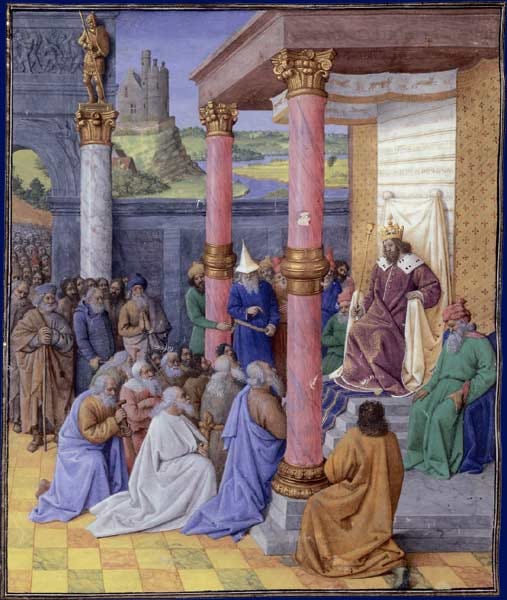
God calls the Persian king Cyrus his shepherd and messiah in the Book of Isaiah. Why would God say that? And what does it mean for us as readers of the Bible? The rest of this article seeks to answer that question.
Isaiah: terms and context
Isaiah 44:28–55:1 reads: “Cyrus is named as the Lord’s shepherd, the one who shall fulfill all his purpose, saying of Jerusalem, ‘She shall be built,’ and of the temple, ‘Your foundation shall be laid.’ Thus says the Lord to his anointed, to Cyrus, whose right hand he has grasped, to subdue nations before him and to loose the belts of kings, to open doors before him, so that gates may not be closed” (Isa 44:28–45:1).
To understand how Cyrus is God’s shepherd and anointed one, or messiah, we need first to define these terms and the near textual context of Isaiah in which God makes these claims.
The term shepherd was a common Ancient Near Eastern title for kings who shepherded their peoples. And the word anointed, or messiah, bespeaks the anointing that God places on his king. So Cyrus the Great (600–530 BC) is, in no uncertain terms, called God’s king and messiah.
Next, the context of Isaiah 44–45 centers on God’s judgment of Babylon. In 586 or 587 BC, Babylon captured Jerusalem and set its people into exile. Isaiah here prophesies Babylon’s demise as punishment for its act of evil against Judah. In fact, Isaiah 46–47 criticizes the Babylonian gods at length as subservient to the LORD.
Thus, Isaiah 46:1 claims that Bel (Marduk) and his son Nebo bow before the true God. The chief god of Babylon was Marduk, and so this insult to their gods struck right at the throat of Babylon’s perceived power. Since God sends his shepherd and messiah, Cyrus, to Babylon, then God, through Cyrus, triumphs over these (false) gods.
It is in this context that God proclaims: “I am God, and there is no other; I am God, and there is none like me, declaring the end from the beginning and from ancient times things not yet done, saying, ‘My counsel shall stand, and I will accomplish all my purpose’” (Isa 46:9–10).
And the Lord further explains why he allowed Babylon to conquer Jerusalem: “Sit in silence, and go into darkness, O daughter of the Chaldeans; for you shall no more be called the mistress of kingdoms. I was angry with my people; I profaned my heritage; I gave them into your hand; you showed them no mercy; on the aged you made your yoke exceedingly heavy” (Isa 47:6–7).
But now God would bring judgment upon Babylon. He uses the evil of Babylon to punish Israel for her sins, but he does not let the evil of any nation go unpunished. It is important to make this point here: God’s judicial wrath in Scripture almost always refers to God allowing humans to harm one another without preventing it through intervening grace. Wrath usually refers to regular human life without God’s grace.
In summary, Cyrus acts as God’s anointed shepherd because he conquers his people’s oppressors and, as I will note in a moment, because Cyrus redeems Israel and lets her return to the Land of Promise.
Cyrus: conqueror and redeemer
In 539 BC, Cyrus the Great conquered Babylon and so brought the neo-Babylonian empire under his heel. Evidence suggests that the Babylonians saw him as a liberator, not a conqueror. However, Cyrus was a master propagandist, and so historical record may only represent his imposed narrative.
In any case, Scripture in two places records the first year of Cyrus’s reign after he conquered Babylon (538 BC), recording his proclamation that Israel may return to her land of Promise. In this way, he becomes a deliverer to God’s people.
The first record is found 2 Chronicles:
“Now in the first year of Cyrus king of Persia, that the word of the Lord by the mouth of Jeremiah might be fulfilled, the Lord stirred up the spirit of Cyrus king of Persia, so that he made a proclamation throughout all his kingdom and also put it in writing:
‘Thus says Cyrus king of Persia, “The Lord, the God of heaven, has given me all the kingdoms of the earth, and he has charged me to build him a house at Jerusalem, which is in Judah. Whoever is among you of all his people, may the Lord his God be with him. Let him go up.”’” (2 Chron 36:22–23)
The second appears in Ezra:
“In the first year of Cyrus king of Persia, that the word of the Lord by the mouth of Jeremiah might be fulfilled, the Lord stirred up the spirit of Cyrus king of Persia, so that he made a proclamation throughout all his kingdom and also put it in writing:
‘Thus says Cyrus king of Persia: The Lord, the God of heaven, has given me all the kingdoms of the earth, and he has charged me to build him a house at Jerusalem, which is in Judah. Whoever is among you of all his people, may his God be with him, and let him go up to Jerusalem, which is in Judah, and rebuild the house of the Lord, the God of Israel—he is the God who is in Jerusalem. And let each survivor, in whatever place he sojourns, be assisted by the men of his place with silver and gold, with goods and with beasts, besides freewill offerings for the house of God that is in Jerusalem.’” (Ezra 1:1–4)
Cyrus delivers God’s people by conquering Babylon. So now he calls upon Israel (1) to rebuild the temple of God and (2) return to Jerusalem.
Importantly, the notion of returning to the Promised Land is a key question in the Old Testament. How can Israel return after her exile? Moses prophetically indicates that God will circumcise Israel’s heart so that she may return to God in every sense (Deut 30:1–6): both in heart and in place.
Although Cyrus sent God’s people to the Land of Promise, the post-exilic writers inform us that their hearts had not yet returned to God. Malachi 3:7, for example, presents the people who were already living in the Land as asking: “How shall we return?” Well, it was a real question. And further only something like 50,000 people returned to the land, and mostly those from Judah and Benjamin along with some Levites (e.g., Ezra 1:5). Others came later, but the narratives present this as only a partial return.
Thus, Cyrus as God’s anointed one shepherded Israel back to the Promised Land to rebuilt the temple and dwell with God. But the problem of Israel’s stubborn heart remained (Deut 10:16), as the post-exilic writings testify (e.g., Ezra, Nehemiah, Haggai, Zechariah, and Malachi).
Conclusion
God reigns over all creation. He raises up kings, and he brings them low. There is no reason to question God’s anointing of Cyrus as his shepherd, since God rules and reigns everywhere. Incidentally, this is why Christians can learn from the wise anywhere in the world, since God is at work preserving and guiding the nations.
However, despite God sending Cyrus for the benefit of his people, they apparently did not all return. It may be that the ten northern tribes of Israel had been so scattered by Assyria that they could not easily return. They may have intermarried (by force or by choice) and lost much of their ethnic identity by this point.
After all, when Babylon brought Judah and Benjamin to Babylon, the northern tribes had already been scattered for nearly two centuries. By the time of Cyrus, they were likely embedded across the empire and beyond, having lost much of their basic tribal identity. Cyrus’s decree permitted return, but it appears that only those whose identity remained closely bound to Judah, Jerusalem, and the temple were able or willing to go back. Obviously, many exceptions would have occurred. I am speaking here of generalities.
Hence, Cyrus, like God’s other kings, would not fully bring Israel back to God. They needed the law of God written upon their heart (Jer 31:33). They needed their heart of stone to be transformed into flesh (Ezek 36:26). They needed a resurrection from the dead (Ezek 37:1–14). All these the prophets speak of, and all of these things Christ, God’s final shepherd and Messiah, offers (Isa 53; Ezek 34:23; John 10:11). What Cyrus could not do, Christ does.
As God himself says, “I will set up over them one shepherd, my servant David, and he shall feed them; he shall feed them and be their shepherd” (Ezek 34:23). This shepherd from the line of David would be Jesus, the Christ (i.e., Messiah). He would bring his people home. He would cleanse their hearts by faith (Acts 15:9). And eventually, he will bring his people back to the Land of Promise.
If you want to learn more, you can audit my class on how to read the Old Testament as Christian Scripture by clicking the button below. It’s only $299 CAD to audit.
Thank you for sharing this thoughtful reflection on why God calls Cyrus His shepherd.It is humbling and faith strengthening to see how God declares His purposes long before events unfold and uses even a Gentile king to accomplish His redemptive plan.As Scripture says of Cyrus He is my shepherd and he shall fulfill all my purpose saying of Jerusalem She shall be built and of the temple Your foundation shall be laid Isaiah 44: 28.This reveals the sovereignty of God who declares the end from the beginning and accomplishes all His counsel Isaiah 46 :9 10.The title shepherd reminds us that the Lord is the true Shepherd of His people as David proclaimed The Lord is my shepherd I shall not want Psalm 23: 1.Cyrus was used by God to release His people from captivity and restore them to their land as recorded in Ezra 1 :1 -4 yet this points beyond him to the greater Shepherd Jesus Christ who said I am the good shepherd the good shepherd lays down His life for the sheep John 10: 11.Through this account we are reminded that God calls by name raises up whom He wills and opens doors no one can shut Isaiah 45 :1 -2.We can take comfort knowing that the Lord is always working in history and in our lives to fulfill His promises for His glory and the good of His people.