


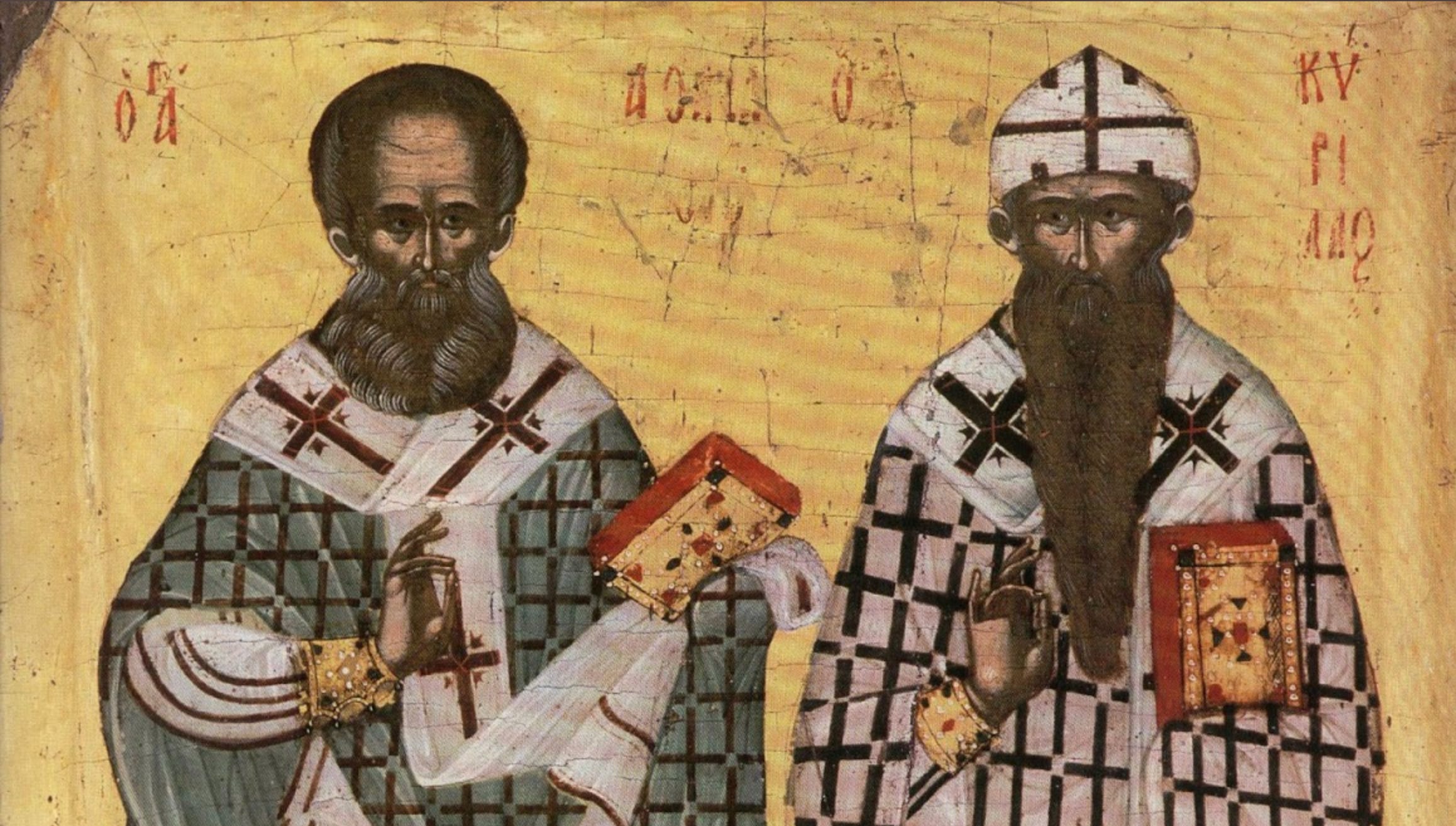
According to Severus of Al’Ashmunein (fl. 955–987), before Cyril of Alexandria (376–444) was called to pastoral ministry, he first entered the Egyptian desert. There, he memorized the Bible in Greek. Why? Presumably, Cyril and his patriarch Theophilus felt that Cyril needed to have the primary text of Christianity memorized before he could guide the souls of those under his care.
Severus explains, “the patriarch [Theophilus] sent [Cyril] to the Mount of Nitria, to the desert of Saint Macarius. And Cyril dwelt there five years in the monasteries, reading the books of the Old and New Testaments; for Theophilus urged him to apply himself assiduously to his studies, saying to him: «By these studies thou wilt some day arrive in Jerusalem on high, which is the dwelling-place of the saints». … so Cyril learnt all the Scriptures by heart.”[1]
Further, Cyril read the books of the New Testament regularly at night, such that Severus records: “during most of his nights he would read through in a single night the Four Gospels, and the Catholic Epistles, and the Acts, and the first Epistle of the Blessed Paul, namely, that addressed to the Romans; and on the morrow after this, Cyril’s teacher would know, by looking at his face, that he had studied all night.”[2] The effect was that “he learnt by heart all the canonical books.”
Now, this account of Cyril was written about 500 years after he lived in Arabic, and so we might be tempted to think of Severus’s account as being more legend than reality. And while we cannot discount the hagiographic elements, nothing in this account would feel out of place in the fifth century when it comes to Scriptural devotion. And it minimally testifies to 10th-century Christian views of Scripture.
Notice in this account Cyril’s face changed, reminding one of Moses whose face became glorious when he communed with God on the mountain; and it reminds one of Paul in 2 Corinthians 3–4 who says that as we see the face of Christ in Scripture, we move from one level of glory to another, pointing to the story of Moses’s glory as precedent. In short, this was a common trope.
And so Cyril would not have been alone in his devotion to Scripture. Consider the words of Augustine, who writes, “I will read the Holy Scripture with complete certainty and confidence in its truth, founded as it is on the highest summit of divine authority” (Letters 1–82, 393–94).
As far as I can discern, this basic approach to the Bible was the norm in the early centuries—actually, it really does not stop being the norm up until this day!
[1] Severus of Al’Ashmunein, History of the Patriarchs of the Coptic Church of Alexandria, trans. B. Evetts, Patrologia Orientalis 1 (Paris: Firmin-Didot, 1904), 427–28, https://www.tertullian.org/fathers/severus_hermopolis_hist_alex_patr_02_part2.htm.
[2] Patriarchs, 428.
For ease I included the URL link. However, Michael Haykin in his book, “Rediscovering the Church Fathers,” mentions Athanasius’s biography on Antony includes he memorized the entire Bible. Athanasius probably did as well. I am not a scholar of the early Church Fathers but was this the regular pastoral preparation? Or could this be the habit of “scholars” / authors of the early church?
https://www.crossway.org/articles/10-things-you-should-know-about-athanasius/
I have seen pastors confess that they have not read the entire Bible. I have had people argue with me about the meaning of passages that they have never studied outside of Sunday morning sermons. And these guys wanted to have the Bible memorized before they tried to teach anything to anyone.
No wonder we are in the mess we are in.