


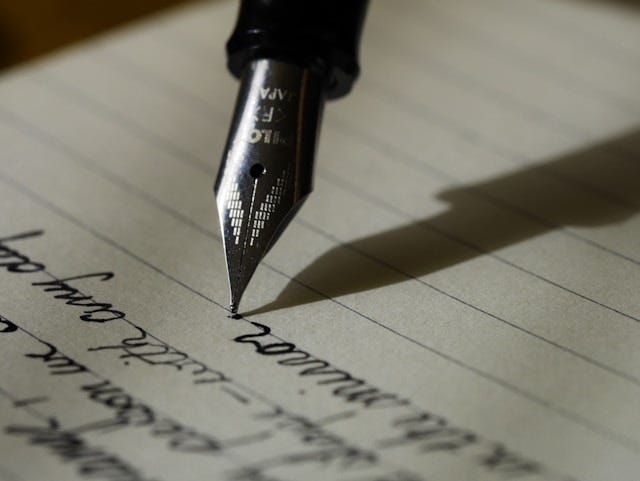
AI writing is fairly obvious, not so much because it cannot mimic the style of an author, but because the authors who use AI writing all seem to write as if they are machines outputting “content” for efficient engagement. It all sounds the same. It’s boring.
Perhaps AI writing could compete with humans, were it to have a human and humane purpose behind it. AI writers, however, generally build content for engagement to grow their brand or sell something or reach some other inhumane goal. That is the goal of this genre of writing. (And yes, I understand that some technical writing may use AI to write a manual for work, etc. Do note that I am talking about the kind of writing that humans generally do to communicate knowledge.)
Almost no one uses an AI prompt to contemplate their soul in an act of leisure. Usually, it is to farm engagement. By contrast, the reason we journal and write is for our souls. The outward product of our transformation by writing is one thing; the transformation within is another.
Meanwhile, the whole process of AI writing, of prompts, of creating a readable text, gainsays the necessity of friction in writing, in thinking, and in soulful growth. The immaterial gains of writing by the slowness of thought, contemplation, and leisure (in the old sense of considering the most important parts of life) cannot be replicated easily in AI-prompt writing.
As for the quality of prose, I make no sweeping comment. It may be that the latter will be better on average. Fine. It may be that AI writing will be able to create new ideas, connect new dots, and advance knowledge. Fine.
Still, the humans behind AI writing who lack full-some soul development will continue to create listicles and farm engagement because they have no goal beyond this temporal and efficient writing; they haven’t felt the pressure of internal change through the difficulties of writing for the soul.
I fully expect that AI writing will be better than most human writing in external ways. But that is beside the point since the mechanical skills of writing are a means towards an end (leisure, soul, etc.). The machine can write mechanically well, even human-like. But the human behind the prompt will be a shade, a shadow man, who won’t have found what writing is for, mistaking engagement and likes for the real thing.
The real thing is deeper than all that. Simone Weil published very little in her lifetime; she released only a small handful of essays. Her capacious soul, however, speaks chiefly through the journals, notebooks, and letters published after her death. She was the kind of person she was not because she prompted the machine to write, but because she wrote to become the kind of person she yearned to be.
To imagine that AI can replace writing because it will produce more skillful products of writing is to confuse techne with sophia. And even to say that AI writing is easy to spot betrays the point. It will get better. It will be hard to spot soon. Then what? Is your argument that the product of writing is itself the proof of the purpose of writing? You might as well give up now, if that is the argument.
Instead, the argument is that humane arts remain human because they have particularly human ends. In this case, writing is to understand; I write to understand. And understanding happens in my mind (nous), mediating through my organs, including the brain. Had I been mindless, then we might only say that one machine competes with another. But since I am nous, I am mind or soul (and yes, much more), I write to understand, to grow my inner life so that my eye shines, and the pressure of more spirit crushes evil outside of me and converts the evil of others into mercy.
My human and humane purpose in writing is something unable to be replicated by the machine since the latter has no nous; it has brain, but not soul. It has memory but not mind. It cannot have nous, since the chasm between physical creation and metaphysical being is not crossed by computational or mechanical means.
If we think AI writing cannot compete because it is not yet as good as some writers, we lack a strong argument. AI will soon be better in external respects. But the machine cannot communicate presence by writing to others who read.
AI cannot say, “For though absent in body, I am present in spirit” (1 Cor 5:3). There is a mystical communion of immaterial souls in this terrestrial frame, closer or further, depending on one’s proximity to God. AI has nothing in that.
AI writing cannot compete because of human agents behind it; and if it happens to compete in writing through its permutations, AI cannot cross the chasm to the soul from computation. That is uncrossable, barring creation ex nihilo. AI remains machine; we remain nous. The question will be whether or not we remember this in time before the machine makes us into its image, an efficient machine with productive ends.
Who knows. Maybe it will? And with Nietzsche, we will finally become men who have overcome man. We will be a bridge between what we were and what we might become. But will we lose what makes us human and not machine by doing so?
Hey Wyatt. I appreciate the tear that you have been on recently with the substack, lots of very thought provoking stuff. The concept of the "Shadow Man" who mistakes the product for the process is a absolutely a danger. If we imagine that we are having a machine do our thinking, our minds and souls will atrophy.
However, I’d offer a distinction regarding the "friction" of writing. You argue that the struggle to pull words onto the page is inherently a spiritual friction, a wrestling with the self/Nous. I suggest that for some minds, I can't say how many, that friction is merely mechanical.
I am aware I probably have a fairly unique way of viewing the world with 4 standard deviations between my verbal IQ and my working memory.
This means my "Nous" moves significantly faster than my hands or mouth for that matter. For me, a blank page doesn't feel a mirror for the soul, but often like a brick wall I have to poke holes in. The struggle isn't determining what is true; it is holding the paragraph in memory long enough to serialize it before it evaporates. For me the friction isn't forming my soul; it is silencing it.
Steve Jobs famously described the computer as a "bicycle for the mind." A bicycle doesn't move unless you pedal it; it just converts your energy more efficiently so you can reach destinations that were previously out of range.
When I use AI, it functions as that bicycle. It handles the linear serialization of text so that I can function as an Architect. I don't accept its output passively. I treat it more like clay: evaluating it, rejecting it, and reworking it to match the vision I already had in my mind before.
Historically, we accepted this distinction with authors like Milton or Churchill, who dictated their works. They didn't physically "write," yet we don't accuse them of bypassing the soul. They moved the site of their labour from typist to editor and composer. And even for lower quality works, we generally accept an autobiography that has been ghost-written as being that person's autobiography. It was the origin of the souls movement, not the terminus that made it their work.
Or to put it in theological language, we distinguish between the Principal Cause and the Instrumental Cause. A carpenter is the Principal Cause; the saw is the Instrument. The saw cuts, but the cabinet exists in the mind of the carpenter, not the saw. Even if the instrument is complex (like an AI or a human secretary), it remains an instrument if the form and end are determined by the Principal.
I wonder if we can view the "soul-making" of writing not just in the drafting, but in the judgment? If I spend three hours wrestling with an AI draft to shape it into the form in my mind, have I avoided the friction, or have I simply moved the friction to a new location that better fits my mind?
As I said, I am aware that I am statistically extremely unusual, but I do think that the utility that I have found isn't purely unique to me.