


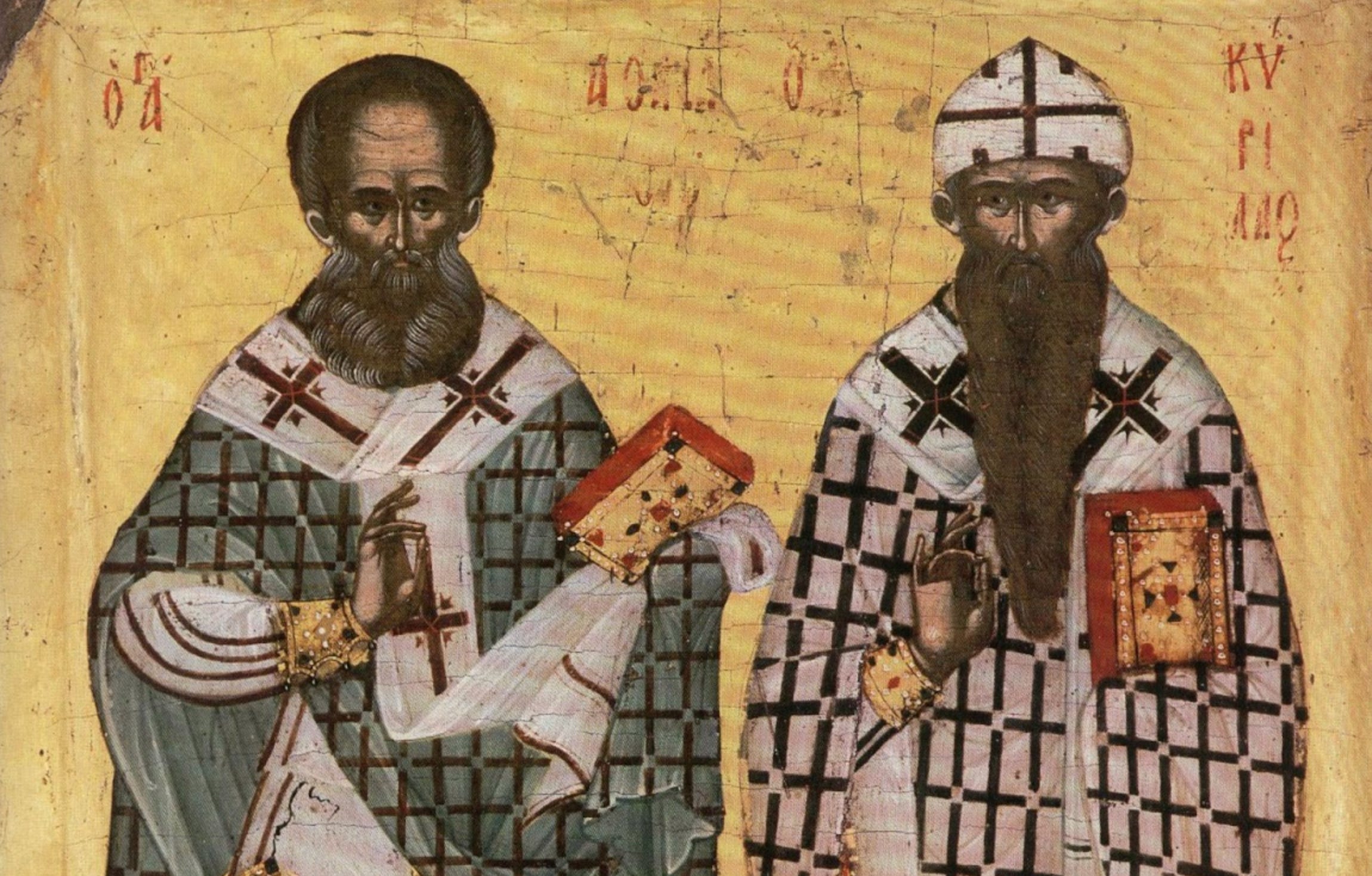
Peter affirmed, “Christ suffered in the flesh” (1 Pet 4:1). This phrase and its conceptual parallels in the New Testament defined the terms for 5th-century debates over Christ’s passion (suffering).
On one side, Cyril of Alexandria championed the notion that the one Lord Jesus Christ suffered impassibly in the flesh. The emphasis here falls on the “one Lord Jesus Christ.” By contrast, others, sometimes called Nestorians, could use similar language but emphasize “in the flesh.”
This Christological debate revolved around the question who or what suffered. Was it the one Lord Jesus Christ in the flesh, or was it the flesh of the one Lord Jesus Christ?
Theodoret: The suffering of Christ’s body
What makes the fifth century Christological debates difficult is our historical distance. Most of the terms of the debate have been forgotten, and we tend to read theological claims from that era in a flattened way, assuming everyone merely battled over words without substance.
For example, Theodoret of Cyrus, when asked who suffered in the passion, can simply say, “Our Lord Jesus Christ.” That sounds nearly identical to the view of Cyril of Alexandria. And indeed, Theodoret would eventually affirm the Creed of Chalcedon and anathematize theological formulations attributed to Nestorius (in a guarded way). But Theodoret remains at the time of writing someone associated with the Nestorian position.
With that said, does Theodoret’s affirmation genuinely parallel Cyril’s? Probably not, since Theodoret also clarifies “the body is spoken of by the name of the person.”[2] In other words, Theodoret believes the apostolic authors use the name Christ in contexts of suffering to refer to the body, not the person (i.e., the One Lord Jesus Christ). He emphasizes the body’s (or flesh’s) suffering, flesh that is proper to the person, the one Lord Jesus Christ.
But the key here is that Christ’s human nature suffered, according to Theodoret. In this regard, he will affirm that “a body won our salvation for us” but is quick to add: “but not a mere man’s body, but that of our Lord Jesus Christ, the only begotten Son of God.”[3]
Cyril: The suffering of Christ the Word
Cyril admits that we mentally sometimes need to think about Christ as God and as man: “It is appropriate for one’s mind to sense a distinction between the natures (after all, human and divine natures are not identical), but at the same time as this acknowledgment, the mind must also accept the concurrence of the two into a unity.”[4] Here, he might sound like Theodoret and even Nestorius upon first glance.
But the key here is “mentally.” This is not a distinction in reality. The one Lord Jesus Christ is the single subject of the birth of the virgin and the passion of the cross. So we can mentally say Mary birthed God, God suffered on the cross, or the opposite. But what we must mean is that: the one Lord Jesus Christ suffered in his own flesh.
In his response to Theodoret, Cyril carefully explains:
“For he made the passible body his very own, the result of which is that one can say that he suffered by means of something naturally passible, even while he himself remains impassible in respect of his own nature; and since he willingly suffered in the flesh, for this very reason he is called, and actually is, the Savior of all. It is just as Paul says, “By the grace of God he tasted death on behalf of all.” The divinely inspired Peter will testify to the same thing, rightly saying, “since Christ suffered for us,” not in his divine nature, but in his flesh.”[5]
Where the differences really lie
Although our historical distance from this debate makes it hard to detect the stakes, Cyril here and throughout his writings will emphasize that the one Lord Jesus Christ personally suffered in his own flesh. The emphasis falls on the divine Person who suffers.
Theodoret and others almost speak as if Christ’s body or flesh alone suffered, not the Person. Such authors will respond that Christ may be said to suffer, but what the New Testament really means is that his human flesh suffers because God cannot suffer.
In other words, the doctrine of impassibility plays a central role in the debate. Just who suffers? Christ (Cyril) or Christ’s body (what Cyril sees implied in Theodoret’s teaching). And it is hard not to agree with Cyril, who, to my mind, more clearly affirms what the apostles freely do by saying Christ himself suffered in flesh (e.g., 1 Pet 4:1). It is Christ who suffers, not merely his flesh.
While in the second century, the doctrine of impassibility served to rebuff Greek notions of deity (i.e., gods who lived by passions unlike the Biblical God), in the fifth century, the doctrine centers on the one Lord Jesus Christ, who suffered (passion) in the flesh.
But do note that the stakes matter more than we might think. Did Christ, the eternal Word from the Father, suffer for our sake or not? If it was only his flesh that suffered, then can we say that Christ tasted death for everyone? Or must we say, his flesh alone did? Cyril believes the Nestorian logic of the passion requires the latter belief; and he may be right, as I argued elsewhere.
Should we care about this debate today? Yes, for two reasons. First, because it sharpens our understanding of the biblical doctrine of Christ’s incarnation and atonement. Second, because the logic of Nestorius can appear in our preaching still today when, for example, we say only Christ’s body died on the cross in order to protect the deity of Christ from the passion of death.
And while such notions come from a good place, they invariably create a strange scenario where the eternal word from the Father who made human flesh his very own does not himself suffer, but only his human nature. Neither Christian theology nor, more importantly, the Bible itself teaches such a thing. With Peter, we must affirm plainly, “Christ suffered in the flesh” (1 Pet 4:1).
Footnotes
[1] Theodoret, Eranistes or the Polymorph 3, p 217
[2] Theodoret, Eranistes or the Polymorph 3, p 227
[3] Theodoret, Eranistes or the Polymorph 3, p 221
[4] Cyril of Alexandria, On Orthodoxy to Theodosius, §25
[5] Cyril of Alexandria, A Defense of the Twelve Anathemas against Theodoret §12
Excellent Substack that bodes well with my current study of Christology. Yes, these fine points do matter for the very reasons you state. Ignorance is not bliss in theology!
I actually haven’t come across this argument before. (In the thick of motherhood.) Most helpful and interesting. Thanks for delving into this!