


Because of the length of this article, you will likely need to hit “view entire message” in your email application or simply click into the Substack site.
Few Baptists have a rationale for why they are Baptist, or even realize what it means to be Baptist.
— John Hammett, Biblical Foundations for Baptist Churches, 2nd ed., 12.
John Hammett points out how we, as Baptists, do not always realize why we are Baptists. That was true of me. I was saved about thirty-five years ago while my family attended First Baptist Church Penticton, a then Baptist Union of Western Canada church (now CBWC). I have been a life-long Baptist. And yet: until I got into Christian ministry, I really had no idea what made a Baptist different from other Protestants, except I knew foggily that some Christians baptized babies and we did not.
Two events, however, led me to pursue why I was Baptist. The first was becoming a Baptist pastor. That might be obvious. But I needed to really know why, if I was going to pastor a Baptist church. The second probably was more existentially pressing: I became a parent. And so I had to figure out: do I baptize my kids? What church will nourish their souls? What does God want me to do? What does the Bible say?
Many people whom I respected were Lutheran, Presbyterian, or Anglican. They baptized babies, and they believed the Bible tells them to do so. So that meant I had to ask the million-dollar question as a parent: how should I disciple my family? Well, as you may have guessed, I stayed Baptist. And now: I have four children, and I am more convinced of Baptist theology and practice than ever.
But this experience leads me to wonder how many Baptists today feel as I did then. They encounter Christians who disagree, and they think: why am I a Baptist?
So in this article, and in at least three subsequent pieces of writing, I am going to explain what Baptists believe, why Baptists came to hold these beliefs, how Baptist churches came to Canada, and finally, speculate on what is next for Baptist churches in Canada and across the world.
To begin with, I want to tell the story of the first Baptists to understand why they practiced believer’s baptism, congregational autonomy within associations, and maintained an identity as a company of visible saints. To tell this story, I will look at key events around the emergence of early Baptists in the 1600s in England as well as tracing the beliefs and practices articulated in their voluminous confessions.
Church Organization in 16th Century England
To understand Baptist origins, we need to first understand how the Church of England operated during the 16th century because the Baptist story begins with a protest against the Established church.
In the 1500s, the Church of England was a national church. Parish churches dotted the countryside. Bishops presided over dioceses. And every parish church existed as part of this national church with its required worship, ceremonies, and church governance. Laws enforced uniformity in worship and practice across the realm.
But the Protestant Reformation gave life to reformers within the Church. And many of these reformers within were called Puritans. These leaders saw the Church of England’s ecclesiastical rules as preventing Christians from worshipping God biblically. Eventually, some of these Puritan priests decided that the only way to have biblical worship was to separate fully from the Church of England. Others took a slightly less radical approach and simply formed Independent congregations.
And from among these Separatist or Independent congregations in the early 1600s, the first Baptist congregations emerge. As Stanley Grenz explains, “Among others, one crucial and lasting product of the Puritan movement of the sixteenth and seventeenth centuries is the existence of a worldwide Baptist denomination, for this is in a very real sense the product of the historical processes set in motion by those reformers of the English Church.”[1]
Church Separation in 17th Century England
So why did these Church of England priests and congregations separate or form independent congregations? Here are four reasons.
First, congregations could not elect their own pastors. Instead, each benefice (pastoral role) had an appointed patron like a bishop, or Lord, or even an institution who had the right (advowson) to nominate new pastors (priests). Next, this nominated person would go to the bishop who would approve or deny the request. If approved, the pastor would be appointed to a parish congregation. Now, congregations had informal roles; they could obviously say to the bishop, “we hate this guy.” But the point is that they didn’t have primary responsibility and generally could have pastors/priests imposed upon them.
Second, every congregation had required patterns of worship, articulated in the Book of Common Prayer and other formularies. This meant that the Church of England legally required churches to worship according to an approved pattern. Marriages, deaths, Scripture readings, and more besides had a prescribed pattern that churches needed to follow.
Legal requirements also had teeth. Baptist historian Michael Haykin explains, “In April 1593 a law was passed that required everyone over the age of sixteen to attend their local parish church. Failure to do so for an entire month meant imprisonment. If, after three months following the individual’s release from prison, he or she still refused to conform, the person was to be given a choice of exile or death.”[2] Indeed, many Baptists were arrested for their faith during the 17th century.
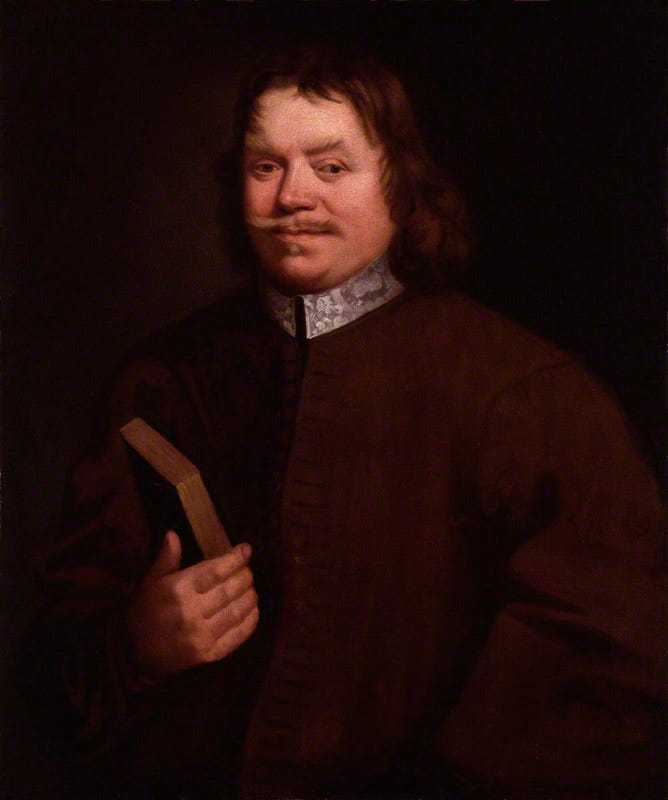
Famously, John Bunyan, the author of Pilgrim’s Progress, was imprisoned for twelve years where, in God’s kindness, he wrote beautiful works of Christian spirituality and theology. It turns out the state could stop pastors from preaching verbally but not with the pen.
Third, individual congregations had little to no autonomy over worship and its clergy. Parishes did have reasonable control over local affairs via churchwardens or the like; but they were a parish within a diocese of a national church. Essentially, this meant congregations showed up for church and could manage some local affairs, but they did not have authority as a congregation to order their own worship.
Fourth, in England, almost everyone was baptized into the Church of England. Further, Elizabeth I’s 1559 Act of Uniformity required church attendance. As noted above, further laws re-affirmed this Act and laid out specific punishments for failing to attend one’s parish church. Consequently, not all people within the visible church believed with conviction. Many lived unholy lives. And those who separated accused bishops of not enforcing holy standards, of not disciplining those who sinned and maintaining the holiness of the church. For example, the separatist priest Robert Browne argued for the “separation from all kirks where excommunication was not rigorously used against open offenders not repenting.”[3]
For these reasons, some Puritans in the Church of England separated into their own congregations. Others stayed in the Church of England to reform it towards congregationalism; and still others remained in to reform it towards Presbyterianism. And I am sure there are many other patterns as well. But for our purposes, we find the earliest Baptists emerging among the Congregationalists who separated from the Church of England. So we must turn to the early Separatist tradition to understand the historical contexts in which General Baptists emerged.
Separatist Congregationalism
Robert Browne (1550–c.1632) is known as the first separatist, and the movement often bore his name (i.e., “Brownists”). He was not loved by the Establishment, and one opponent nicknamed him “Troublechurch” Browne.
In the course of his ministry at Norwich (1580–1582), he came to congregationalist convictions. Near the end of his tenure there, he published A Treatise of Reformation without Tarrying for Anie (1582) in which he laid out congregational principles against the Episcopal system described above. In short, he maintained that “the true Church consisted only of such as led Christian lives and did not properly include all baptized persons,” meaning that those baptized as infants were not necessarily part of the true church.[4]
As we might imagine, he did not win friends and influence people within the Church of England. He was imprisoned more than once. And due to harassment, he chose to make his way to the Netherlands. His congregation also disbanded and fled to the Netherlands.[5] Almost all imprisoned Separatists (including Baptists) would choose to go to the Netherlands because of its tolerance for religious diversity. Haykin points out, “What attracted the Separatists to the Netherlands was its geographical proximity to England, its policy of religious toleration, its phenomenal commercial prosperity…and the Reformed nature of its church.”[6]
Despite Browne’s instrumental role in founding congregationalism, when he returned to England in 1584, he was arrested and would recant his separatist convictions. In 1591 he became an ordained priest. And from within the Church of England, he turned against his former congregationalist friends such as Henry Barrow and John Greenwood.
Yet he remains important for his view that, “A voluntary association or covenant of true believers constituted a church, and each church had the exclusive right of discipline and the choice of its own officers.”[7] It is this doctrine of the church that all Baptists affirm to a greater or lesser degree, and it was this teaching that led finally to the doctrine of a regenerate church membership, members who all were baptized by faith, because that would ensure that church would be made up of true believers.
[Let me offer a brief call out on the doctrine of separation of church and state in Baptist thought. It should be clear at this point that separation here means separation from a state-imposed liturgy, not separation from the state in every capacity. Early Baptists took oaths, worked in public service, and joined the army. In fact, under Oliver Cromwell, Baptists received toleration and great growth across Great Britain because of their success in military service. Cromwell favoured them, and they planted or visited churches across the country during the wars of the interregnum period. So separation has a very specific sense: separate from required liturgy and clerical imposition.]
Separatists continued to emerge across the country. For example, in 1587 or 1588, a congregation appeared in London. Its two leaders, Henry Barrow and John Greenwood, were arrested. But in prison, they produced the first congregationalist creed called A True Description out of the Word of God, of the visible Church. In the document, “The church itself was defined as a company of believers united in fellowship to Christ and to one another.” And further: “Church officers to be elected by the congregation were said to be pastor, teacher, elder, deacons, and widows.”[8] So here we have a formal rejection of the episcopal system of church government and an affirmation of congregationalism as well as the right and responsibility to elect one’s own leaders.
By 1592, this London congregation finally nominated its own pastor, Francis Johnson. The delay in gaining a pastor was due to persecution. During a temporary release from prison, they also elected John Greenwood as a teacher for the church. However, things became impossible when in 1593, fifty-six of the church’s members were arrested.[9] Further, the English figured that the best thing to do at this point was to keep leaders in prison and send members to the Netherlands. So that is what happened, and in 1595, the church regathered in Amsterdam under the leadership of Henry Ainsworth, whom they elected as teacher, since their prior leaders remained in a London prison. Barrow and Greenwood had been hung at Tyburn on April 6th, 1593, but Francis Johnson was released in 1597 and joined the Separatist congregation in Amsterdam.
In 1596 Separatists, among whom were this Amsterdam church and Ainsworth, produced the True Confession. For Baptist history, this may be the most important early confession. It argued for congregationalism and rejected episcopalism. It also emphasized that congregations should appoint their own leaders and maintain holiness through church discipline (art. 23–24).
The True Confession’s statement of congregational principles showed a coherent view of congregationalism as a viable alternative to Episcopalian ecclesiology. What makes it so important for Baptist history is that in 1644, seven churches in London would write a confession of faith based on the True Confession, which becomes the first instrument of unity for Baptist voluntary associations.
In this way, the True Confession provided congregational backbone for Baptist thought while the First London Baptist confession explained its particular variant of congregationalism: one that emphasized a believer’s church, where every member was baptized on the condition of confessing the faith and living a holy life.
But before we get to this first association of Baptist churches, bound together by the First London Baptist confession, we need to learn more about the first English Baptists: John Smyth and Thomas Helwys.
John Smyth and Thomas Helwys
Browne, Barrow, Greenwood, and Ainsworth were not the only separatists from the Church of England. Others separated and formed congregations as well. Two such separatists, John Smyth (1570–1612) and Thomas Helwys (c.1575–c.1616), famously led their congregation to re-baptize themselves as believers by affusion. While the term “Baptist” did not regularly appear until the late 17th century, we can historically categorize Smyth and Helwys’s congregation as the first Baptists because of their biblical convictions that only those who first believe and are baptized are part of the church.
The story begins first with John Smyth, who joined the separatist cause and became a pastor of Gainsborough in about 1606 or 1607. Thomas Helwys shortly afterwards joined this congregation, becoming an important leader.
Smyth initially studied at Christ’s College, Cambridge, where he obtained his BA (1590) and MA (1593). There, he learned Puritan principles, and Francis Johnson (the Separatist pastor noted above) tutored him. So Smyth came by his separatism honestly.
Although Smyth remained within the Church of England as a lecturer in the town of Lincoln, legal pressure increasingly made staying difficult for him. In late 1604, James I issued decrees that required conformity to the Thirty-Nine Articles, the Book of Common Prayer, and allegiance to the bishops.[10] As a result, Smyth met with Puritan leaders including John Robinson who would eventually lead his congregation to take the Mayflower to New England, bringing congregationalism with him to the New World. (Robinson, however, died in Leiden in 1625).
This group of Puritans concluded that they must leave the Church of England, and like so many others, Smyth eventually left with his congregation to the Netherlands to avoid persecution. When he arrived in Amsterdam, he encountered Francis Johnson’s separatist congregation (whom I mentioned earlier). Unfortunately, Smyth struggled to work alongside his former friends. And he published a book in 1608 called, The Differences of the Churches of the Separation. The disagreement led to a breakdown of relationship between the two separatist congregations.
It also split the congregation at Amsterdam. Of around one-hundred-and-fifty people who accompanied Smyth to the Netherlands, one hundred left with John Robinson to Leiden and later sailed to New England. This left Smyth with only fifty people in his congregation, a number that would increasingly dwindle due to Smyth’s temperament.
In 1609, Smyth became convinced that baptism was for believers only. In consequence, he had to discern whether his earlier baptism in the Church of England remained valid. He concluded that it was a false baptism. But if his baptism was invalid, then that also meant the baptisms of Separatists like John Robinson and Francis Johnson were likewise invalid and thus unbiblical.
Hence, in Smyth’s 1609 treatise, The Character of the Beast, he calls Roman Catholics, the Church of England, and other Separatists of the same ilk and pours insult upon them: “Be it known therefore to al the Separation that we account them in respect of their constitution to be as very an harlot as either her Mother England, or her grandmother Rome is, out of whose loins she came.”[11]
Thus after fleeing from England, separating from the separatists, and losing two-thirds of his allies (not including Johnson’s congregation), Smyth decided it was time to be baptized as a believer. Yet since he believed the churches around him had apostatized, he maintained that he could go to no other congregation or church to receive baptism. He therefore decided to baptize himself and his congregation. He did so by pouring water over his own head in an act of affusion. It was not until the 1640s that the historical record would show that Baptists baptized by immersion. Before then, pouring or sprinkling may have been the norm.
Smyth shortly thereafter believed his self-baptism was a mistake because he learned about a community of Mennonites and their Waterlander church. He discovered that they too baptized believers, and he then once again sought baptism by them. Smyth thus rejected his prior two baptisms and requested not only baptism by the Waterlanders but also to join their church. He likely also felt an affinity to this group since he had recently adopted some Arminian principles that aligned with Waterlander theology.
Smyth’s move here once again caused a rift. Thirty-one members followed him in this process, while most or all of the rest followed Thomas Helwys, who remained convinced that their self-baptism was valid. Helwys, along with his part of the congregation, also objected to aspects of Mennonite theology: particularly what they saw as an unorthodox view of the Incarnation of Christ. Probably other issues came up such as oaths and how Christians should interact with the world.
As Smyth waited for membership, he wrote a twenty-point confession of faith. The Waterlanders, however, were wary. And Smyth died in 1612 without being brought into the Mennonite community. Three years later, it appears that his congregation integrated into the Waterlander community where they appear to have lost an independent identity.
By contrast, in 1611, Thomas Helwys wrote a confession of faith to the Wetlanders to explain why he and his portion of the congregation could not become Mennonite. According to Lumpkin and Leonard, this confession “aimed, indeed, to distinguish its authors from the Mennonites.”[12] And thus these two authors conclude that the confession “is rightly judged the first English Baptist Confession of Faith.”[13]
Helwys, realizing that he and his congregation could not become Mennonites, returned to England to begin what we would eventually know as the General Baptist movement; it was so-called because they believed in a general atonement, that Christ died for all people, not just for particular people.
Like Smyth, Helwys also struggled to see himself as united with other Separatists or Puritans. So in A Short Declaration of the Mystery of Iniquity (1612), he calls Puritans in the Church of England and Separatists “false prophets” and those lacking “the seal of the Spirit” because they did not baptize believers only.[14] Likely due to this tract, Helwys was arrested and died in prison in 1616.
And yet the General Baptist movement outlived him. And by 1626, it had congregations in London, Coventry, Lincoln, Salisbury, and Tiverton. They were small. All totalled, there were about one-hundred-and-fifty members in these churches combined.[15]
Immersion
Because Smyth and Helwys did not baptize by immersion, it is worth asking the question, how did Baptists first begin baptizing by immersion? Until the 1640s, we do not have evidence that Baptists practiced baptism by immersion. It would seem that most if not all practiced pouring or sprinkling. However, the Kiffin Manuscript provides evidence that London congregations began baptizing by immersion in the early 1640s.
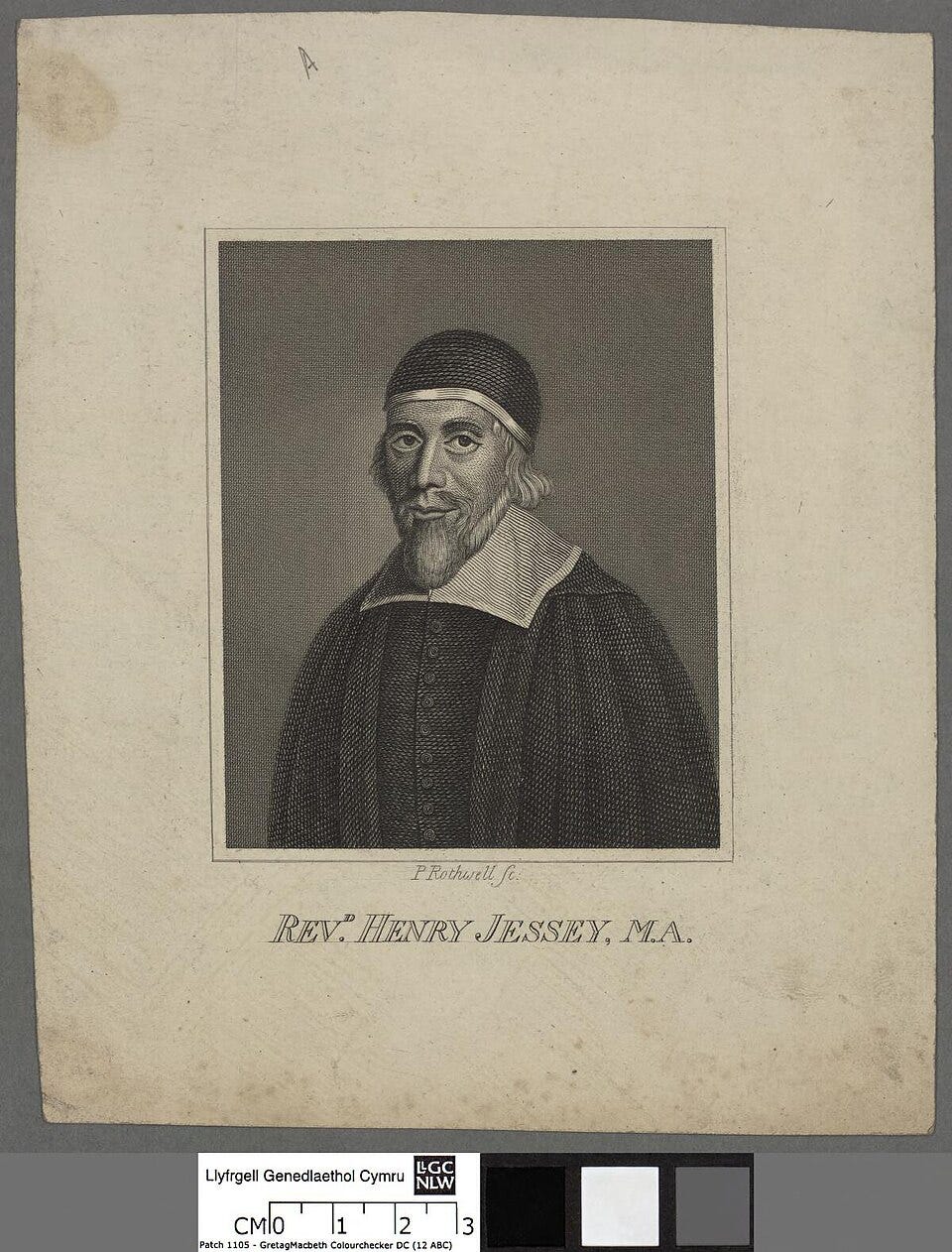
The story begins in the Jacob-Lathrop-Jessey Church (more on this congregation below). Henry Jessey, the pastor of the church in 1640, had an irenic approach to differences. So when Richard Blunt concluded that Colossians 2:12 and Romans 6:4 implied full immersion as the means of Baptism, Jessey and others listened. However, the congregation did not know of anyone who baptized in this way. So they inquired around and discovered that a Dutch fellowship called the Collegiants in the Netherlands baptized in this way.
Because Blunt knew Dutch and probably because of his interest in baptism, he travelled to the Collegiants congregation. Apparently, he was successful. When he returned, he baptized his friend Mr. Blacklock who in turn baptized Blunt and others, about forty-one all tallied.[16]
Slowly, after this time, immersion seems to have become the norm among Baptists.
Jacob-Lathrop-Jessey Church
The second part of the Baptist story begins with a remarkable independent congregation called the Jacob-Lathrop-Jessey Church after the names of its first three pastors: Henry Jacob, John Lathrop, and Henry Jessey. Henry Jacob established the congregation in 1616, and it is an instrumental congregation in Baptist history for many reasons.
First, among its peers, the church had an irenic (peace-making) culture. When they had division within the congregation, they amicably disagreed and often simply church planted from the home church. And afterwards, the withdrawn congregations would fellowship together for prayer meetings and more.
Second, perhaps because of this irenic culture, the church allowed its members to worship in Church of England churches, provided the church did not teach human tradition. In other words, they accepted that the Church of England had true churches amongst it unlike Smyth and Helwys.
And it would be from this congregation that the first Particular Baptists would emerge in London and then elsewhere. The word “particular” in Particular Baptist means that they believed Christ died savingly for the elect only; whereas, General Baptists believed Christ died for all people in the same way. We might be tempted to say: this is an Arminian and Calvinistic debate. I want to push back on that caricature.
For example, two of the most important General Baptist confessions, the confession of thirty churches in 1651 and the 1679 Orthodox Creed reject aspects of Arminianism and pave their own path.[17] In fact, the General Baptist theologian, Thomas Grantham (1634–1692), a prodigious leader and author of an early Baptist systematic theology, could not be easily placed on the Arminian-Calvinist divide. Baptist historian Michael Haykin writes, “Grantham’s theology cannot be neatly aligned with either consistent Calvinism or the mainstream Arminianism of his day.”[18]
So how does the Jacob-Lathrop-Jessey (JLJ) church fit into the Baptist story? Well, in 1638, a year after Henry Jessey became the pastor, six members of the church became “convinced that Baptism was not for infants, but professed believers.”[19] These six members “joined John Spilsbury” according to the Kiffin Manuscript.
Spilsbury (1593–1668) may have been a member at the JLJ congregation at one point. In any case, they formed their own congregation and stayed in good relationship with their mother church. Haykin notes, “There is evidence of joint gatherings for prayer and members of the Spilsbury congregation continued to attend meeting at the Jacob-Lathrop-Jessey Church.”[20]
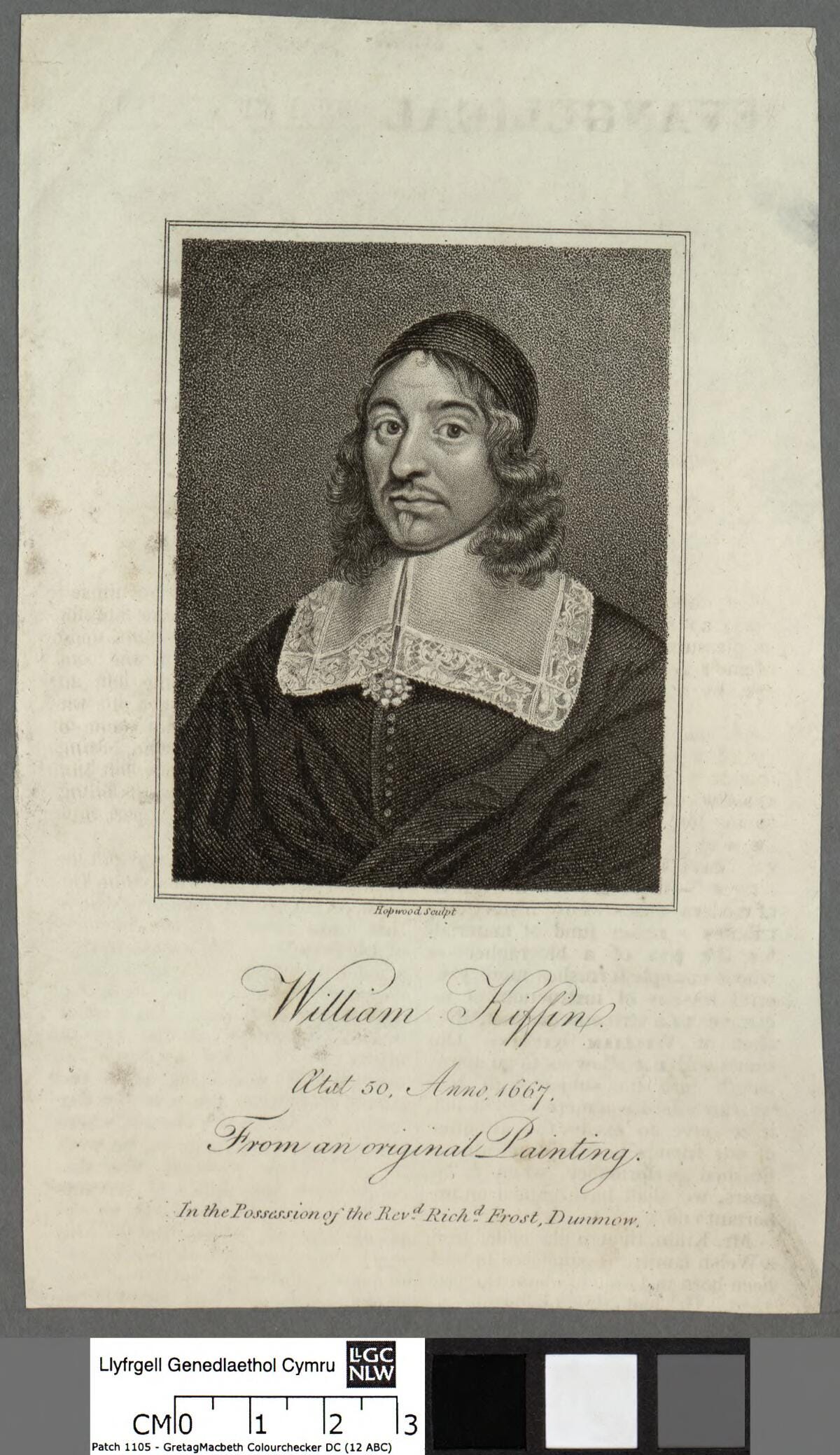
Spilsbury would join a number of Independent congregations in London who came to Baptist convictions. And in 1644, seven London Baptist congregations create a confession called The Confession of Faith, Of those churches which are commonly (though falsely) called Anabaptists, which united them as an association.[21] Of the fifteen signatories of this confession, five of them had clear ties to the JLJ congregation: William Kiffin, John Spilsbury, Thomas Shepherd, Thomas Munden, and Thomas Killcop.[22] Further, three or four of the seven churches emerged from that congregation.
In this Confession, we begin to see the beginnings of the Baptist ideal of congregational associations. Its forty-seventh article reads:
“And although the particular Congregations be distinct and several bodies, every one a compact and knit city in itself, yet are they all to walk by one and the same rule and by all means convenient to have the counsel and help one of another in all needful affairs of the church, as members of one body in the common faith under Christ their only head.”[23]
It is almost certain that this impulse towards unity came from the DNA of congregations like the Jacob-Lathrop-Jessey church, which helped birth many Baptist congregations. And this irenic approach meant that Particular Baptists viewed pastors within the Established church and without as perfectly Christian, but incorrect on the question of Baptism.
Baptist Identity
Of course, this openness carried some liabilities. The famous pastor John Bunyan, of Pilgrim’s Progress, practiced not only open communion but also open membership. In other words, he allowed those baptized as infants to be members. Now, this is an outlier case, but it shows that some Baptists pushed the edges of Baptist identity.
On the other hand, General Baptists tended to be much more separatist and insular. Some viewed other Congregationalists and Puritans in the Church of England as antichrists, whores, and so on. Due to this inwardness, they practiced endogamy: marriage only within their congregation, which had fairly disastrous effects since it was often impossible to find someone to marry and led fractious church discipline cases.
Further, the General Baptists, because they could not agree on identity early on, struggled immensely to deal with division in their midst. So they regularly lost members to Quakers, Particular Baptists, and later to a heresy called Socinianism, which amounted to denying the Trinity.
However, due to these pressures, they also created some of the best early Baptist confessions of faith and theological writings. I think of Thomas Monck and the congregations behind the 1679 Orthodox Creed, or the writings of the great Thomas Grantham.
Thomas Grantham and others also had more openness to other Christians as well, desiring to unite with Particular Baptists. That would not happen for some time. Around 1770, Dan Taylor’s New Connection began the process of General and Particular Baptist union, which came to fruition fully in 1891. By this time, the General Baptists had undergone serious decline due to a lack of coherent theological identity and separatist bent.
It would not be until the Great Awakenings that both General and Particular Baptists would once again receive energy and growth.
Now, I could say so much more here about identity and what happens after the 1640s. Baptists grow exponentially through military service under Oliver Cromwell because they not only gained toleration but they also church planted as they warred across the country.
But because I only wanted to talk about origins, I think it may be appropriate here to make a few comments about the General and Particular Baptists, especially their names General and Particular.
Particular and General
General Baptists believed Christ died for all people. On other issues, they were split. Some believed a person could lose their salvation, others believed they persevered until the end. All agreed that God’s grace was prior to belief in some way. But whether one could fall from grace was not always agreed upon. And some (not all) denied original sin, namely, that the Fall meant that all people after Adam were born with a sin nature.
Particular Baptists maintained that Christ died for the elect, that grace always preceded salvation, that one could not fall from grace, and that everyone was born into sin. Here, it is worth noting that Particular Baptists did not adopt these beliefs in a vacuum. They shared the same Baptistic convictions as General Baptists, but they emerged from an environment that aimed to be more irenic with other Protestants. And in 1644, a common opinion in England and in Europe was that Christ died for the elect (particular atonement). So this belief, along with the others named here, was born out of this idea that Particular Baptists could work alongside other Protestants.
While General Baptists had local confessions and covenants and some uniting confessions, they tended to remain more separate from other Christians; the practice of endogamy being one such example. So we might say that the General and Particular aspects of being Baptist have their origins in whether one emphasized separatist congregationalism or whether one emphasized Independent congregationalism.
For my part, I find myself in a strange position of appreciating the General Baptist theologians like Thomas Monck and Thomas Grantham as well as their confessions, since they tend to be more careful, due to the landmines in associations, than the Particular Baptists needed to be. At the same time, I see a great need to retrieve the irenicism present among some of the independent Congregationalists, including early Particular Baptists.
We may not need to choose between the two per se, since by the end of the 17th century, General and Particular Baptists continued to demonstrate their commonality with other Protestants. For example, Thomas Monck, a messenger (apostle) for Buckinghamshire and Hertfordshire, wrote a confession representing his constituency wherein he called Baptists Protestants and aimed to show how much they had in common with others.[24] The same could be said for the Second London Baptist Confession, written in 1677 and adopted at an assembly in 1689.
Conclusions about the Origins of Baptist Theology and Practice
I want to make a few conclusions about the origins of Baptist faith and practice. Since I am limiting myself to the Baptist story in England from about 1600 to 1645, I am not generalizing about later developments that happened among Baptists. I plan to do so at a later time. Here, I only generalize about Baptists in their originating decades.
First, Baptist origins start as a protest against the Established church’s imposition of priests, worship, and its national church program. Baptists, like other Congregationalists and Presbyterians, desired to order their worship according to Scripture. Thus, Baptists believed congregations should elect their own pastors, create their own liturgy, write their own confessions and covenants, and unite around the idea of voluntary, not compelled, associations with other like-minded congregations through associational confessions.
Second, both General Baptists and Particular Baptists have their origin among the Puritans within the Church of England. General Baptists might be categorized as Separatist Congregationalists, while Particular Baptists emerge from independent congregationalism. The latter simply means congregations view themselves as Independent of the Church of England worship and organization, but they did not view Puritans within the Church of England as enemies but as allies. General Baptists tended to view paedo-Baptist Separatists, other Congregationalists, and the Church of England as heretical or apostate groups. Both groups, however, maintain that congregations have the authority to organize their own worship according to Scripture.
Third, the origins of Baptist life involved confessions and covenants. While I did not note it above, each congregation generally had their own confession of faith or they voluntarily adopted one in association with other congregations like the London Baptists did. Sometimes they did both. For example, Benjamin Keach’s congregation asked for a local church confession, which they agreed to in 1697, called the Articles of the Faith of the Church of Christ, or Congregation Meeting at Horsley-down.[25] Congregations also covenanted together, which generally meant they agreed to live a holy and pure life. Note that this was how congregations enforced discipline, holding people to their covenant, as the Church Books of various churches illustrate.
Fourth, part of the origin story of Baptists involves church discipline. Many Puritans rejected a perceived laxity in the Church of England, and they found that separatism or independent congregationalism made allowance for congregations to be a company of visible saints. Sometimes, they went too far.
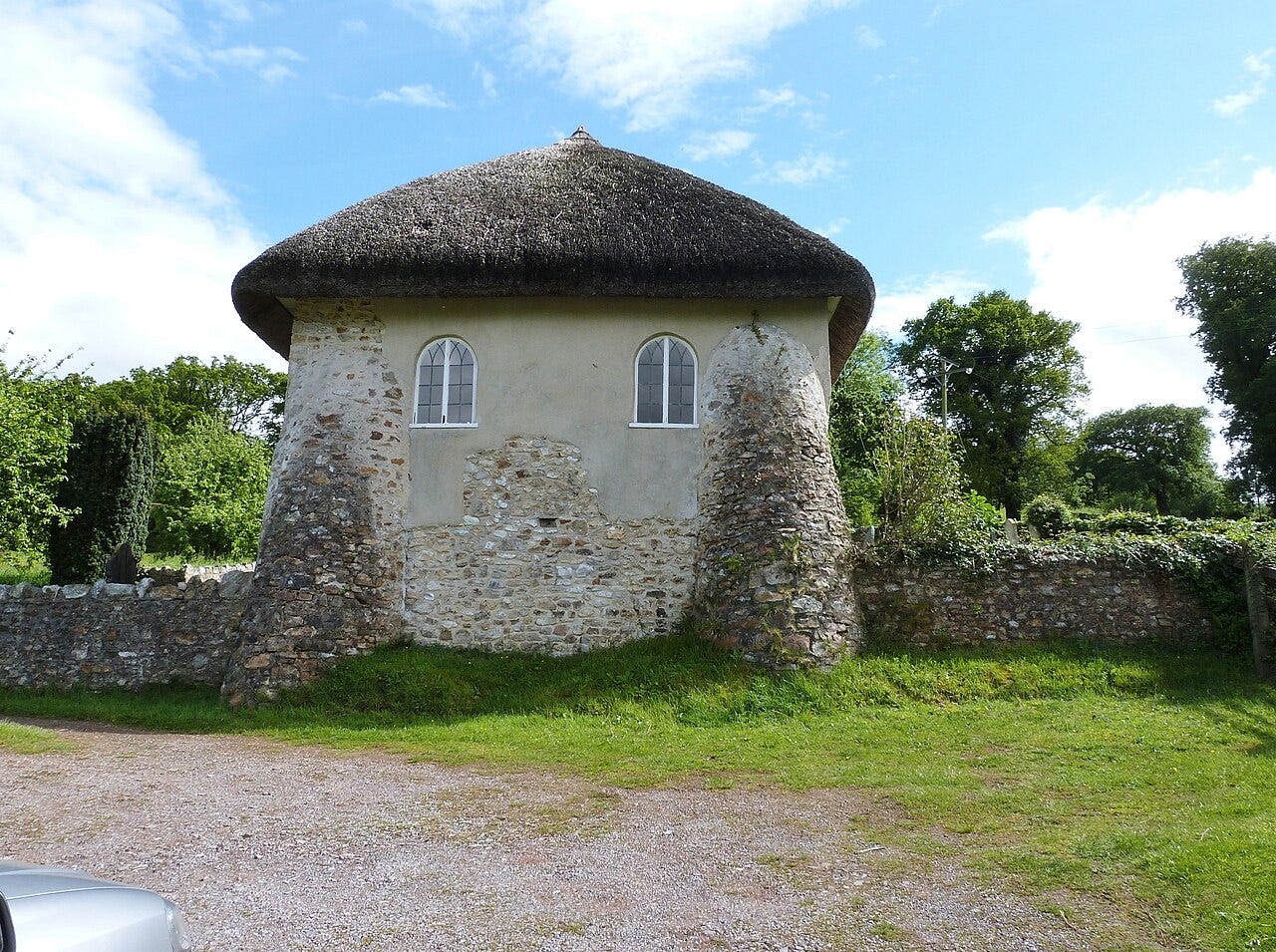
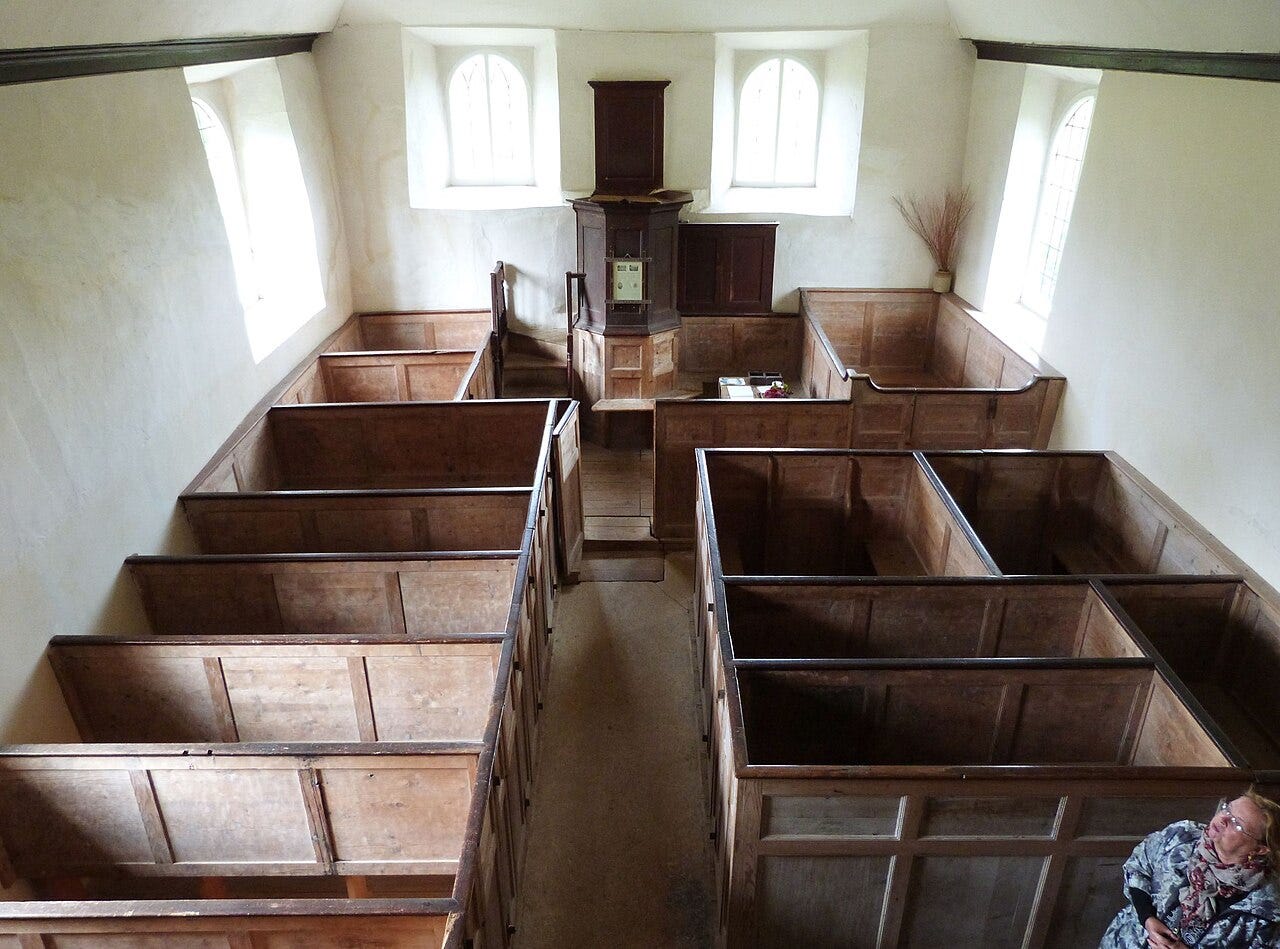
For example, Loughwood Baptist Church in the middle of the 17th century at one point had 105 members in good standing, and 38 members withdrawn for sin and disorder. That’s roughly 27% of the total congregation who were under church discipline.[26] By the way, its church book is fascinating. In 1884, the same church records: “Whilst we were partaking of tea, Mrs. Robert French to the annoyance of all present, began to make a speech about a presentation to Mrs. Samuel French, but our pastor wisely prohibited her from doing so.” The detail here is almost hilarious, but what I find fascinating is that whoever wrote the minutes, which the congregation approved, said that “Mrs. Robert French to the annoyance of all present, began to make a speech.” Well, anyway, back to the topic.
Fifth, Baptists could either be separatist or independent, the latter meaning they viewed Puritans within the Church of England and others as allies, despite disagreeing with them. This would characterize the churches that emerged from the Jacob-Lathrop-Jessey congregation. Jessey would later become a Baptist himself, but would allow members who were baptized as babies into his congregation (like John Bunyan’s congregation). But here we find a diversity of origins which, at least for their early history, points to two different trajectories for both General and Particular Baptists. Both groups early on do not appear to have worked closely together. That said, reality is messier than the categories we create. For example, the Particular Baptist minister William Kiffin saved the lives of twelve General Baptist ministers who were sentenced to death in 1664.[27] So there must have been some camaraderie, especially during times of persecution.
Sixth, early Baptists sprinkled, poured, and then later immersed. It does not appear that most early Baptists felt that they needed to be re-baptized when immersion became the norm. Yet when immersion did become the norm, they ceased pouring and sprinkling for baptism.
Seventh, the whole Baptist movement involves non-conformity to the Church of England. They therefore sought religious toleration. And during the interregnum period, Oliver Cromwell promoted a species of religious liberty. Hence, Baptists gravitated to him and supported the republican government (1649–1660). They entered into military service and even Parliament, where they expanded rapidly. The point, however, is that, as non-conformists, they privileged religious toleration. And so religious liberty ends up becoming very important to Baptist thought and practice.
Much more could be said, but here I think I have accomplished my purpose of providing an introduction to Baptist origins. In a further article, I will talk more about Baptist beliefs at a theological level. Here, I simply wanted to share the story of origins.
Appendix 1: Three stories for Baptist Origins
The Baptist origin story is generally told in one of three ways. While each pattern has its strengths, I have opted to tell the story through the lens of English Puritanism. I believe I am justified historically in doing so, but here I will explain why I have done so in more detail by surveying the three ways people usually tell this story.
First, some point out that early Baptists desired to be biblical, and that this impulse existed throughout the entire age of the church. So one can discern traces of Baptist thought and practice in the margins. This view implies a succession of true churches always existed in the margins, sometimes through a trail of blood. Smyth evinces this tendency when he rejects his first two baptisms due to his being baptized by false churches.
The major liability with this position is that we don’t have historical evidence for it. It also seems to imply the mainstream of Christianity was either false or in grave error across the centuries. But Jesus promised to build his church (Matt 16:18). This view then seems to doubt the genuineness of most Christians, especially Christians of the Imperial Church. Yet it is important to recognize that early Christians regularly baptized adults after their confession of the faith, and upon inspection of early canons, one sees that congregations had an important role in electing their pastors. So some of the key pieces of Baptist thought are not in the margins, but in the mainstream. With all that said, this view lacks historical evidence and ultimately must be rejected.
Second, some point out that in the 1500s the Anabaptist movement already held to a believer’s church, congregational authority, a separation of church and state, and so on. This view makes a lot of sense, especially because Anabaptists were concentrated in the Netherlands, which was geographically close. And John Smyth, an early Baptist, in 1610 attempts to join a Mennonite community in the Netherlands while in exile there.
The liability of this view is that it is too narrow in its story of origins. The Lollards in England, for example, had already existed for over two hundred years before the Baptists emerged. They shared many principles. Further, early Baptists clearly emerge from Puritanism in England. That is, all early Baptists were Puritan separatists or Independents whose goal was to reform worship according to New Testament principles.
Next, all major confessions of Baptists in the early era specify that they are not Anabaptists (e.g., First London Baptist Confession of 1644 or the Standard General Baptist Confession of 1660). Additionally, Helwys’s General Baptist congregation explicitly rejected Mennonite Waterlander theology and would not join with them or receive their baptism. Furthermore, most Baptists did not appear to know much about Anabaptists in practice. For example, in 1641, Baptists sent Richard Blunt to the Netherlands to understand how the Dutch Collegiants baptized because, until this time, they poured water over each other and did not immerse. While the Collegiants may not have been anabaptist per se, they had some association with the Mennonites as an Anabaptist-like group.
In conclusion, Baptists and Anabaptists do have some historical connections, but I do not think we can explain Baptist belief and practice by only telling the origin story with reference only to Anabaptists. That story is too narrow.
Third, most today recognize that the Puritan and Separatist story best aligns with the available evidence. Baptists were Congregationalists who, in their effort to reform the church according to New Testament principles, discovered that believer’s baptism best fit their congregationalist view of the church. And it further had the benefit of being directly tied to the New Testament’s teaching. And yes: this meant over time learning about the Anabaptists who shared many of the same beliefs.
[1] Stanley J. Grenz, Isaac Backus—Puritan and Baptist: His Place in History, His Thought, and Their Implications for Modern Baptist Theology, NABPR Dissertation Series 4 (Macon, GA: Mercer University Press, 1983), 1.
[2] Michael A. G. Haykin, “Separatists and Baptists,” in The Oxford History of Protestant Dissenting Traditions, vol. 1, The Post-Reformation Era, 1559–1689, ed. John Coffey (Oxford: Oxford University Press, 2020), 117.
[3] “Browne, Robert,” in The New Schaff-Herzog Encyclopedia of Religious Knowledge, ed. Samuel Macauley Jackson, vol. 2, Basilica–Chambers (New York: Funk and Wagnalls, 1908), 279, Christian Classics Ethereal Library, accessed September 7, 2026.
[4] “Browne, Robert,” 279.
[5] William L. Lumpkin & Bill J. Leonard, eds., Baptist Confessions of Faith, 2nd rev. ed. (Valley Forge, PA: Judson Press, 2011), 76.
[6] “Separatists and Baptists,” 116.
[7] “Browne, Robert,” 280.
[8] Lumpkin and Leonard, 76.
[9] Lumpkin and Leonard, 76.
[10] Haykin, “Separatists and Baptists,” 119.
[11] Cited in Haykin, “Separatists and Baptists,” 120.
[12] Lumpkin and Leonard, 107.
[13] Lumpkin and Leonard, 107.
[14] Haykin, “Separatists and Baptists,” 122.
[15] Haykin, “Separatists and Baptists,” 122.
[16] On this, see Haykin, Kiffin, Knollys, and Keach, 25–26.
[17] The Orthodox Creed likely had Thomas Monck as its primary author, but it represented many General Baptist congregations. On this, see B.R. White, The English Baptists of the Seventeenth Century (Baptist Historical Society, 1996), 93–4.
[18] Haykin, “Separatists and Baptists,” 136.
[19] From the Kiffin Manuscript. Cited in Champlin Burrage, The Early English Dissenters, vol. 2, 302. I modernized the spelling.
[20] Haykin, “Separatists and Baptists,” 124–5.
[21] Baptist Confessions regularly rejected the nomenclature of Anabaptist. Consider also the Standard General Baptist Confession of 1660, which rejects Anabaptism in its opening lines.
[22] B.R. White, The English Baptists of the Seventeenth Century, 39.
[23] Lumpkin and Leonard, “Baptist Confessions of Faith,” 157.
[24] On Monck, see White, The English Baptists of the Seventeenth Century, 92–8.
[25] “The articles of the faith of the Church of Christ, or, Congregation meeting at Horsley-down Benjamin Keach, pastor, as asserted this 10th of the 6th month, 1697.” In the digital collection Early English Books Online. https://name.umdl.umich.edu/A47381.0001.001. University of Michigan Library Digital Collections. Accessed September 13, 2026.
[26] See J. B. Whiteley, “Church Discipline in the Loughwood Records,” Baptist Quarterly 31, no. 6 (1986): 288–94.
[27] Haykin, Kiffin, Knollys, and Keach, 59.