


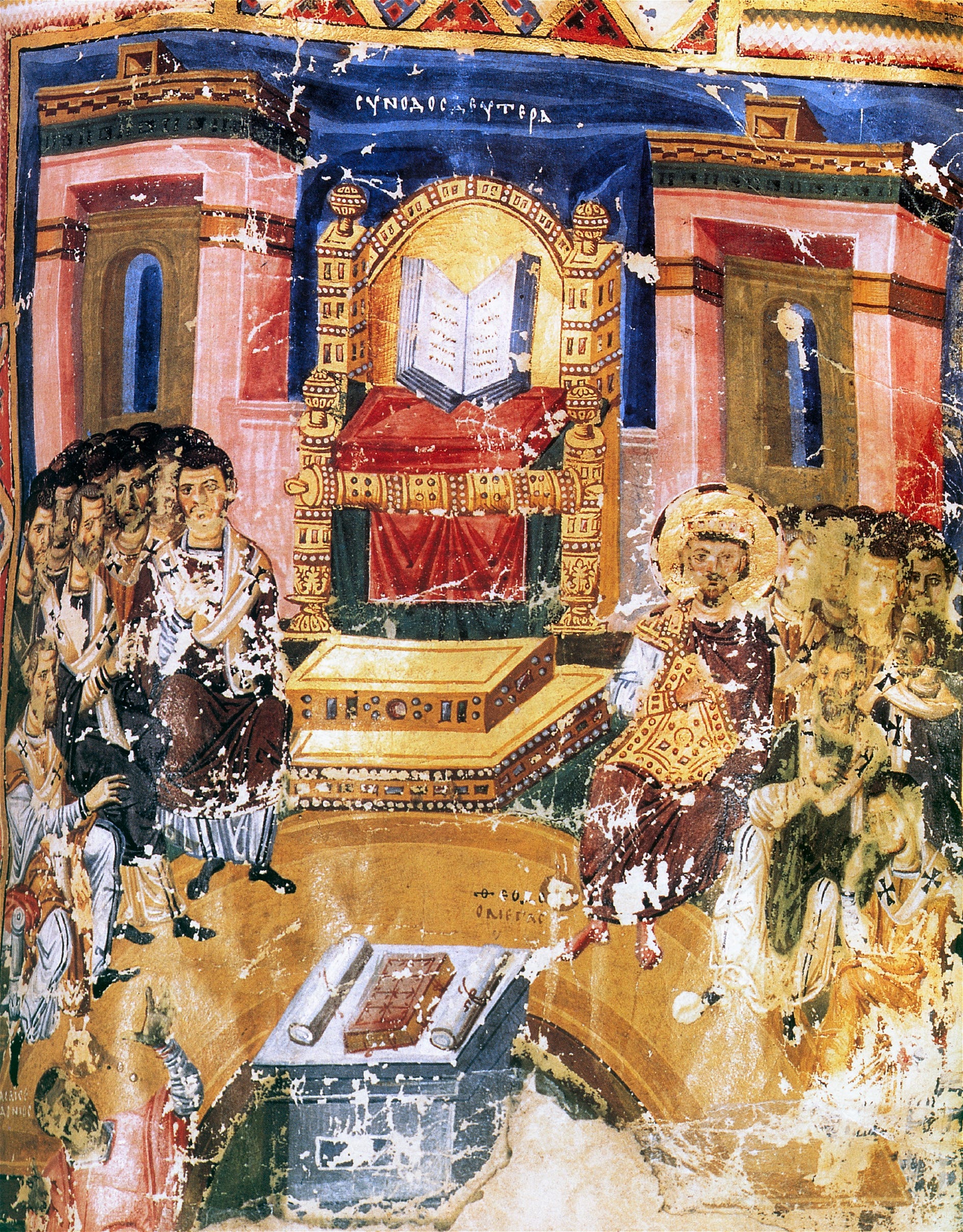
At the Council of Ephesus in 431, bishops and leaders there placed the Gospel books upon a throne. It signified that whatever statements or decisions were made there would be made under the reign of Jesus. The council synod formed in order to protect the “true faith.” And thus its members began deliberations “with the holy gospel-book set before [us] on the midmost throne to indicate that Christ himself was present with us.”[1]
Speaking of the enthronement, Charidimos Koutris explains, “they employed the object which contains the truth (i.e. the word of God), that is the Gospel-book. They enthrone it in the middle of their assembly to manifest Christ’s presence among them, and they employ it to seek and establish the truth in matters of faith and in the testimonies of the witnesses.”[2]
While we have no evidence the same thing happened in 325 at Nicaea, although it might have, we can say that Scripture played a central role at that Council. Indeed, the Nicene Creed symbolized a pattern of reading Scripture according to its scope and sequence, which accords with Christ and the Rule of Faith.
Anyone reading the various accounts of the Rule of Faith or the baptismal creeds of the second and third centuries would not be surprised to read the Nicene Creed, save for two phrases: “from the essence of the Father” and “same-essence with the Father.” These non-biblical terms caused a protracted debate that lasted fifty-six years; the debate concerned whether it was appropriate to use non-biblical language in a Creed and whether these terms captured appropriately the scope and Rule of Faith that the apostles delivered both verbally and in their writings.
Ultimately, the Church came to the conclusion that the Creed represented the Rule of Faith, but the road to consensus was not an easy one. Many books and letters were written; friendships started, friendships ended; bishops were exiled, others persecuted. The story may sound like a battle over mere words, but when we look at the historical settings and writings of the theologians, we find something that we may not be able to grasp in our modern contexts: the theologians of the church believed salvation was at stake.
In other words, for them, the stakes were not minuscule. Heaven and hell hung in the balance. And while we do find some Christians seeking power, that is not the primary story. Instead, Christian leaders held fast to the faith once and for all delivered (at least as they understood it) and were willing to undergo exile and death for the sake of the salvation of others.
Why? Because they maintained that the Rule of Faith must be preserved for the salvation of souls. So Origen will write, “If living a life of good morals is sufficient for salvation for people, how are the philosophers among the Gentiles or many among the heretics who live self-controlled lives by no means saved?”[3] Good morals are insufficient; faith must accompany works since one without the other leads to similar ends: a dead faith or dead works.
This pursuit to maintain the Rule of Faith, the Faith once and for all handed down by the apostles, for us and for our salvation, therefore caused existential crises, yet the fruit of such crises produced an indomitable conviction in the Faith. We can see this especially in the second and third centuries when infrequent but deadly persecutions struck Christian communities. At both Nicaea (325) and Constantinople (381), many Pro-Nicene Fathers would have had friends and family who had suffered or died for their faith, just years before each respective Council. Yet the majority saw in the Creeds of these Councils the same Rule of Faith that the apostles delivered, that Tertullian, Irenaeus, and Origen proclaimed, and that was present in both the interrogative and declarative baptismal creeds for at least a century and a half (and likely much earlier).
The Nicene Fathers believed that earliest and early Christians received the teachings of Christ from the apostles. They therefore ordered them in a pattern of sound teaching that became a Rule (guide) for reading Scripture, which climaxed at the Councils of Nicaea and Constantinople. They were willing to die, suffer exile and great loss for the sake of this Faith, believing salvation hung in the balance.
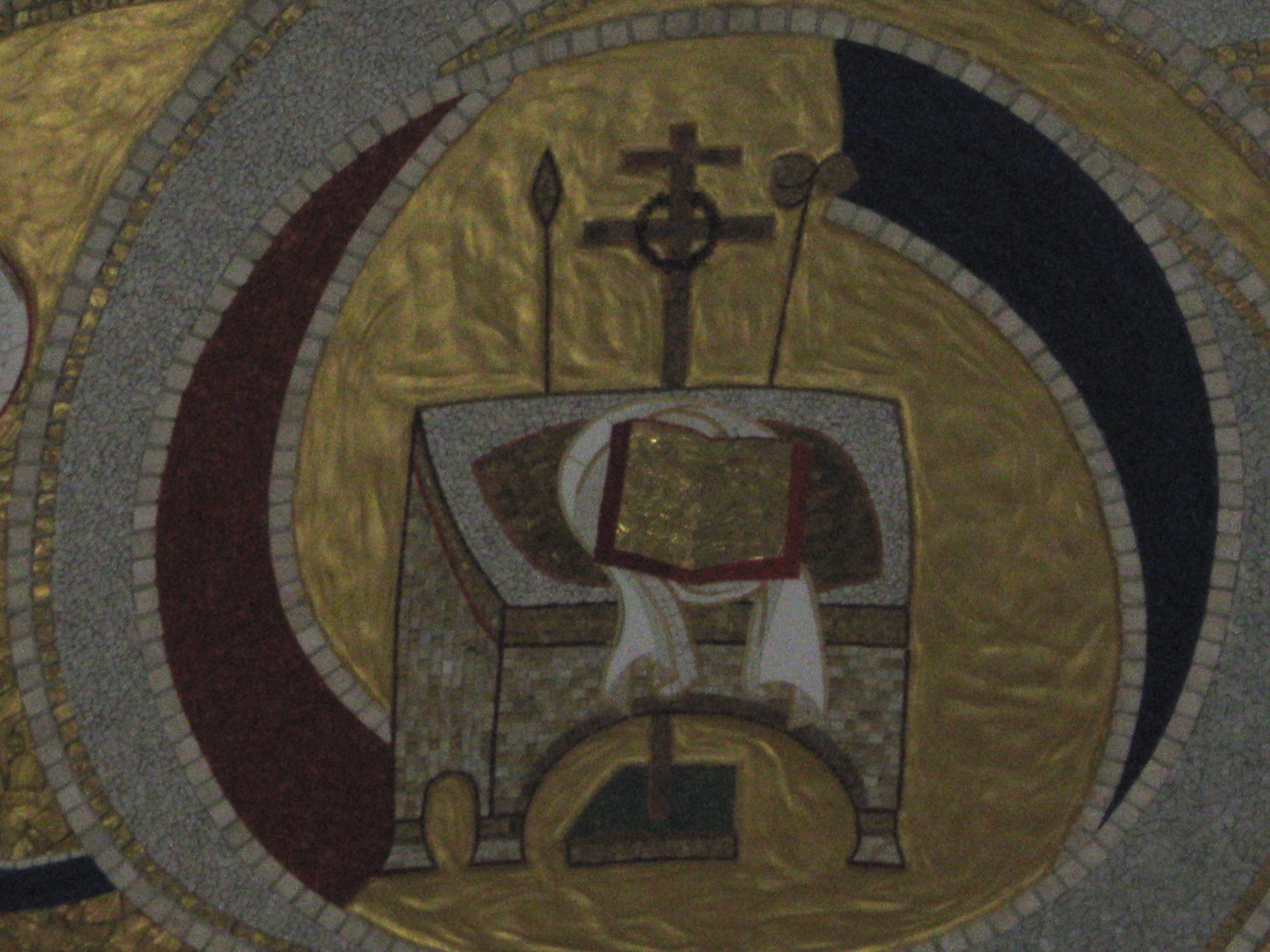
Today, the situation feels quite different. Even so, the Nicene Creed is the one Creed that all Christians agree on, even if they do not confess it as a Creed in their local settings. That would not surprise the members of the Council of Nicaea, since they simply believed the Creed was the same faith that all Christians up till that time confessed. The Creed was not a special or unique statement, although the Arian controversy led to the formulation of the Rule of Faith in the creed. And yes, that meant clarifying the Rule of Faith in some specific ways.
Particularly, the reason why the Pro-Nicene bishops introduced the words “from the essence” (ek tes ousias) and “one in essence” (homoousia) was because these terms clarified the ecclesiastical faith (so Athanasius, De Decretis, §3, §19). And they had good reasons to clarify. Consider how Athanasius explains, for instance, why the Nicene Fathers introduced the phrase “from the essence of God”:
“But the party of Eusebius … wished the designation of his being “from God” to be taken as something in common with us and the Word of God to be no different from us in this respect, as it is written; “one God from whom are all things” (1 Cor 8:6) and “the old things have passed away; behold all that is new has come to be; and all this is from God” (2 Cor 5:17,18). So the fathers of the council … finally found it necessary to proclaim the “from God” more clearly and to write “the Son is from the essence of the Father” (ek tēs ousias tou theou), so that “from God” may not be considered to be the same and equal in the case of the Son as it is with things that have come to be; but that it may be confessed that while all others are creatures, the Word is uniquely from the Father” (De Decretis 19).[4]
In other words, Athanasius claims that the Eusebians believed the Son is from God, but they believed he is from God in the same way that all things are from God—as creatures. But the Son is from God as the one through whom all things were created. He is thus from God in a way that no creature can be. The way Athanasius says the council expressed that was by affirming that the Son is from the Father’s essence. He will say much the same thing when it comes to affirming the Son’s unity of essence with the Father.
Athanasius saw this as a clear breach in the church’s teaching, that Rule of Faith that both confessed the oneness of God and also the trinitas of the one God of Israel. This meant that to preserve what is one in God, one must confess that what is three in God (Father, Son, Spirit) is naturally one. Thus, the doctrine of natural birth or, in the old-fashioned language, the Son’s generation from the Father, found pride of place in the Creed to clarify that the Father and Son are naturally one, not merely united in will, honour, or activity. But Father and Son truly are alike in every way, sharing a natural union.
While human parents beget children of the same nature, the latter are born in time and through material change. But, as Athanasius would point out, since Christians believe God’s mode of existence is outside of time and change and because God is simple, then it follows that the Son’s generation happens eternally (not in time) and without change (since simple). Hence, through a proportional analogy of God’s being to ours, we can say that while we generate in time and through material division, God has always had a Son through a relation of eternal generation without change.
The theological reflection here seems overwhelming, but this is because priests and theologians like Asterius, Arius, and Eusebius (less so, him) introduced a cosmology and divine principle that divided the natural unity of Father and Son by placing the Son as the Mediator between the Father and creation through a relation of will to both. In other words, the Son had a united will with the Father and willed the creation of all things with the Father. While that sounds plausibly orthodox, Pro-Nicene bishops recognized a breach in the Rule of Faith because it meant that the Son fell on the side of creation; he was a creature, even if elevated and the most divine of all creatures.
Assuming we accept Athanasius’s portrayal of events around Nicaea, it would not be the first time that Christians made explicit the Rule of Faith’s sense (dianoian), so that the statements of Scripture are understood according to their sense, along the sequence of words that disclose its subject matter.
Nicaea is one significant blip in history as Christians continued to argue from Scripture for the Rule of Faith against Docetism, Marcionism, gnostic teaching, Sabellianism, and more besides.