


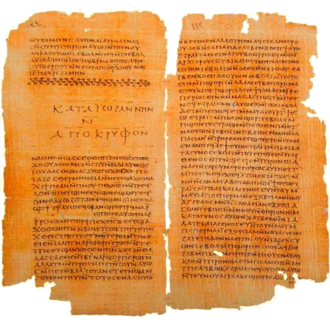
Whenever someone on the internet calls some one or thing Gnostic, I can almost guarantee that this will be an inaccurate accusation. After all, the dualism present in gnosticism was not unique to them. What likely marks them off as a distinct group is, as David Brakke argues, their mythology. And I do not think anyone today holds to their myths.
In this short, I want to give a brief overview of gnostic Christianity to explain why it created a crisis of identity for Christians associated with Rome and Egypt (and probably elsewhere).
Gnostics within Christianity
When Christians began to call themselves Gnostics in the early to mid 100s, it probably sounded strange. Everyone wanted to receive gnosis (knowledge), and even Clement of Alexandria believes that Christians should pursue the ideal of being a Gnostic, but the term to describe Christians remained, well, Christian. The word was simply not used to describe a religion or group yet.
Indeed, it was an academic term that probably sounded flattering. Oh, you are a knower, someone who has true knowledge. Even Evagrius Ponticus called ascetics gnostics. It was not then an insult or slur as it is sometimes today.
Given the evidence in the writings of Irenaeus, Tertullian, Hippolytus, Porphyry, and the various recovered texts at Nag Hammadi, it seems clear that some of those who claimed the title emerged from within Christianity. Tertullian even recounts that Valentinus, one who shared in the gnostic myths and cosmology, was a candidate to become the bishop of Rome.
He explains: “Valentinus expected to become bishop because he had great abilities of mind and tongue, but another was preferred for the position because he suffered as a martyr. Angry at this, Valentinus broke with the legitimate church” (Against Valentinians 4).
While we cannot speculate too much over whether or not Valentinus truly could have become bishop, I find it reasonable that he was a candidate. He was eloquent and intelligent. And his public teaching was Christian while his private teaching revealed gnostic myths. So many would perceive him as saying similar things to someone like Justin Martyr. His brilliance likely also covered a multitude of sins. A near contemporary to Valentinus, Basilides, wrote twenty-four books on the gospel in the early second century. Therefore, Valentinus was not alone in his literary production; this group of Gnostics represented an elite layer within Christian communities.
Now, I am speaking about Gnostics emerging from within Christianity, and so I think I should at least justify the language of “within Christianity.” First, Valentinus claimed Christ as Saviour. So did many people who called themselves Gnostics. I agree with David Brakke in his The Gnostics that this was a self-designation, based on the ancient evidence. In this sense, they claim Christ for themselves while taking the title Gnostic; they also participated in non-gnostic or apostolic churches. In this sense, they emerged from within Christianity.
Technically, the Gnostics were an identifiable group who had offshoots; the Valentinian school was one such offshoot. And we can call it Gnostic because it shares gnostic myths. As noted, I again agree with Brakke that the best way to identify gnostic teaching is through its myths. Hence, Valentinus, although distinct from the earlier gnostics, would be a gnostic teacher of the next generation.
With all that said, what myths did they tell? And why did they threaten such teachers like Irenaeus, Clement, and Tertullian?
Gnostic Myths
The major sources for early gnostic teaching include both critical works such as by Irenaeus, Clement, and Tertullian and, due to the discovery of the Nag Hammadi library in 1945, positive writings of gnostic thought such as The Secret Book According to John and The Gospel of Judas (the latter not from Nag Hammadi but from the Codex Tchacos, discovered separately in the 1970s and published in 2006).
These writings present gnostic teaching as attempting to re-read Scripture (the Old Testament) in light of Jesus’s advent. Remember, the New Testament documents began circulating widely in the early 100s, but they were not yet “the New Testament” as we understand it. Thousands of people primarily read the Old Testament and produced their own writings to explain the significance of Jesus.
Early Gnostics and later teachers such as Valentinus read the Christ event in light of a creation story and cosmology, which meant they saw the Old Testament (i.e., the Scriptures) as telling a specific story. While there is some diversity in these myths, one telling of it goes like this.
First, the god who created heaven and earth is an ignorant and proud being, who descended from Sophia who bore him out of passion and ignorance. This being, the Demiurge or Yaldabaoth, created the material world and lacks knowledge of the true God and Father (sometimes called the Abyss). The flood, for example, was his anger at the Sethites because they began worshipping the true God, not him. Hence, the creator is not the father of the Lord Jesus Christ.
Christ, an Aeon, came to materiality to share secret or hidden things to liberate spirits from their material existence. He, along with various powers and Aeons (Sophia, Truth, Light, etc.) makes up a cosmic map of beings. The body of Jesus is either used like a glove or, in another myth, Christ switches places with Simon of Cyrene who is then crucified. Obviously, in this paradigm, the resurrection of the body is moot since the goal was the liberation of the spirit from flesh, from matter.
Now, I have combined two or three different versions of the gnostic myth, and I think in this narrow case, I am justified in doing so because it helps to paint a picture of how elaborate these myths were.
They acted like a rule or canon by which the Scriptures were read. God in Genesis 1:1 was Yaldabaoth. The titles for Christ are not his titles but rather speak of various Aeons. The God of the Old Testament is not the God and Father of Jesus Christ. The resurrection of the body is reinterpreted away. And so on.
So that meant these teachers claimed salvation in Christ but read Scripture according to these myths, like keys to unlock the literal meaning of the text to understand its hidden, secret meanings. Indeed, gnostics within Christianity believed Christ taught these things to one apostle who alone held on to this knowledge—sometimes Judas, at other times John. Indeed, the Gospel of Judas paints the one who betrayed Christ in a positive light, as a true gnostic, who betrays him according to a pre-arranged plan to destroy the material order. It is quite the reversal of expectations, given the Gospels of Matthew, Mark, Luke, and John.
Gnostic Exegesis
So what seems to really be at stake is who can interpret the Scriptures, that is, the Old Testament and what they mean. Tertullian, in his Prescription against the Heretics, uses a legal term praescriptio to argue that only Christians who hold fast to the Rule of Faith, given by the apostles verbally and present in the apostolic writings, have the right to teach it.
Remember, contextually, that the above myths were used as a key to interpret the words of Scripture in ways that are not obvious in the text. Further, Irenaeus points out how many of these teachers re-ordered the story of Scripture to fit within their mythic system. And hence, Christians found it difficult to debate with gnostics.
After all, if a gnostic says God gave him special insight into the text and its hidden divine meaning, which one cannot discover except through extra-biblical revelation and a complex cosmological system, how does one respond? We could say that John 1 teaches that Christ is the Word of the Creator. They would say: actually, no, and the words like Truth or Light in the context refer to Aeons, not Christ (another Aeon).
Okay, so then there is no way to argue from the text because something outside the text determines its meaning, viz., gnostic myths. Now, Christians also purported to have their own Rule of Faith. Yet the key difference here is that this Rule came from the verbal teaching of the Apostles, yet also agrees with the given sequence in the Old Testament and the manifest meaning of the apostolic writings.
It is doubtful that gnostics within Christian communities felt the same way. Indeed, we have some evidence in the Gospel of Judas that they thought apostolic Christians were misguided. Do remember that these groups too claimed apostolic succession from one apostle upon whom Christ had bestowed gnosis, and from this unbroken line they received revelation and knowledge.
Consider, for example, the Gospel of Judas which specifies that Judas was the one who had true gnosis; the other apostles did not. Well, when the Gospel of Judas was written, Christians read and followed writings from the other apostles who were ignorant of the truth!
Final thoughts
Ultimately, what we know as orthodoxy grew and gnostics declined. I cannot imagine that Jesus allowed Paul and the Eleven to remain ignorant while Judas, who betrayed him, somehow was the true gnostic. Nor am I convinced that secret revelations of Aeons and the fall of the one who would create the world seem in anywise plausible. The discontinuity between this teaching (supposedly of Christ) and the Old Testament scriptures is striking.
Marcion desired to cut away the Old Testament due to the lack of the creator’s clemency; while Valentinians like Ptolemy, whose letter to Flora remains extant, simply wanted to re-identify him as a fallen and semi-just creator of a material reality that requires Christ to save us from.
The Rule of Faith as presented by Irenaeus, Tertullian, and others seems to treat the Old Testament much more naturally, and show how Jesus came in fulfillment of its promises. That Rule states that there is one God and Father of our one Lord Jesus Christ through whom God created all things. And it states that Christ, that eternal Word from the Father, became Incarnate for us and for our salvation. And it maintains that the Spirit spake in the prophets, that Christ would return to judge the quick and the dead; and a bodily resurrection would precede our eternal felicity.
That Rule seems a better guide to the Scripture than one given by Valentinus.
By the way, I am teaching a class on how the early church read Scripture, which you can audit.
I just finished Elaine Pagels’ “Beyond Belief” which was a chore to say the least. It’s too bad Irenaeus forced the church to accept John’s gospel and not Thomas’s… Thanks for the concise and helpful read^^