


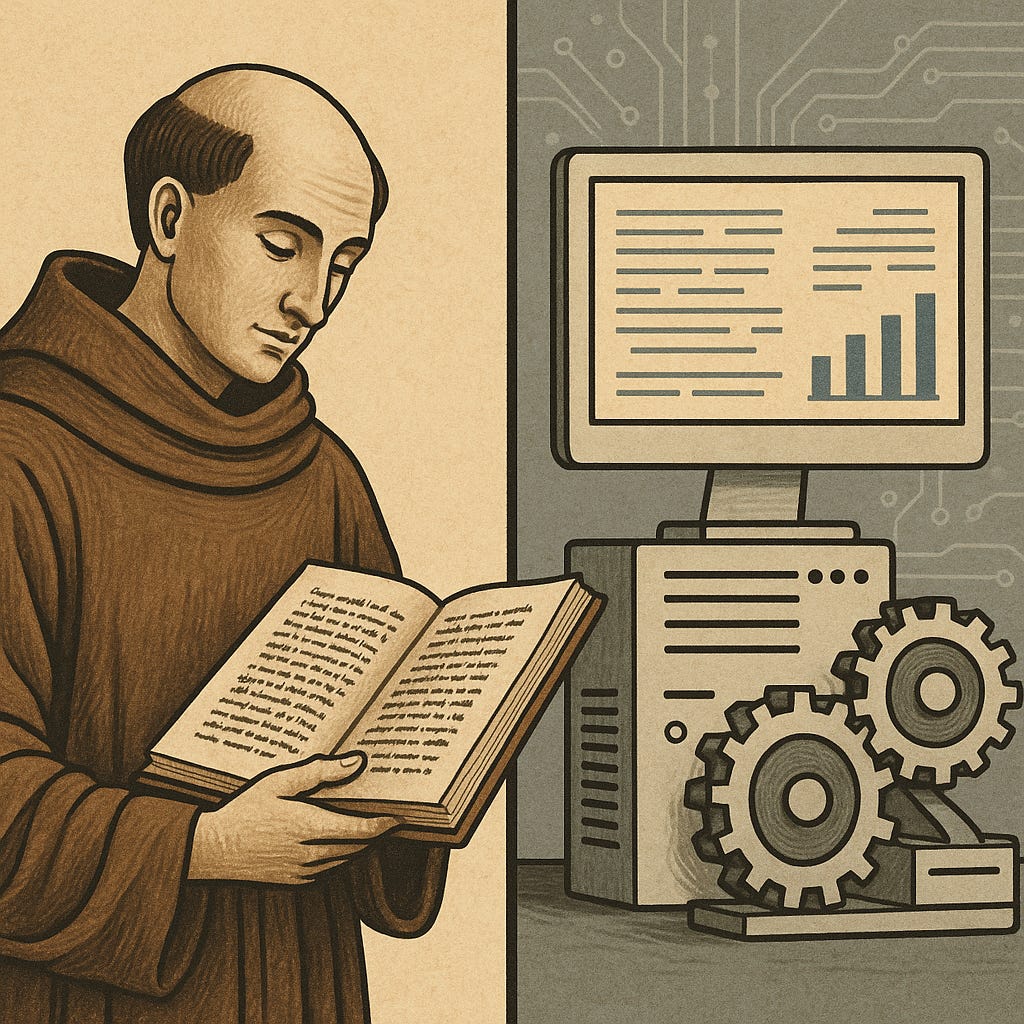
Since we have an immortal and rational soul, humans alone can do what only humans can do, namely, contemplate intelligibles such as truth, justice, God, and angels. AI can never contemplate intelligibles, because humans alone have rational souls (animus / nous).
Here I am distinguishing anima, what every living creature has, from animus, what humans alone have. Given this distinction, humans possess an immaterial animus or nous (the Greek equivalent) that can contemplate other immaterial objects, that is, intelligibles. Only what is by nature intelligible can contemplate what is by nature intelligible.
Given this basic distinction, we should ask a follow-up question: what is AI for?
What Machines Are For
The things AI is for are the things humans are not made to do. AI is particularly good at mechanical or machine-like activities: calculation, organizing, storing and accessing data, rearranging information, and analyzing and retrieving it at a large scale. In other words, AI excels at tasks that are burdensome for humans because they do not cultivate human excellence. You are not meant to look at 10,000 pieces of inventory to extract 27 similarities across product lines. You are not meant to comb through 10,000 documents to update the spelling of one word twenty-seven times. Such labours do not, under normal conditions, ennoble the soul nor foster virtue. But machines are made for them. A machine, traditionally, does what a windmill does: it grinds grain in a way and at a scale no human could manage, for a purpose proper to the machine.
Some things only machines can do, because machines have ends proper to them. Some things only humans can do, because humans have ends proper to them. It is particularly human to sit down and master a tradition through documentary study, through writing a book, monograph, or article, or through teaching and organizing knowledge.
There may be some overlap between human and machine capacities. For instance, AI can summarize sources, but it cannot shape the soul the way slow, attentive reading does. The difference, however, is this: uniquely human labour does not exist merely to order information. It has a double end. First, it shapes the soul. It makes you into the kind of person who can contemplate the virtue you are studying (prudence, justice, wisdom) and apply it to civic life. It perfects excellence in us, and it applies that excellence to life.
For that reason, there will always be something a human can do that a machine cannot. Human work not only orders the world outside us but also forms the person within us. Education, teaching, and mentorship are irreducibly human because they pass on intelligible goods from one soul to another. This kind of communication can only happen at the level of the soul, where virtues are cultivated and wisdom is shared.
The Limits of AI
An AI machine—or generative AI—is essentially like a SQL database. It stores data and information, and it retrieves whatever you put into it. You feed it large swathes of data so that it can organize, present, and arrange the material: make charts, produce forms, track income and expenses, account for inventory, and so on. In this sense, AI continues what machines have always done, whether through hardware or software, whether an abacus or a SQL database for a warehouse. The way to use AI, then, is quite limited. Its limits come from its lack of soul. It can only do what machines are for.
AI has particular uses, and those are the uses proper to machines. You should not rely on it unless you have already put in the information yourself or clearly directed it to the databases you want it to search. You cannot get anything out of it that you did not already put into it.
If you use AI to replace conversation or to act as a source of general knowledge, you are depending on an algorithmic search for information that is, by necessity, highly biased toward recency. AI tends to return what is most recent, that is, recently verified facts or what is currently taken as “the way things are.”
That means if there is something true, good, and beautiful from the sixteenth, seventeenth, or eighteenth century, but it has gone out of fashion, AI will likely not present it as a valid or probable answer. Instead, it will return what is currently accepted. For that reason, you cannot use it as a source of general knowledge.
The Coming Challenge
Almost nobody uses social media well. Most become addicted, and it harms the mind and emotions. In the same way, almost everyone using generative AI, at least for now, will use it badly. Younger people may be more aware of social media’s dangers, since they grew up with it, but still, most use social media as earlier generations used TV. It is dumb entertainment, consumed all day, because entertainment is made for speed, for economic advantage, for advertising, and to pacify.
Likewise, generative AI will almost entirely be used in that way. On the other hand, businesses will use AI to replace many of their current software suites. Instead of a customer portal here, a SQL database there, and some other proprietary program besides, they will be able to run all of it through a single front end powered by something like ChatGPT. This could simplify processes and even make work more humane. But that potential will probably not be realized widely, except by those who know what it means to be human.
In other words, if you understand what it means to be human, you can use AI to reduce the inhuman elements of modern work—those tasks fragmented across countless software applications. It may even be possible to use AI to make space for deeply human endeavours. But if you do not know what it means to be human, AI may dehumanize us further since we will place machine ends into human activity.
With all that said, we also must face the existential problem: AI is coming, just as social media came, and there is no way to escape it. So the question “should you or should you not use it?” is moot. You will have to use AI for your job or to exist in modern society.
The real question is: do you know what it means to be human, and what it means to be a machine? Only if you can distinguish those ends will you find the duties proper to each.
Interesting article, Wyatt. Your basic distinction between a human and a machine is crucial to grasp. I heard on the news the other day about parents suing ChatGPT for giving advice to their child about ways to commit suicide. When people look to AI for answers about life, then they are definitely in trouble.
Very perceptive critique. AI has no soul, but with the right questions it can appear to reflect a particular perspective. Sometimes it acts like an echo chamber. Is it AI, or just me being reflected? It can give very precise theological definitions and do comparisons on a grand scale. Who has time to do that? Does Luther teach x or y and what was his opinion on z? Is it true or is it just AI? I don’t know. AI is useful but dangerous. Need a course on its proper use. Any suggestions?