


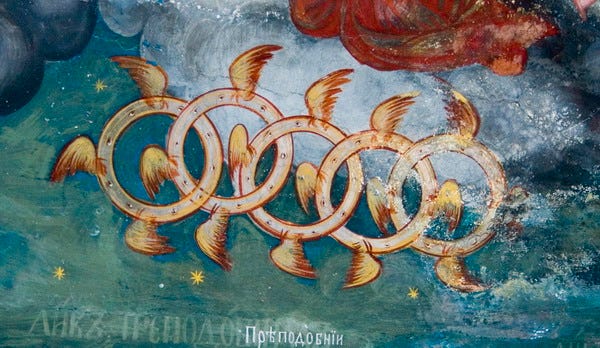
Ezekiel 1 is one of the strangest passages in Scripture. Here, Ezekiel sees a chariot with four living creatures that have four different faces (Ezek 1:6, 10). The living creatures move without turning (1:9, 12), and their wheels have rims full of eyes that move below them (1:15–18). Above the living beings is an expanse (1:22–23), and one “like the appearance of a man” sits upon this mobile throne (1:26).
What on earth is Ezekiel describing? Or better: what in heaven did Ezekiel see?
In this article, I seek to answer that question, so that you can better grasp Ezekiel’s theological intention.
What did Ezekiel see?
The vision begins with a storm theophany: a windstorm from the north, a great cloud, flashing fire, and gleaming metal (Ezek 1:4). From within this storm, Ezekiel sees a chariot with four living beings that have four different faces: human, lion, ox, and eagle (1:6, 10). Fire and lightning flash among them (1:13). They move without turning (1:9, 12), directed wherever the spirit goes (1:12, 20–21).
Below the living beings are wheels structured as a wheel within a wheel; their rims are full of eyes (1:15–18). Ezekiel may be describing smaller wheels within larger wheels. Or perhaps he is describing a sphere. It is hard to know precisely. In any case, the eyes upon the wheels probably signify God’s all-seeing nature from his throneroom. Ezekiel 10:12 also says the bodies of the creatures are covered with eyes.
Above the creatures spans an expanse (1:22–23) like in creation, and upon a throne sits one “like the appearance of a man,” radiating fire and brightness, surrounded by something like a rainbow (1:26–27). Ezekiel identifies this luminous sight as “the appearance of the likeness of the glory of the LORD” (1:28).
So what is that thing?
Ezekiel sees a theophany, an appearance of God, on a mobile throne. The language of theophany (windstorm, cloud, fire, etc.) signifies that this whole object portrays God. For example, the spheres mean that the chariot can move in any direction, to the four corners of the earth. God is omnipresent. The eyes everywhere represent God’s omniscience. The creatures, identified as Cherubim in Ezekiel 10:1, may show God’s power over the created order.
And here, God appears in a storm as he did at Sinai (Exod 19:16–18). What makes this theophany unique, however, is that, like Isaiah 6, Ezekiel sees God’s heavenly throneroom. Here, God’s chariot and throne appear with cosmic signs. That this is God’s heavenly throne also becomes clear in Ezekiel 10 when we learn that Ezekiel sees the heavenly reality that the earthly temple symbolizes.
In that chapter, God’s glory leaves the temple. Now, the most holy place held the ark of the covenant with winged cherubim surrounding it (Exod 25:18–22). In other words, the ark of the covenant is like a throne. The whole room represented God’s heavenly dwelling. But it was visible; what Ezekiel sees is the reality which the visible signs pointed to, namely, the throne of God.
Ezekiel sees past the earthly signs to the reality of God’s enthroned presence, his glory as it is in the heavenly places. Put directly, the earthly symbols of the temple reveal God’s real presence; Ezekiel sees that real presence.
And it is the same throne room that both Isaiah and John see. For example, the vision parallels Isaiah 6 in which seraphim surround God’s enthroned presence. Here, the four cherubim approximate the seraphim, although the cherubim have four wings instead of the six of the seraphim.
So the thing Ezekiel sees is the heavenly reality that we believe in with our hearts but do not see with the eyes of our flesh. Second Kings 6:17 shows a parallel scene where Elisha’s servant has his eyes opened to see chariots of fire at Dothan. Or one might think of the throneroom scenes in Revelation and Isaiah 6.
Where is God?
If Ezekiel sees God’s presence, where is God? This is the most important question, because the Bible is a work of theology: it reveals God and things related to God. To answer this question, three observations follow.
First, God cannot be seen as God. At Sinai, the people saw signs of thunder and lightning. But they saw no form of God (Deut 4:15). God cannot be seen, and no one has seen except the only begotten God (John 1:18). So God reveals himself, as Augustine pointed out, through creatures: angels, fire in a bush, prophets, and here in Ezekiel, a cosmic chariot. We should not expect to see the invisible God who dwells in unapproachable light, because that light is by definition unapproachable and unseeable (1 Tim 6:16; cf. Exod 33:20; John 1:18). We see the created form that reveals to us.
Second, not only does the whole scene reveal God to us, but Ezekiel also identifies the Spirit as the director of the chariot-throne (Ezek 1:12, 20–21). God is thus implied and his Spirit named as the animating and directing force of the chariot.
Third, and most shockingly, God is described as being in human form. As Ezekiel 1:26 says, “And above the dome over their heads there was something like a throne, in appearance like sapphire, and seated above the likeness of the throne was something that seemed like a human form.” How and why could God be described in human form? After all, God made humans. He is not first a human, but he is God!
Ezekiel, however, tells us: the being on the throne is “like a human.” He is not a human per se, but he is like one. He has the look and form of a human.
What does this mean exactly? Mark Gignilliat and Heath Thomas explain: “What Ezekiel sees in this divine vision of omnipotent and omniscient glory is nothing less than the glory of God revealed in human form. Ezekiel peers into the mysteries of the universe with this vision, and in so doing, he sees the form of Christ slain before the foundations of the world” (Old Testament, 239).
Christ on the Throne
John’s vision of the glorified Jesus Christ in Revelation 1:13–16 parallels many features of Ezekiel’s vision.
John sees “one like a son of man” (Rev 1:13), echoing “the appearance of a man” seated on the throne in Ezek 1:26. Ezekiel describes brightness and fire from the waist up and down (Ezek 1:27), while John sees eyes like blazing fire and feet like bronze glowing in a furnace (Rev 1:14–15).
The gleaming metal surrounding the figure in Ezekiel (1:4, 27) parallels the burnished bronze of Christ’s feet (Rev 1:15).
Ezekiel’s rainbow-like radiance encircling the divine glory (Ezek 1:28) reappears both in Christ’s face shining like the sun (Rev 1:16) and in the rainbow surrounding the throne in Revelation 4:3.
Likewise, Isaiah 6 and Ezekiel 1 share many features (throne, seated one, winged creatures, glory, smoke/cloud, fire, etc.). And John 12:41 identifies Jesus as the one on the throne in Isaiah 6: “Isaiah said this,” explains John, “because he saw [Christ’s] glory and spoke about him.” This indirectly furthers the conclusion that the Incarnate Christ is the one upon the throne.
But how could he be, since the Incarnation had not yet happened? The answer centres on God’s experience of time. As Gignilliat and Thomas alluded to in the quote above, Revelation 13:8 speaks of “the Lamb slain from the foundation of the world.” He was slain as the lamb and as Christ because Christ is the eternal Word from the Father. We can think of Christ as Incarnate in his fulfilled vocation. He was always meant to be the Lamb; in this sense, he always was.
God the Word took on human flesh (John 1:14). He who lives outside of time took time to himself; he who was apart from flesh received our flesh and blood; he who could not change became changeable for us and for our salvation. As the Timeless One took chronology as his very own by the Incarnation, we can think of God the Word in almost no other way than as Jesus of Nazareth. That is who he is as the eternal Word from the Father.
In these ways, we can understand that God the Word appeared as Incarnate in something “like a human form” (Ezek 1:26) because that is how the Son is always revealed to us.
What did this mean for the exiles?
Ezekiel recorded this vision while in exile. He, along with 10,000 others, was exiled to Babylon in 597 BC. The major crisis for the exilic Judahites had to do with the temple. If God’s presence was there, then could God bless and help the exiles?
The vision of God’s throne and the later vision of God’s glory leaving the temple (Ezek 10) show that God is not a local deity, but his glory fills the earth. The rest of Ezekiel, especially the oracles against the nations, furthers this impression.
For Ezekiel, the man on the throne also gives him his commission as a watchman in Ezekiel 2–3. So the vision serves as his commissioning.
Putting Ezekiel’s original and Christological contexts together, we can say that the God who met Ezekiel in Babylon is the same Lord who would later take on flesh and dwell among us. His presence is never confined, always reaching toward his people, whether through vision or Incarnation.
More could be said, but I wanted to relay some reasons as to why Ezekiel included this vision in his prophecy.
Conclusion
Ezekiel saw Christ in his glory. The vision is nearly indescribable. We cannot fathom what Ezekiel saw. (Just try to draw the wheels within wheels.) We can, however, say that the overwhelming pressure of glory in that vision shows us Christ, the Lord of Glory, who would bring Judah and the nations low before raising them up again to newness of life through the glorious Gospel of our salvation.
Can't tell you how much this article blessed me.