


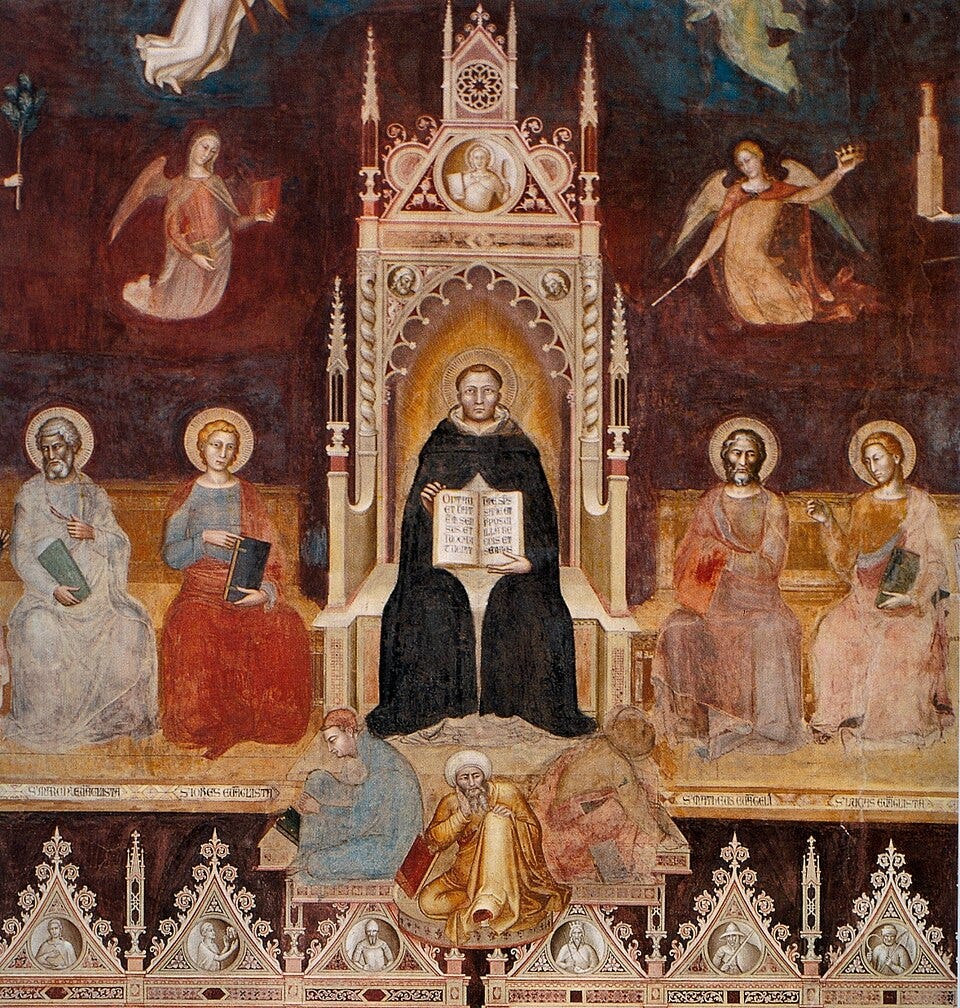
When Thomas Aquinas answers the question “Whether God exists” in his Summa Theologicae, he cites Exodus 3:14, wherein God declares, “I am who I am.” God exists because he says so. In this Scriptural context, Aquinas presents his Five Ways to demonstrate that God exists (ST I.2.3).
Far from having a “frigid” natural theology, Aquinas here evinces his characteristic approach to Scripture and theology, showing how sacra doctrina depends on revelation yet uses reason in service of faith (ST I.1.8 ad 2; I.1.1).
The way in which he balances reason and faith centres on a number of important distinctions that we must learn to grasp his position and also to find the intellectual concepts to understand God’s duplex revelation in Word and world (see Belgic Confession §2).
First, Thomas argues for the truthfulness of the statement “God exists,” not aiming to demonstrate God’s existence precisely, because God’s esse (“existence) is his essentia (“essence”). God’s essence transcends our ability to know (ST I.3.4). Hence, the Five Ways demonstrate that “God exists” is a true proposition, not God’s existence as it is in itself (esse divinum), which remains beyond comprehension (ST I.2.2 ad 2; I.12.12).
Second, Thomas does not demonstrate the sacred doctrine of Scripture in the Five Ways. Sacred doctrine in Thomas refers to saving revelation that transcends human reason and must be received in faith. Instead of this, Thomas demonstrates that the statement “God exists” (Deum esse) is true. In any science, one must first demonstrate that the object of study exists (ST I.2.2). Thomas does that here; he provides ways of seeing that quia est Deus (“that God is”), not quid est Deus (“what God is”).
Third, the Five Ways find their principles in reason, that is, natural knowledge. But sacred doctrine, which provides saving knowledge of God that transcends reason, has its principles (articles of faith) given by divine revelation and received by faith (ST I.1.1; I.1.8). Hence, the natural theology of Thomas here does not compete with Scriptural revelation; it serves it as a rational preamble (preambula fidei; ST I.2.2 ad 1; SCG I.7). It also can support sacred doctrine as a handmaiden to it (ST I.1.5).
Fourth, Thomas states that all men are directed towards God, but in such a way that transcends reason. Hence, the Five Ways cannot bring someone to their blessed goal. “Hence it was necessary for the salvation of man that certain truths which exceed human reason should be made known to him by divine revelation” (ST I.1.1). The Five Ways are not abstract ways to God in salvation; they instead show that God’s world testifies to its Creator in the things that God has made.
Fifth, that God exists can be denied by the fool (Ps 14:1; 53:1), because God’s existence is not self-evident to the senses apart from rational demonstration. Hence, Paul argues that God makes his divinity known through what he has made (Rom 1:19–20). We know God through his created effects. In this sense, God’s existence is not self-evident to us, though it is in itself necessarily true. Hence, anyone can know God’s invisible power and divine nature and is thereby rendered “without excuse” (Rom 1:20; ST I.2.1).
Sixth, Thomas distinguishes between knowing that God exists (quia est) and knowing what God is (quid est). We know that God exists through his effects, but not what he is in himself, for his essence surpasses the capacity of human intellect. While we cannot know what God is, we can know what God is not by, for example, a way of remotion (ST I.12.12; SCG I.14). Remotion means removing limitations and imperfections from God by a way of negation. (There is more to this, actually, but I will leave here for the sake of simplicity).
Seventh, Thomas explains that one can make a demonstration in two ways: first, from cause to effect (a priori), and second, from effect to cause (a posteriori). He argues in the second way, from effect back to cause, in the Five Ways, because the former requires knowing the cause itself; which we cannot know, since God is infinite and thus unknowable in essence (ST I.2.2; I.12.12). For this reason, we can demonstrate through God’s effects (“in what he has made”) the conclusion that God exists as First Cause (ST I.2.2; SCG I.13).
Conclusion
Thomas demonstrates that the proposition that God exists is true. He says much less than one might imagine, and he orders his answer within the context of sacred doctrine. The above distinctions clarify what Thomas aims to accomplish in his own intellectual context.