


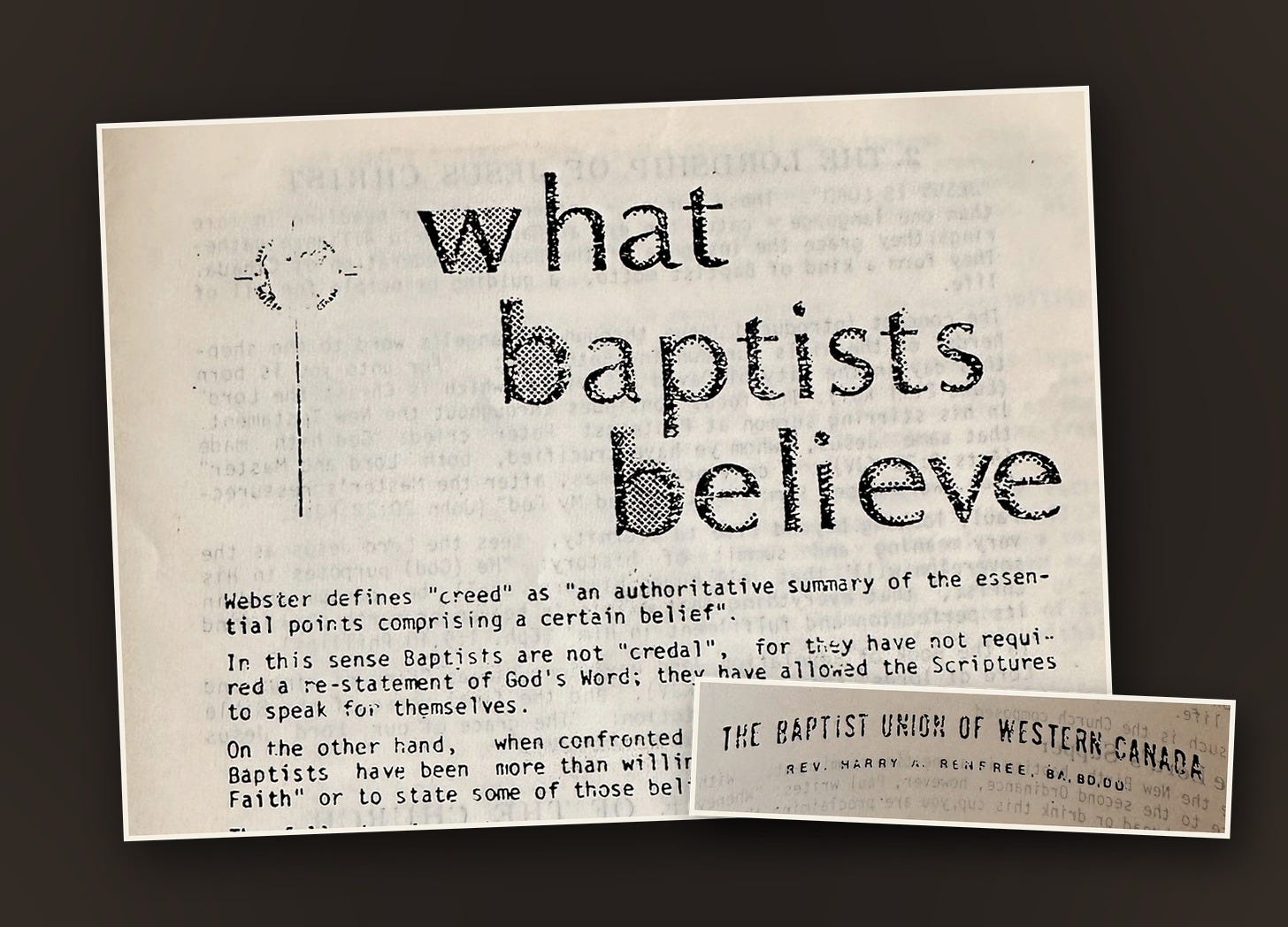
Probably in the late 1960s, Harry Renfree, then Executive Minister of the Baptist Union of Western Canada (BUWC), published a pamphlet through the Union that functions as a confession of faith. It was likely written to explain the Ten Baptist Principles that the BUWC added to its constitution in 1962.
The first three paragraphs explain that Baptists are not credal, in that they do not require subscription to a creed; they are confessional, in that they willingly share confessions of faith. Part of this has to do with what a voluntary association is. Congregations voluntarily associate around forms of unity, usually a statement of faith.
Here are his words:
“Webster defines ‘creed’ as ‘an authoritative summary of the essential points comprising a certain belief’.
“In this sense Baptists are not ‘credal’, for they have not required a re-statement of God’s Word; they have allowed the Scriptures to speak for themselves.
“On the other hand, when confronted with ‘What do you believe?’, Baptists have been more than willing to share a ‘Confession of Faith’ or to state some of those beliefs commonly held.
“The following is such a statement, scripturally-based.”
Afterwards, he confesses the faith in six major parts: Scripture, Christ, the Church, the Ordinances, the universal priesthood, and religious liberty. One can probably detect E. Y. Mullins in his last point. Compared to earlier confessions in Western Canada, it’s fascinating that there is no affirmation of the Trinity.
Here is the text below:
Cover: what baptists believe
Webster defines “creed” as “an authoritative summary of the essential points comprising a certain belief”.
In this sense Baptists are not “credal”, for they have not required a re-statement of God’s Word; they have allowed the Scriptures to speak for themselves.
On the other hand, when confronted with “What do you believe?”, Baptists have been more than willing to share a “Confession of Faith” or to state some of those beliefs commonly held.
The following is such a statement, scripturally-based.
1. Centrality of the Scriptures
More than any, Baptists have been known as “people of the Book”. This Bible is the guide-book, the complete creed, the authoritative, sufficient rule of faith and practice. Hence, what Baptists believe about life and death, beginning and ending, time and eternity, meaning and purpose, are found in the Scriptures.
Inspired - Of this Book the Apostle Paul writes positively, “All scripture is inspired by God and is useful for teaching the faith and correcting error, for resetting the direction of a man’s life and training him in good living. The scriptures are the comprehensive equipment of the man of God, and fit him fully for all branches of his work” (2 Tim. 3:16,17 Phillips). The Apostle Peter adds “But you must understand this at the outset, that no prophecy of scripture arose from an individual’s interpretation of the truth. No prophecy came because a man wanted it to: men of God spoke because they were inspired by the Holy Spirit” (2 Pet. 1:20, 21 Phillips).
Verified - The Scriptures, tested by time and experience, have proved to be an infallible guide, as hosts of Christians have testified. “Your word is the truth”, writes one Apostle (Jn. 17:17 Phillips). Paul asserts “It is in truth the word of God” (1 Thess. 2:13 KJV). Many centuries before, the Psalmist put it this way: “The law of the Lord is perfect . . . the testimony of the Lord is sure” (Ps. 19:7 KJV). The “ancient word” is also self-validating, as Jesus claimed Isaiah’s prophecy concerning Himself (Luke 4:21). “The Scripture”, He insisted on another occasion, “cannot be broken” (John 10:35 KJV).
Imperishable - This Word is the eternal Truth, as emphasized so strikingly by Christ: “Heaven and earth shall pass away, but my words shall not pass away” (Matt. 24:35 KJV).
Focus - The Bible clearly portrays the tragic need of sinful men and points as clearly to the remedy. Jesus Christ, the eternal Son of God, is its focus. “Those here written have been recorded in order that you may hold the faith that Jesus is the Christ, the Son of God, and that through this faith you may possess eternal life by His name” (John 21:31 NEB).
2. The Lordship of Jesus Christ
“JESUS IS LORD”. These words - often in banner headline in more than one language - catch the eye at Baptist World Alliance gatherings; they grace the insignia of the Baptist Federation of Canada. They form a kind of Baptist motto, a guiding principle for all of life.
The concept introduced Jesus through the angel’s word to the shepherds on the hills surrounding Bethlehem: “For unto you is born this day in the city of David a Saviour, which is Christ the Lord” (Luke 2:11 KJV). Its focus continues throughout the New Testament. In his stirring sermon at Pentecost Peter cried: “God hath made that same Jesus, whom ye have crucified, both Lord and Master” (Acts 2:36 KJV). A convinced Thomas, after the Master’s resurrection, worshipped Him: “My Lord and My God” (John 20:28 KJV).
Paul, looking beyond time to eternity, sees the Lord Jesus as the very meaning and summit of history: “He (God) purposes in His sovereign will that all human history shall be consummated in Christ, that everything that exists in heaven or earth shall find its perfection and fulfilment in Him” (Eph. 1:9,10 Phillips).
In the Book of Revelation John envisions Him as “King of kings and Lord of lords” (Rev. 19:16 KJV), and the final verse of the Bible is a prayer for His benediction: “The grace of our Lord Jesus Christ be with you all” (Rev. 22:21 KJV).
3. The Nature of the Church
“Regenerate church membership” is the usual term descriptive of Baptists’ conception of the Church, a view in which Baptists are distinctive.
Baptists do not believe that the Church is composed of potential believers, nor believers-by-proxy. They do not hold that being born within a Covenant group is adequate for membership, nor does baptismal water make this possible, whether the act is performed voluntarily or involuntarily.
The Church is made up of those who have been regenerated through the Holy Spirit after repentance and the conscious acceptance by faith of Jesus Christ as Saviour and Lord. These, ‘the people of God’, alone make up the Church of Christ, described by Peter as “a chosen race, a royal priesthood, a dedicated nation, and a people claimed by God for his own, to proclaim the triumphs of him who has called you out of darkness into his marvellous light. You are now the people of God, who were once not his people; outside his mercy once, you have now received his mercy” (1 Peter 2:9,10 NEB).
These alone are proper candidates for baptism and membership in a local church, which has been aptly described as the “outcrop” of the Church of Christ - outcrop being a geological term for the part of a rock formation that appears on the surface, similar in nature to the main body.
These members of the “household of God”, the Church, have exchanged their former situation as “utter strangers to God’s chosen community . . . nothing to look forward to and no God to whom you could turn”, now “are no longer outsiders or aliens, but fellow citizens with every other Christian” (Eph. 2:12,19 Phillips).
Of that household, the Church, Jesus Christ is “the chief cornerstone” (Eph. 2:20 KJV). Changing the figure from that of a building to the human frame, the Apostle writes elsewhere: “He (Jesus) is the head of the body, the church” (Col. 1:18 KJV). To the Ephesian elders he had summoned to meet him at Miletus, Paul said: “Take heed to feed the flock . . . the church of God, which he hath purchased with his own blood” (Acts 20:28 KJV).
All of this is consistent with the statement of Jesus Himself: “I will build my church; and the gates of hell shall not prevail against it” (Matt. 16:18). Even additions to the Church are made by Him (see Acts 2:47, 5:14, 11:24).
The Church, then, is “gathered”, not “inclusive”, containing only those gathered by Christ out of the world. Its membership is “separated” rather than “mixed”, called by the Master from lost humanity. It is not thereby composed of “better” people, but sinners saved by grace. It is not a human institution. “It is, remember, the Church of the living God, the pillar and the foundation of the truth” (1 Tim. 3:15 Phillips).
4. The Ordinances
Such Ordinances - acts “ordained” or commanded by Christ for the use of His Church - are but two, Baptists believe - Baptism and the Lord’s Supper.
Baptism
Here again Baptists uphold what is believed to be clear New Testament teaching, although the practice of many other Christians differs. Consistent with the conception of the nature of the Church, being composed alone of believers as enunciated above, Baptists declare that the right, privilege, and duty to be baptized is for believers only.
As spiritual heirs of Anabaptist and other “Free Church” movements in Europe, Baptists, as such, began to take their place on the world scene at the beginning of the 17th Century. Driven out of England in 1607 by persecution, John Smyth established in Holland what is recognized by many historians as the first Baptist Church. Smyth had initially sought fellowship with another denomination in Amsterdam, only to have his name removed from its roll when he published a tract in favour of believer’s baptism and denying infant baptism. He was charged with the murder of the souls of infants by depriving them of the visible means of salvation.
Over 350 years later, the theological climate is not so bitter. Biblical scholars of many persuasions openly agree that the New Testament position is that of believer’s baptism although, as noted, the practice of many denominations remains unaltered.
The command of Jesus to baptize is crystal clear, as expressed in the Great Commission (Matt. 28:19). He was Himself baptized by John the Baptist as an example although John at the time protested that Jesus should be the one baptizing him. It was on that holy occasion, as the Master came up out of the water, that the voice of God was heard, placing His seal of approval upon His Son (Mk. 1:9-11).
The scriptural directions are plain, as Peter exhorted in his sermon at Pentecost: “Repent, and be baptized” (Acts 2:38 KJV) - the logical order of repentance and faith, then the symbolic witness. The testimony of the Ethiopian treasurer is typical. When Philip, by his presentation of the Gospel had convinced him, the Eunuch asked his teacher: “Here is water; what doth hinder me to be baptized?” Philip’s reply was equally to the point: “If thou believest with all thine heart, thou mayest.” The response was immediate: “And he answered and said, I believe that Jesus Christ is the Son of God” (Acts 8:36-38 KJV). He then was baptized.
The mode - immersion - is not only understood clearly from the Greek word corresponding to the English “baptize”, but it portrays graphically the meaning of the symbolic act. As Paul put it, “We are buried with him by baptism into death; that like as Christ was raised from the dead by the glory of the Father, even so we also should walk in newness of life” (Rom. 6:4 KJV; see also Col. 2:12). By his baptism the Christian pictures his turning from sin, his union with Christ in death, and his resurrection with Christ to new life.
Of such is the Church composed.
The Lord’s Supper
Like the New Birth, baptism is a one-time commitment. With reference to the second Ordinance, however, Paul writes: “Whenever you eat this bread or drink this cup, you are proclaiming that the Lord has died for you, and you will do that until He comes again” (1 Cor. 11:26 Phillips).
The Lord’s Supper, also instituted by the Master himself, is to be a constant reminder of His broken body and shed blood which resulted in His sacrificial death for mankind. It points back to the Last Supper of Jesus with His disciples in the Upper Room, where Jesus, prior to His crucifixion “took bread and brake it, and gave it to the disciples and said, “Take, eat; this is my body”. Similarly, “He took the cup, and gave thanks, and gave it to them, saying, drink ye all of it. For this is my blood of the new testament, which is shed for many for the remission of sins” (Matt. 26:26-28 KJV).
The classic description of the Ordinance is that found in 1 Cor. 11:23-33. Here the Apostle not only sets down the procedure but he describes the preparation required of the one who would sit down at Jesus’ Table.
Baptists generally have been reluctant to use the word “sacrament” to describe the observance, for this seems to infer a guaranteed blessing from God regardless of the conditions. The Lord’s Supper has been described as a “memorial feast”. It is that, but it may and should be more; to the honest seeker it may well be a means of grace, a time when his Master draws very near.
5. The Priesthood of All Believers
Baptists - again, it is believed, consistently and in accord with Scripture - affirm that the man who, by conscious choice, repents of his sins, is regenerated by the Spirit, accepts the Lordship of Christ in his life and becomes a member of Christ’s Church, is entirely competent to approach God through his Master without any other priestly intermediary. His access to God is clear and direct and no church hierarchy or sacrament can bar his way.
“It is through him” (Jesus) Paul writes, “that both of us now can approach the Father in the one Spirit” (Eph. 2:18 Phillips). “But when you pray”, Jesus said, “go into a room by yourself, shut the door, and pray to your Father who is there in a secret place” (Matt. 6:6 NEB). Christians are, added Peter, “an holy priesthood, to offer up spiritual sacrifices acceptable to God by Jesus Christ” (1 Pet. 2:5 KJV). Jesus said further to His disciples, “One is your Master, even Christ; and all ye are brethren” (Matt. 23:8 KJV).
“For there is one God, and one mediator between God and men, the man Christ Jesus”, Paul insists, as he confers with his young co-worker Timothy (1 Tim. 2:5 KJV). “You, like holy priests, can offer these spiritual sacrifices which are acceptable to God by Jesus Christ” (1 Pet. 2:5 Phillips).
“Please pray to the Lord for me”, begged Simon, the magician, of Peter (Acts 8:24 Phillips). This, too, is the Christian’s privilege and responsibility - to bring others and their needs before God, themselves carrying out a “priestly” function. “Tremendous power is made available through a good man’s earnest prayer”, adds the Apostle James in his epistle (5:16 Phillips).
6. Religious Liberty
All of these principles point from God to man and all emphasize the ultimate worth of the human person in the eyes of God. He has freedom.
Man is a free individual, free to choose the right or the wrong. He may choose forgiveness or he may remain alienated. He may claim the Lordship of Christ or bar Christ from his life. He may be a member of Christ’s Church or he may refuse. He may share in the Ordinances or pass them by. He may claim his prerogative to approach God or he may insist that there is no place for God in his life.
“In the day that God created man, in the likeness of God made he him” (Gen. 5:1 KJV) - this is the story of man’s freedom. Like God he can think, feel, choose and act. Speaking of man’s prerogatives the Psalmist calls out to God, “What is man? . . . Thou madest him to have dominion over the works of Thy hands; Thou has put all things under his feet” (Psalms 8:4,6 KJV).
Man is a free moral agent.
But that freedom carries grave responsibility. The responsibility of liberty is man’s, and that responsibility he cannot deny.
“Responsible” in the dictionary definition means “answerable legally or morally for the discharge of a duty, trust or debt. . . involving accountability or obligation”. This primary meaning of the word has largely been ignored in the late 20th Century. The free man, it is said, “is not accountable to any”.
Not so. As to the privilege of choice, Jesus Himself put the facts very plainly. “He that is not with me is against me” (Matt. 12:30 KJV). This eternal choice one must make - a default is a vote against God. “Every one of us”, Paul insists, “shall give an account of himself to God” (Rom. 14:12 KJV). Speaking further of a man’s responsibility, Ezekiel writes: “the righteousness of the righteous shall be upon him, and the wickedness of the wicked shall be upon him” (Ezekiel 18:20 KJV).
Freedom and responsibility are the two sides of the most precious coin in man’s possession, the coin of the realm of eternity.
To man’s self-responsibility is added his obligation to others, both in the church and outside. “Am I my brother’s keeper” (Gen. 4:9 KJV) is a question consistently answered in the affirmative, and the Great Commission of Matthew 28:19,20 brings the whole world within the compass of Christ’s claim upon His disciples.
Two corollaries of the concept of liberty of souls are held by Baptists.
A. The Separation of Church and State
This is the term usually utilized, but “A free Church in a free State” is better. Each within its own sphere is held to be competent.
The State does not have the right to coerce the free minds of men by establishing religion or by forcing men to worship or not to worship God. As free moral agents men are at liberty to worship God according to the dictates of their conscience. . . or to refuse to worship Him. The State, then, should not interfere in the lawful realm of the Church.
Neither should the Church. . . or any part of it. . . seek to impose its will upon the State in the realm of government.
Jesus, asked pointblank, “Is it lawful to give tribute unto Caesar, or not?” replied: “Render therefore unto Caesar the things which are Caesar’s and unto God the things that are God’s” (Matt. 22:21 KJV).
“Every Christian ought to obey the civil authorities, for all legitimate authority is derived from God’s authority. . . to oppose authority then is to oppose God” wrote Paul (Rom. 13:1,2 Phillips). “Remind your people to recognize the power of those who seek and bear authority” he added to Titus. “They must obey the laws of the State and be prepared to render what good service they can” (Titus 3:1 Phillips). Peter was equally firm, “Obey every man-made authority for the Lord’s sake” (1 Pet. 2:13 Phillips).
In short, the Christian is to be a good citizen. Indeed, he is a better citizen as a Christian.
On the other hand, should there be a choice in the spiritual realm the decision is clear. Brought by the authorities before the Council charged with teaching in the name of Jesus, the Apostles answered simply “We ought to obey God rather than men” (Acts 5:29 KJV).
B. Democratic Church Government
The second corollary to the concept of soul liberty has to do with government of the Church, beginning with the local congregation. Involved are both freedom and responsibility, independence and interdependence.
Although the New Testament can hardly be said to outline in detail the precise order for present day church operation, the starting point is unquestioned, “Jesus is Lord”. Under His leadership each church member has a position to fill, a task to do, in line with his talents.
In separate epistles Paul confirms such responsibilities devolving upon “apostles”, “prophets”, “evangelists”, “teachers”, “pastors”, etc., and all pointing to the single objective - “the work of the ministry”. (See Eph. 4:11,12; 1 Cor. 12:28-31).
There is an equality in God’s household. “The rich and poor meet together: the Lord is the maker of them all” (Prov. 22:2 KJV). “There is neither Jew nor Greek, there is neither bond nor free, there is neither male nor female; for ye are all one in Christ Jesus” (Gal. 3:28 KJV).
Just as those equal parts make up the body of Christ, they are ineffective unless working together cooperatively. “So we, being many are one body in Christ, and every one members one of another” (Rom. 12:5 KJV).
So grows the Church of Christ.
Purpose
Among the objects of the Baptist Union included in its Act of Incorporation granted by the Government of Canada, the first is “to promote, maintain and carry on the common work and enterprises of its constituent churches and bodies”.
That “common work” is the continuing task of Western Baptists within the Church of Jesus Christ, for Jesus pointedly urged in one of His parables, “Occupy till I come” (Luke 19:13 KJV).
God, states the Apostle, “purposes in His sovereign will that all human history shall be consummated in Christ” (Eph. 1:9,10 Phillips). The purpose of Jesus, He Himself clearly enunciated: “I have come that men may have life, and may have it in all its fullness” (John 10:10 NEB).
To share in the spreading of the Good News, offering new life to all . . . to participate in the maturing of the lives of those who respond, this is the dual purpose which covers the whole range of human need.
THE BAPTIST UNION OF WESTERN CANADA
REV. HARRY A. RENFREE, BA, BD, DD
Blessed to be a Baptist
♥️♥️♥️