


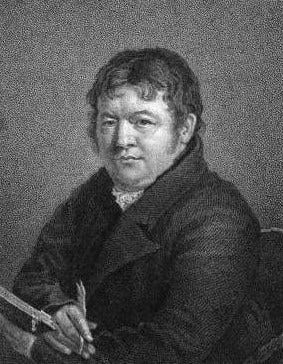
In 1813, Particular Baptists would form the Baptist Union in Great Britain. Nineteen years later in 1832, the New Connexion of General Baptists, associated with Dan Taylor (1738–1816), was permitted entry into the Union, reforging it into a union of Baptists, which fully occurred in 1891. What lay behind this impetus on unity? One name comes to the front, Joseph Ivimey, an energetic and visionary particular Baptist. As an incredibly important work of Irenicism, I have reprinted it below for wider viewership.
[234]
Union essential to Prosperity.
The advantages of union in promoting the accomplishment of important objects requires no proof. Two are better than one, and a threefold cord is not quickly broken. While the Church of Christ is united, there is no danger of its being injured; but if its members are divided they presently become an easy prey to those who lie in wait to deceive. There is abundant proof that flourishing Churches and Kingdoms have been destroyed by their own dissensions. When Jerusalem was besieged by Titus Vespasian, all his battering-rams, and engines of war did not so much harass and distress the Jews, as the animosities which prevailed among the fiery zealots within their walls. It is said of Julian the Apostate, who treated the christian religion with the greatest spite and malignity, that he considered the most effectual way to prevent the spread of the gospel, was to keep up the divisions between the Catholics and the Donatists. We know who has said, A house divided against itself is brought to desolation. and A kingdom divided against itself cannot stand.
It is our happiness to live at a time when there is a greater degree of union manifested amongst christians than at any former period. The establishment of Bible, Tract, and Missionary Societies, have tended greatly to promote this desirable object. Those who have attended the annual meetings of these institutions in London, have insensibly imbibed the spirit by which they are influenced, and have left the assemblies determined to unite with every christian, of any denomination, who possessed a kindred spirit, and who was disposed to attempt the amelioration of human misery, whatever form it may bear. By these meetings also a gradual accumulation of talents, of property, and of exertions have been drawn into unison with the parent Societies, by which the deficiencies made by death and otherwise, have been repaired; the zeal of their members has been increased; and their hopes have been so animated, that they have been individually resolved not to decline in their exertions, but with a cessation of ability or of life.
[235]
Feeling ardently desirous in common with all christians that these institutions may abundantly prosper, there is one society which has paramount claims to the attention of the denomination to which we belong. This is the Particular Baptist Missionary Society for propagating the gospel among the Heathen. An institution which has already done more towards uniting our denomination than any plan that was ever devised. “It has (said one of our judicious ministers well acquainted with its operations) passed like a magnet over our churches, and by powerfully attracting the particles of steel they contain, has brought them to a point, and united them into one object.”
This effect has been produced by the greatness of the design contemplated. An attempt to evangelize the millions of Asia by circulating the scriptures in the languages of the East, and by preaching amongst these Gentiles the unsearchable riches of Christ, must approve itself to the judgment and to the heart of every one who properly estimates the nature and design of the glorious gospel of the grace of God. What Christian can feel indifferent while he hears the song of Angels sung in these lands of misery? He imbibes its spirit and joins in the chorus, Glory to God in the highest, on earth peace, and good will towards men. What Christian can be unaffected while he beholds the triumphs of the cross, in turning men from darkness to light, and from the power of Satan unto God? What Christian can refrain from rejoicing when he hears that Idol Gods have been abolished! that their deluded votaries have consigned them to oblivion, and instead of paying their daily orisons to the Ganges, and their annual devotions to Juggernaut, that they are become disciples of Jesus; members of his church; and preachers of his gospel?
That a very considerable degree of unanimity prevails in our denomination on this subject is cheerfully admitted, and it is a cause for much gratitude to the God of Peace. But it is asked whether every mean has been adopted which is likely to increase and perpetuate it? Has all the benefit been obtained from this circumstance which it is calculated to produce? Does not the constitution of our churches which prevents all external interference, and therefore preserves them independent of each other, require some general bond of union? and in order to this, some mode of general association? The plan that has often been talked about, is now submitted, through the medium of their Magazine, to all the members of our churches, and particularly to the Ministers and Messengers of our Annual Associations, viz. That an Annual Assembly be held, either in
[236]
London, or at some of the larger, and most central towns in the Country; composed of the Ministers and Messengers from the neighbouring Churches, and of two deputies from every Association in the united kingdom. If at this meeting a report was to be made of the state of the Mission in India, and collections made after the Sermons, for its support, one valuable end would be answered; a spirit of zeal and benevolence would be thus diffused through all our churches. In addition to this, an account of the itinerant labours in our own country, through the medium of the Secretary of the Baptist Itinerant Society in London, may be made, and thus a spirit of emulation to visit our dark and benighted towns and villages may be excited. Many other things might be mentioned, such as perhaps a fund for the support of our Seminaries, and the relief of our aged and necessitous ministers, &c. &c.
Such an Assembly in the year 1689, and till 1693, met in London, and in the last year at Bristol. And it is likely, had such an institution then existed as the Baptist Missionary Society, to absorb their attention in a regard to the interest of the Church of Christ in general, rather than to the particular concerns of a denomination, it might have continued, a great blessing to our churches and to the world. What is the cause that while the Methodists have their “Annual Conference;” the Quakers their “Yearly Meeting;” and those who compose the Missionary Society, their Annual Assembly in London, that the Baptists have no General Meeting of any description? Why should we be so far behind other denominations in plans to promote the union, the peace, and prosperity of the Church of Christ? Some of our friends object to bustle and parade, and point to the quiet and persevering zeal of the Moravians as our example. But the case is not in point. The Moravians have their Septennial Synods, and numerous plans to keep them a compact body, they are like a company of horses in Pharaoh’s chariots; and to this principally, under a divine blessing, are their great attempts, and eminent successes in the conversion of the heathen to be attributed. O! that we, like them may adopt and maintain the honourable appellation of the United Brethren. And may he who has all hearts in his hand, and with whom is the residue of the Spirit, so water our churches with the influences of his grace, that the Fruits of the Spirit may be abundantly produced in every congregation. Then, there can be no doubt, but a plan will be soon matured among the Ministers and Messengers in our Country Associations, in connection with those of the London “Monthly-meeting,” by
[237]
which a General Assembly may be convened to assemble in the summer of 1812. Thus shall we attend to the exhortation of the Apostle, Rom. xiv, 19. Let us therefore follow after the things which make for Peace, and things wherewith one may edify another.
IOTA.
Source: Joseph Ivimey, “Union essential to Prosperity,” The Baptist Magazine 3 (1811): 234–7.
History: https://www.baptist.org.uk/Publisher/File.aspx?ID=151602 and
