



All Christians must pass through the archway of the Sermon on the Mount. But as history shows, there are many ways to approach these gates. In this article, then, I want to lay out what I understand to be a traditional pathway to the Sermon, so that readers might see Jesus’s words as summoning us upon his Way (John 14:6) as followers of the way (Acts 9:2).
My argument is simple: the Sermon on the Mount is the constitution for the Christian life, the way in which we follow Christ along the Way. While simple, I believe the implications for this view are staggering once realized. So, before we ascend the Mount with Jesus, I would like to first explain what I do not mean by my argument concerning the Sermon.
Way 1: A Righteousness Impossible to Reach
First, some argue that the Sermon on the Mount points to a righteousness that is impossible to achieve, which draws us to the Gospel where God justifies us by faith. Evidence for this view is the high standard of teaching that Jesus gives and passages like, “You therefore must be perfect, as your heavenly Father is perfect” (Matt 5:48). Historically, this view is often associated with Martin Luther, albeit he had considerable nuance here through his two-kingdom approach to the passage.
In my judgment, this position rightly identifies an effect of the Sermon, namely, to draw us to Christ who saves us by faith. But it wrongly identifies the intent of the Sermon. Part of this has to do with a linguistic complication over the word “perfect.” We often use the word perfect today to mean moral perfection, but the English term translates teleios, which has more to do with completion or fullness.
Further complicating the picture is the English rendering of the word makarios as “blessed” in the Beatitudes. The English word “blessed” translates two distinct Greek terms eulogetos and makarios, the latter being what Jesus uses in the Beatitudes. The first usually refers to God (or someone) blessing another in concrete ways. God blesses us with sunshine, harvest, and cheer. The second (makarios) refers to the quality or state of someone—they are blesséd (not merely blessed by God with sunshine).
So the way to perfection in the Sermon comes by way of being makarios, blesséd, or as I like to translate it, happy. To be happy in this sense has little to do with feelings since Jesus quite readily speaks about being happy when people revile us (Matt 5:11). That surely would not feel good, but it would be good because we would be reviled for righteousness and Jesus’ sake (Matt 5:10, 11).
Way 2: The Ethics of the Kingdom
Second, some argue that the ethics of the Sermon belong to the kingdom, a kingdom that has not yet come. The idea here is that Jesus teaches how we will live in the eschaton in the present. It is a sort of idealism now, but reality in the future. Others locate the presence of the kingdom in us as the community of Jesus. Both views obviously draw upon Jesus’s frequent refrain “the kingdom of heaven” (e.g., Matt 5:3, 10).
As to the first sub-view, I see no reason why Jesus’s ethics here must be in the future rather than now. Even if they were pointing towards the future kingdom, why would we not live in present as we will in the future? Further, Jesus only promises that we will receive the kingdom (Matt 5:3, 10), and so we might say that the ethics presuppose a hopeful reward. In fact, Jesus says as much, “your reward is great in heaven” (Matt 5:12).
As to the kingdom ethics view in the present, I basically agree. However, twentieth-century presentations of kingdom ethics have sometimes abstracted Jesus’s teaching on the Sermon from both natural law and other places in Scripture (e.g., Paul). I see continuity in what Jesus teaches here with Paul, natural law, and the kingdom of heaven.
Further, sometimes this view tips into a strange solipsism whereby Jesus’s ethics here are absolute values that must be obeyed as duty or obligation for followers of the Way. But I do not think Jesus here is merely giving law casuistry, but rather that the Evangelical Law of Jesus comes by way of wisdom because Jesus uses language and arguments appropriate to a sage, not a legislator of detailed casuistry.
This, I think, is clear when he chooses to use words like happy (makarios) or perfect (teleios) which are at home in sapential teaching. Further, in Matthew’s Gospel, Jesus teaches in parables and sayings which are, again, appropriate for the sage. Actually, the genre of Matthew (and the Four Gospels) is bios, a common genre of writing for wisdom teachers in the ancient world.
Jonathan Pennington explains, “This habit of bios writing was firmly established by the time of Jesus and had proven to be a very efficient and effective way to present a philosopher’s teaching, manner of life, and, especially important, the way in which the person died with dignity” (Jesus the Great Philosopher, 18). The genre of the Gospel Books thus lends itself to seeing Jesus as a teacher of wisdom and truth, not as a writer of casuistry.
Way 3: The Way of the Some
Third, some associate the Sermon with individuals, the church, or some smaller set of people. The idea here is that Jesus’s kingdom is not of this world (John 18:36). So the kingdom does not pertain to political orders. And something here is surely correct since Paul clearly says that the magistrate “is the servant of God, an avenger who carries out God’s wrath on the wrongdoer” (Rom 13:4). So God, according to Paul, authorizes authorities to use the sword to execute God’s vengeance, but the Sermon tells us to turn the other cheek (Matt 5:38).
This duality created a complication for many early Christians. Many Christians saw the Sermon on the Mount’s call to non-vengeance as central to Christian morality. For the most part, this meant, for example, that governors were not usually allowed to become bishops because of the “sword.” Hence, Ambrose of Milan’s (339–397) transition from governor to bishop was an awkward one. It is worth noting that in the ancient Roman world, governors were expected to quell revolt by first torturing, then finding the truth. This level of violence from governing authorities therefore exceeded what we might expect of a magistrate today.
Further, the Sermon on the Mount’s morality also challenged Christians to think about military service. Could a Christian serve as a soldier? At least early on, Christians found military service a difficult task because it required killing and usually idolatry, but Jesus quite straightforwardly summons people to turn the other cheek and calls Christians to worship God alone. So Tertullian famously in De Corona argued that it is not meet for a Christian to serve in the military (§11).
However, Christians did not agree on a pacifist consensus, and the question of military service at least had more to do with idolatry than non-violence per se. So we might say that the Sermon on the Mount’s call to nonviolence created a tension, but one that Christians eventually worked out through the process of practical wisdom. Christians could indeed be magistrates, but in that office, they must act as Christians; and the same would be true of soldiers.
For the most part, I find this arrangement to be workable because, again, the Sermon on the Mount as the Evangelical Law (more on that below) calls us to practical wisdom since biblical law, in general, is sapiential. That is what makes it worthy of meditation (e.g., Ps 1:2). If it were simply a list of rules of casuistry, then there would be no need to meditate on it once someone had mastered the content of the legislation. Jesus, like Moses before him, is a sage, a law-giver whose words engender meditative reflection (Josh 1:8).
Each of the above patterns of reading the Sermon on the Mount carries obvious truths, but I think each does not tell the whole story. For that reason, I would like to propose that the Sermon on the Mount is a constitution for the Christian life, an Evangelical Law, exteriorly given in the Gospel but interiorly written on the heart by the Spirit; a law spoken by Christ but more inward and joy-inducing than any merely external law could be.
Way 4: The Way of the Sage
Fourth, many—if not most—Christians have read the Sermon on the Mount as a constitution for the Christian life. The Sermon itself and Jesus’s teachings in general present him as a teacher of righteousness, a giver of wisdom and truth. He tells parables, speaks in aphorisms, invites hearers to contemplate his meaning, and seeks to speak truth.
The language of the Sermon itself also lends itself to this conclusion. Jesus summons hearers to a narrow way of righteousness (Matt 7:13–14). He opens by pointing to a life that can be characterized as happy, a makarios life. First-century hearers could not have missed the resonances with moral and sapiential teaching that was then current. The Lord calls people to righteousness (“the good”) and calls us to become perfect or complete (Matt 5:48).
All of this is in the context of a pursuit of truth, for Christ is truth (John 14:6). And the kingdom of heaven belongs to those who walk the way of Jesus, who is the Way. In short, this way of reading the Sermon includes aspects of the above three but sees Jesus as a sage who teaches us how to live the righteous and happy life, one characterized by virtue that leads to flourishing.
In the Gospel of Matthew, this sermon is set in contrast to Jesus’s final public teaching in Matthew 23:13–31 (so K. C. Hanson, How Honorable! How Shameful!, 102). As Hanson notes, “the makarisms in Matthew 5 and reproaches in 23 form an inclusio on Jesus’s public ministry” (102).
This structure in Matthew’s Gospel suggests a sapential reading of the Sermon because Jesus’s first major teaching and his last public teaching seem to parallel one another:
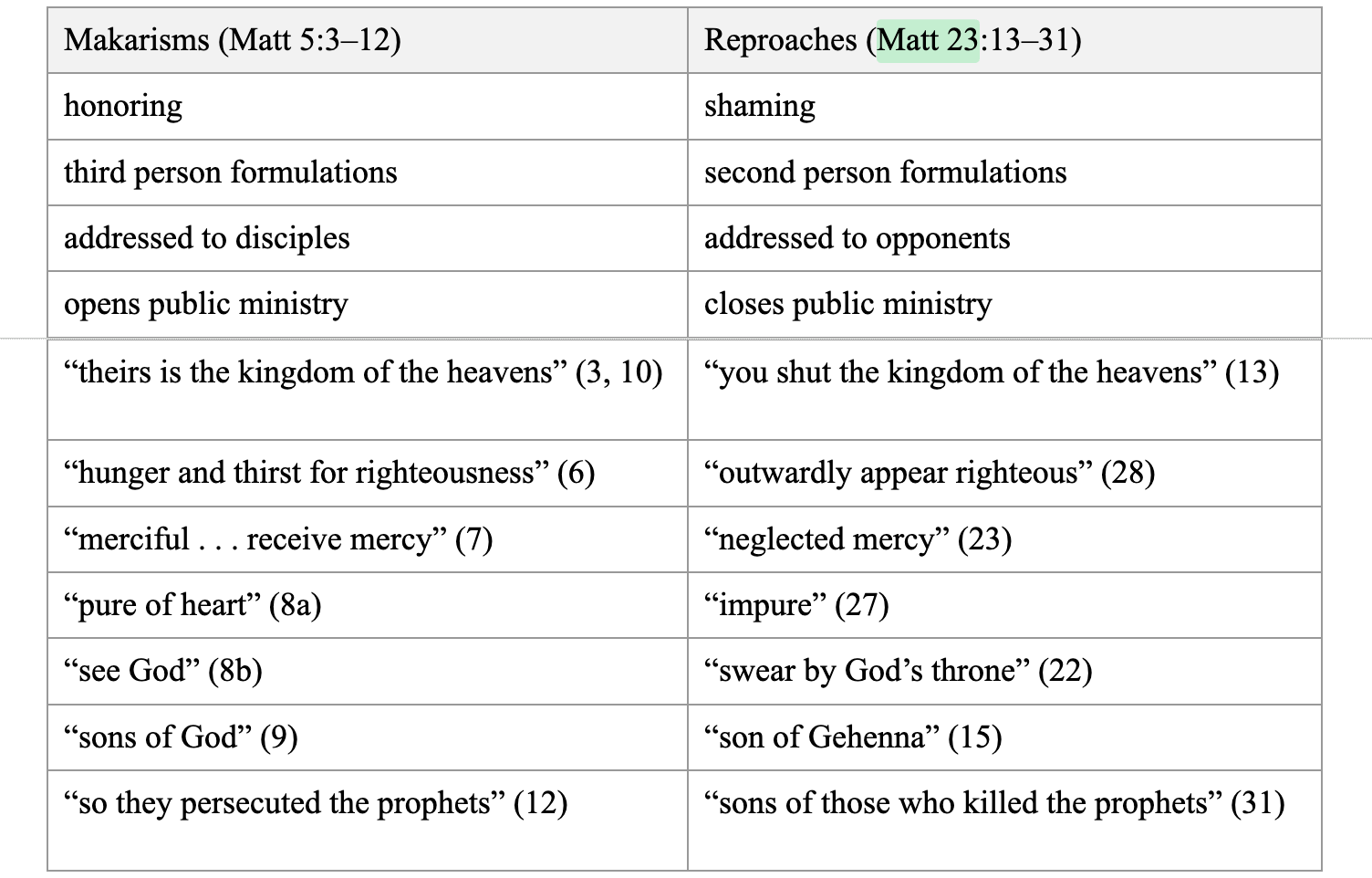
Adapted from K. C. Hanson, How Honorable! How Shameful!, 102.
Thus, we have two ways of life contrasted, a way of righteousness that is inward and true and the appearance of righteousness, which is outward and false. One way of life hungers and thirsts for righteousness, while the other does not. Seeing God is the destiny of the first; Gehenna the second.
I believe the textual evidence points us towards this way of reading the Sermon on the Mount. Jesus teaches us how to live the happy life, a life that constitutes our moral pathway as Christians. To make sense of this, the following discusses certain key concepts that Jesus and Christian theology use to help us read the Sermon along the path of human flourishing.
Happy (Makarios)
The Beatitudes are so titled because of the Latin term beatus or beatitudo, which means happy or perhaps fortunate. By contrast, benedictio often refers to blessing in Latin. So these are two different words in Latin: one means happy and the other means blessing.
All of this follows a translation tradition at least as old as Jerome (347–420), who translated the New Testament into Latin from Greek. Jerome translated the Greek word makarios with the Latin term beatus. And he generally translated the Greek word for blessing, eulogeo, with some form of benedico. In other words, happy and blessed are two different terms in both Greek and Latin. The same is true in Hebrew where happy can translated the word ashre while blessed usually translates some form of the Hebrew word brk. These Hebrew words map unto their Greek (near) equivalents: ashre/makarios and brk/eulogeo.
The problem is that in English, we conflate the two. We use the word blessed to translate two different words in Greek (makarios and eulogeo). So we struggle to know just what Jesus means in the Beatitudes due to this quirk of the English language. Obviously, makarios and eulogeo overlap in a lot of ways, as do their Hebrew equivalents. In fact, Jeremiah can use the word “to bless” (brk) in ways that approximate the asheristic passages like Psalm 1 (e.g., Jer 17:7). Yet the distinction still matters because one word (makarios/ashre) more readily describes the quality of a person, while the other (eulogeo/brk), when used of God and his people, speaks of covenantal blessings.
It is also worth noting that in the Beatitudes, Jesus uses a common form of a Beatitude from the Old Testament. For example, In Psalm 1, the psalmist uses the form ashre, not brk when he says, “Happy [ashre] is the man who … ” (Ps 1:1). Jesus translates this form of ashre with makarios, which is how the Septuagint (an ancient Greek translation of Ps 1) translates ashre.
In Hebrew, ashre generally refers to the state or condition of one who can be called ashre, while brk has a much broader use, including being part of the covenant blessings of God for rain, crops, and so on.
So Jesus by his word choice clearly follows a traditional pattern of thinking in the Hebrew Bible, familiar to those who heard it read in the synagogue. He also would make sense to a Greco-Roman audience who likewise used the word makarios to describe the quality or character of a person, a near parallel to Ancient aspiration of eudaimonia, flourishing.
All that to say, Jesus begins his Beatitudes by introducing the idea of happiness, flourishing, being the kind of person whose quality of life can be called happy. Remember: happy here is not primarily the emotion of elation, but rather a life characterized by virtue: being poor in spirit, meek, hungering and thirsting after righteousness, merciful, pure of heart, and peacemakers. Divine favour is not absent, however, but is precisely the point. Hence, those who are discouraged will receive encouragement (Matt 5:4).
And in this context, the word encouragement matters because Jesus is not giving us a rigorous law-code, but rather speaks to the heart, to someone who inwardly desires the kingdom and thus encouragement is how Christians ideally exhort one another to love and good works (e.g., Rom 12–15).
Perfect (Teleios)
When Jesus says, “You therefore must be perfect, as your heavenly Father is perfect” (Matt 5:48), we intuitively think he means moral perfection as in we have to follow every rule without fail. And if that is the standard, then nobody could ever attain what Jesus commands in this Sermon.
But the word Jesus uses, teleios, and the way he uses it tells another story. First, the word itself does not mean perfection as in dotting every i or mathematical precision. More generally, it speaks of something reaching completion, maturation. “In the Septuagint all the instances of teleios mean ‘unblemished, undivided, complete, whole’” (Pennington, The Sermon on the Mount and Human Flourishing, 76).
For example, the ashre psalm, Psalm 1, describes the happy man as a tree that slowly grows and brings out its fruit at the right time: “He is like a tree planted by streams of water that yields its fruit in its season, and its leaf does not wither. In all that he does, he prospers” (Ps 1:3). That is the perfect and happy human being. The happy human is like a tree that completes its course, bearing fruit in due season.
That I think describes the happy person beautifully. The kind of person who is happy is like a tree nourished by the waters of the Spirit, who grows little by little and bears the fruit of the Spirit.
A little later in the sermon, Jesus says: “You will recognize them by their fruits. … every healthy tree bears good fruit, but the diseased tree bears bad fruit. A healthy tree cannot bear bad fruit, nor can a diseased tree bear good fruit” (Matt 7:16–18). Here, we learn the difference between the blessed one and the wolf (Matt 7:15); the former is a good tree, and this inward health produces good fruit; the wolf is a sick tree, inwardly diseased, and thus produces bad fruit.
“Are grapes gathered from thornbushes, or figs from thistles?” (Matt 7:16), asks Jesus. And the answer is, of course, no. Only a good tree produces grapes. This word-picture shows us the character and quality of the blessed or happy person. They grow slowly like a tree, nourished by years of water, and thus in due season produce good fruit (also John 15:1–11).
Evangelical Law
If the happy person grows by the waters of the Spirit like a tree, then what role does law play? After all, Jesus says, “Do not think that I have come to abolish the Law or the Prophets; I have not come to abolish them but to fulfill them…. For I tell you, unless your righteousness exceeds that of the scribes and Pharisees, you will never enter the kingdom of heaven” (Matt 5:17, 20).
Jesus thus fulfills the Law and exhorts us towards righteousness, something that the happy person hungers and thirsts for (Matt 5:6). His words further advance the Ten Commandments by pointing out how we must not merely avoid adultery but also lust; not merely avoid murder but also hatred. The Ten Commandments themselves implied an interiority since the tenth commandment forbids desiring what we ought not to desire (Exod 20:17).
But Jesus interiorizes the Law. Yes, he teaches exteriorly with words, but the point of his law is to enter into the heart. And this leads to joy: “rejoice and be glad” (Matt 5:12). As Jeremiah 31:33 promises in the new covenant, “I will put my law within them, and I will write it on their hearts” (repeated in Heb 8:10). And it is this covenant and law that Jesus gives.
Thomas Aquinas will speak of this new law upon the heart as being of grace and particularly constituted in the Holy Spirit: “the New Law is chiefly the grace itself of the Holy Spirit, which is given to those who believe in Christ” (ST I–II, Q106.A1). In evidence, he cites passages like Romans 8:2, “For the law of the Spirit of life has set you free in Christ Jesus.” This Evangelical or Gospel Law amounts to the gift (grace) of the Spirit, given to us, who writes God’s law unto our hearts.
And remember the register we are using for law: law not as a mathematical formula of rights and wrongs but as a way of wisdom. The grace of the Spirit infuses our hearts in the form of love (Rom 5:5), so that we might love God and neighbour as ourselves, thus fulfilling the Law (Rom 13:8). This inward change whereby the Living Waters nourish us leads us to manifest the fruit of the Spirit, which results in the kind of life called happy, makarios.
But Isn’t This Legalism?
I have argued that whatever Jesus says in the Sermon on the Mount constitutes the Christian life, internalized by the Spirit who writes this Evangelical Law upon our hearts so that we might grow into a good tree. That is what a happy person is, according to Jesus. We can thus obey Jesus fully, and be called perfect—complete, whole.
We indeed must exceed the righteousness of the Scribes and Pharisees to receive the kingdom of heaven (Matt 5:20). Now, I have often heard that this command demonstrates how impossible it is to be righteous as Jesus commands us to be.
But are we reading the same Bible?
The scribes and Pharisees throughout Scripture are presented as outwardly but not inwardly righteous. Of the scribes and pharisees, Jesus says, “you also outwardly appear righteous to others, but within you are full of hypocrisy and lawlessness” (Matt 23:28).
Following this connection to Matthew 23, Augustine comments that “the justice of those who say and do is greater than that of the Scribes and the Pharisees. In fact, in another passage, the Lord Himself makes the following remark about the Scribes and Pharisees: ‘For they talk but do nothing’” (Augustine, Two Books of Retractions 1.18.4). In other words, according to Augustine, the Scribes and Pharisees are hearers but not doers of the word.
So it seems quite clear to me that Jesus tells us to exceed the righteousness of the Pharisees by not being outwardly righteous in appearance but rather by inwardly having the Evangelical Law written upon our hearts by the grace of the Spirit.
So nothing here implies legalism or that God does not save us by grace through faith, but Jesus rather explains what it looks like to be saved, to be walking on his way of Life. It is the constitution of the Christian life.
Freedom for Excellence, not Freedom of Indifference
We here need to slow down for a moment to ask a bigger philosophical question, a question that determines how we understand Jesus’s commands. That question has to do with how we understand the relationship between freedom and law.
To begin with, Servais Pinckaers insightfully contrasts two kinds of freedoms, which have implications for what it means to obey laws. The first is the freedom for excellence, which means that we naturally desire what is good and thus any true laws help us to attain what we genuinely desire. The second kind of freedom is the ability to choose between contraries (right or left, blue or green, etc.).
Now most everyone thought about freedom in the first way until the middle of the last millennium. So that meant freedom involved bringing one’s natural desires to completion, to perfection (teleios). Hence, Jesus says, “everyone who sins is a slave to sin” (John 8:34). Sin itself is slavery; righteousness is freedom, the freedom to fulfill our natural desires. In this case, freedom means freedom for excellence, to be happy, perfect, and thus righteous. So, an external law would be just when it matched one’s internal desire for righteousness and could be viewed as an educator or pedagogue. In Paul’s language, “the law was our [educator] until Christ came” (Gal 3:24).
External laws that are just correspond to our natural inclinations, and so our wills follow from our natural desire for the good. Freedom meant freedom from ignorance and sin, towards knowledge of what is good and the ability to carry it out. In short, freedom meant righteousness.
During the Middle Ages, other ways of thinking about freedom became popular. Philosophers such as William of Ockham began to speak of freedom as one of indifference, of being able to choose between contraries. Thus, people began to think of the will as primary, as prior to our natural inclinations towards the good. And divine law was increasingly seen as an arbitrary set of rules given by God that our will must obey.
Eventually, philosophers like Immanuel Kant would speak of morality as a categorical imperative: we do what is right, apart from any motivation beyond its rightness. This absolute morality did not attach itself to our natural inclination towards the good, which law itself aids, so that we might gain what we naturally desire but sin prevents us from seeing or willing righteously. Instead, we choose between contraries based on conscience or some absolute standard.
So these two ways of seeing freedom transform our moral imagination. And depending on one’s starting point, it also changes what might seem obvious in the Sermon on the Mount.
If we take the classic conception of freedom for excellence, we can see quite readily that Jesus summons us to happiness, to fulfill our natural desire for the good. On the other hand, if we assume a freedom of indifference, we might more readily see Jesus talking about rules, of dos and do nots. We might be ready to see Jesus calling us to exceed the righteousness of the scribes and Pharisees as about doing more right things than they do.
However, as argued above, Jesus more readily fits the paradigm of freedom for excellence, and this is how Christians, as far as I can discern, had read the Sermon on the Mount until the late Middle Ages. To see this, we can turn to Augustine’s reading of the Sermon on the Mount as a representative example.
The Constitution of The Christian Life
Augustine will say, “If anyone piously and earnestly ponders the Discourse which Our Lord Jesus Christ delivered on the Mount—as we read in the Gospel according to Matthew—I believe that he will find therein, with regard to good morals, the perfect standard of the Christian life” (Augustine, Our Lord’s Sermon on the Mount bk 1, ch 1).
And this perfect standard is not one of specific legislation, but of perfect wisdom. Thus, when speaking about the peacemakers who are blessed, Augustine writes, “This is the life of a man of consummate and perfect wisdom. The prince of this world, who rules over the perverse and disorderly, has been cast out of a thoroughly pacified and orderly kingdom of this kind” (Matt 5:9). Here, Augustine sees the blessed or happy person as one whose life is characterized by “consummate and perfect wisdom.”
Indeed, each beatitude Augustine sees as a gradation that ends in a life of moral perfection or completion (Sermon, bk 1, ch 3).
And hence, when Jesus says one must exceed the righteousness of the scribes and pharisees to receive the kingdom of heaven, Augustine simply agrees: “This means that you shall not enter the kingdom of heaven unless you fulfill not only those least commandments of the Law—which are merely rudimentary prescriptions with regard to a man’s moral development—but also those which will be added by Me; for I have come, not to destroy the Law, but to fulfill it” (Sermon, Bk 1, ch 9).
For example, Augustine contrasts the rudimentary prescriptions of the Pharisees with Jesus’s additions: “The justice of the Pharisees is that they shall not kill; the justice of those who are to enter the kingdom of God is that they shall not become angry without cause. Not to kill is, therefore, the least commandment, and whoever breaks it will be called least in the kingdom of heaven” (Sermon, Bk 1, ch 9).
As to Jesus’s command to be perfect as God is, Augustine simply says, “This is to be understood in the sense that God is perfect as God, and that a soul should be perfect as a soul” (Sermon, Bk 1, ch 21). It is obvious to him that a perfect soul is one who has climbed the gradation of perfection as enumerated in the Beatitudes, and this alone happens when God gives us the gift of God’s love (i.e., the Spirit).
The Archway into the Christian Life
I believe we misread the Sermon on the Mount when we think of it primarily as giving obligations that we must do or as an impossible standard that we cannot reach. Both readings of the text have elements of truth in them, but they only tell a partial story and miss the message that Jesus aims to tell us.
My view of the Sermon centres on the idea that Jesus calls us to a kind of life that leads to happiness. Further, I see the New Law that he gives as a sort of pedagogue or instructor for us as we increasingly internalize the Evangelical Law that the Spirit brings into our hearts. The written words of Jesus guide us so that we might become pure in heart and thus see God (Matt 5:8).
In my view, then, I see the Sermon on the Mount as not only the archway into the ethical life but also the constitution for the Christian’s life in Christ. Or in Augustine’s language, it is “the perfect standard of the Christian life.”
The goal of happiness both matches our creational desires and the gracious end of knowing and enjoying God for which we were made. God created us to desire Him, to be perfect or complete in the knowledge of him. So when we pursue good things in this life, we pursue the good things of God.
Sin interposes itself between us and goodness by introducing the ignorance of darkness into our minds and by twisting our desires, so that we find ourselves doing evil. Such evil amounts to sin against God and nature, the latter being the way God created us to flourish and, in this sense, it is also against God.
When Jesus says “Blessed are those who hunger and thirst for righteousness” (Matt 5:6), he is not speaking against nature; rather, he is telling us what we were made for. That is why, when we put on the new self, Paul can say we are “created after the likeness of God in true righteousness and holiness” (Eph 4:24). Sin meant we lost this original righteousness, but we still desire it because that is what we were made for.
Why then do we desire goodness? The answer is obvious; it is because everyone desires happiness, and the only way we can find lasting happiness is to hunger and thirst for something that can satisfy us: “Blessed are those who hunger and thirst for righteousness, for they shall be satisfied” (Matt 5:6). And God alone can ultimately satisfy: “Blessed are the pure in heart, for they shall see God” (Matt 5:8).
This satisfaction and vision of God result in joy, despite our circumstances: “Rejoice and be glad, for your reward is great in heaven, for so they persecuted the prophets who were before you” (Matt 5:12). In other words, the happy life that Jesus commends to us has its end in God and his righteousness (or kingdom); and it results in joy, a joy that is indefatigable because it does not rely on bodily health, peace, or prosperity. It relies instead on poverty of spirit: “Blessed are the poor in spirit, for theirs is the kingdom of heaven” (Matt 5:3).
Blessed or Happy are the poor in spirit because God will satisfy their natural hunger and thirst for righteousness and thus usher them into joy, even while persecuted. So Augustine will write, “And this is the happy life, to rejoice unto Thee, from Thee, on account of Thee: this it is and there is none other” (Confessions, 10.22.32).
This is why the deceit of sin or unrighteousness is so profoundly anti-human. We think we shall be satisfied by lust, hatred, accumulating wealth, and external religion, but they twist our original desires for the good by inserting deficient, evil, and twisted desires that both offend God and also mar our nature, making us unhappy and joyless.
Jesus by contrast summons us to walk the narrow path of life, so that we might become good trees, allowing the sap of the grace of the Spirit to slowly bring health to our limbs. We enter into the joy of our salvation; we rejoice always; we give thanks in all situations. For our happiness relies not on bodily health and wealth but upon the treasure that waits for us in heaven.
And here I must make a polemical point. I disagree with any moral argument that says we must desire good things without motivation, with a pure desire to do the right thing. Really? Does not the structure of the Beatitudes tell us we do good precisely because what is good is good for us? Does not Jesus tell us our “reward is great in heaven” (Matt 5:12)?
The idea that we must do categorical good apart from any motivation for reward is anti-human, against nature and foreign to God’s ordering of the world. God made us naturally to desire goodness, ultimately Himself, so that we, knowing him, might become happy and full of joy. I am here not advocating for hedonism, but only that we must pursue God and his gifts to fulfill our natural desire, a desire that God himself placed in our souls.
The Spirit infuses God’s love into our hearts, our inner selves (Rom 5:5), so that we desire (in the mode of love) God and his good creation. “For everything created by God is good, and nothing is to be rejected if it is received with thanksgiving” (1 Tim 4:4). So I love God’s created world, and I love the Creator of this world. The duplex love of God and neighbour requires us to be lovers of life (Matt 22:37–40).
And hence, Jesus says, “You have heard that it was said, ‘You shall love your neighbor and hate your enemy.’ But I say to you, Love your enemies and pray for those who persecute you, so that you may be sons of your Father who is in heaven. For he makes his sun rise on the evil and on the good, and sends rain on the just and on the unjust. For if you love those who love you, what reward do you have? Do not even the tax collectors do the same?” (Matt 5:43–48)
So we must love for the reward of being sons of God, and yet this reward is the same thing as saying we will become happy or blessed and thus will rejoice and be glad.
Jesus as a teacher of wisdom gives us Evangelical Law in the Sermon on the Mount. As his Word comes to us, the Spirit works inside of us to transform our heart of stone into a heart of flesh. Slowly then we grow like a tree, nourished by living water, so that we bloom Spiritual fruit in due season.
The various commands of Jesus against lust, hatred, greed, and so on correspond to our natural desires that sin so often suppresses; but fidelity in marriage, love of all, and treasures in heaven satisfy our truest longings for God and his goodness. All other perceived goods fall short, leading us to misery. We would not be happy. But like the hypocrites, we should expect to hear the woes of Jesus rather than the makarisms of our Redeemer.
Thank you for this. It's a truly encouraging reading of what has been turned into a burdensome passage.
Question: Do you see "joy" as falling under the same "non-emotional" (or at least, not primarily emotional) category as blessedness? Is it proper, based on the way the words are used, to view them as overlapping?
Excellent summary.
Is anyone aware of any catechetical resource that uses the Apostles Creed, Lord's Prayer and the Beautitudes (instead of 10 Commandments) as a teaching structure?