


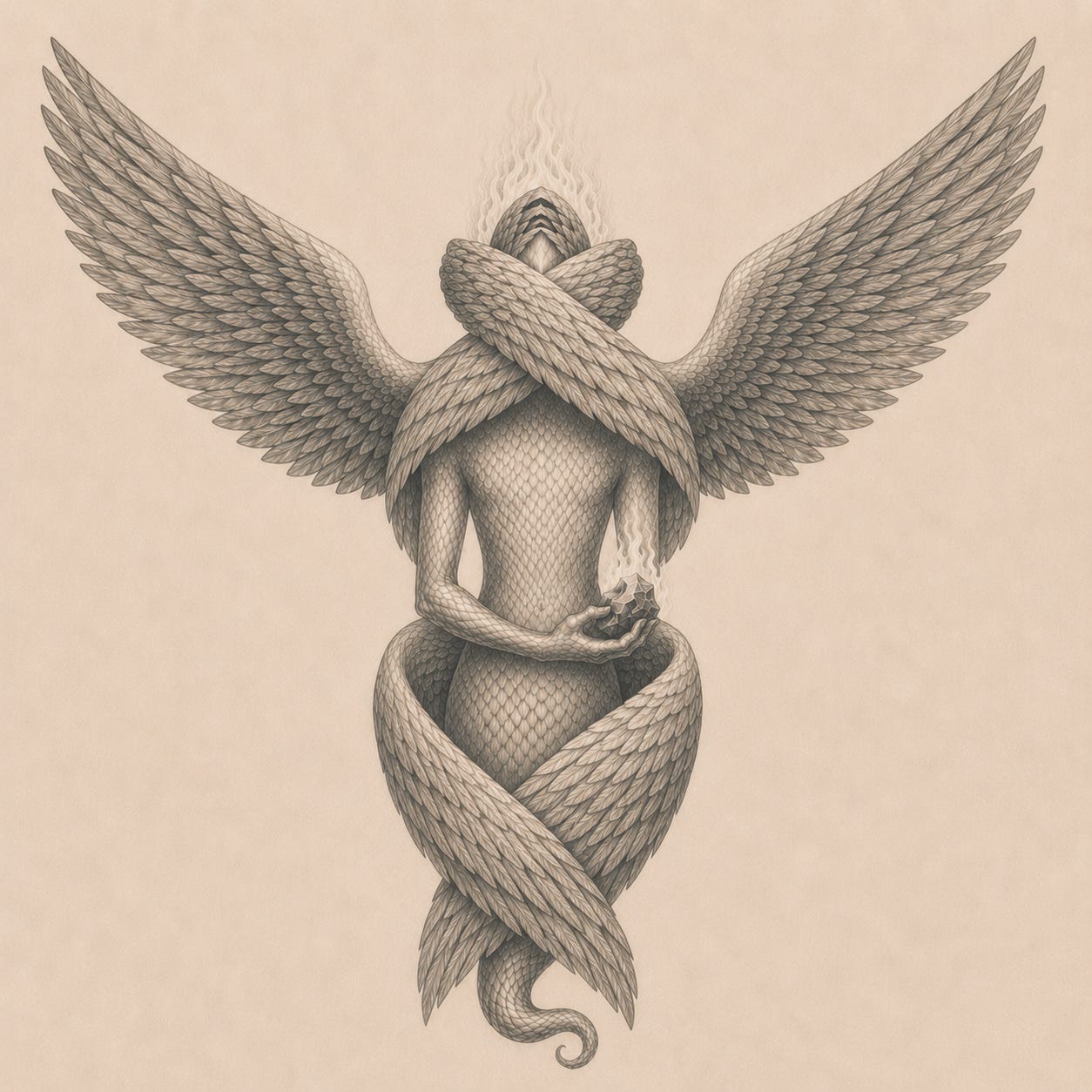
The word saraph, as in Seraphim, appears seven times in the Hebrew Bible. Three times in the Pentateuch (Numbers 21:6, 8; Deuteronomy 8:15) to describe fiery (saraph) serpents who bite. Four times in Isaiah. Twice they are flying creatures, born of a snake (Isaiah 14:29; 30:6). And twice as Seraphim around Yahweh’s throne in Isaiah 6 (vv. 2, 6).
In this article, the question I am curious about is: what are the seraphim in Isaiah 6? If every other occurrence in the Bible presents seraphim as fiery (and flying) serpents, then should we expect the seraphim in Isaiah 6 to also be serpentine?
For the rest of this article, then, I want to explore the biblical descriptions of seraphim to see if we might be able to understand what they looked like.
Saraph
The word saraph occurs only seven times in the Hebrew Bible. Its verbal form means “to burn,” which regularly appears as a verb in the Hebrew Bible. The noun saraph, as noted, only appears seven times in the Bible.
Its first three instances appear in the Pentateuch and describe saraph-serpents who venomously bite Israelites in the wilderness (Num 21:6, 8; Deut 8:15). Likely, the venomous bite felt like “fire” and hence the name saraph to describe these serpents. The other four uses occur in Isaiah and refer to heavenly beings (Isa 6:2, 6) and flying serpentine saraphs (Isa 14:29; 30:6).
The following will analyze all these passages.
Numbers 21:6–9
In Numbers 21, Israel complains in the wilderness. So God sends (fiery) serpents to the camp. After their affliction, the Israelites call out to God. God responds by instructing them to build a bronze serpent statue that will heal them.
The key verses are found in Numbers 21:6–9:
“Then the LORD sent fiery serpents [הַנְּחָשִׁ֣ים הַשְּׂרָפִ֔ים] among the people, and they bit the people, so that many people of Israel died. 7 And the people came to Moses and said, “We have sinned, for we have spoken against the Lord and against you. Pray to the Lord, that he take away the serpents [הַנָּחָ֑שׁ] from us.” So Moses prayed for the people. 8 And the LORD said to Moses, “Make a fiery serpent [שָׂרָ֔ף] and set it on a pole, and everyone who is bitten, when he sees it, shall live.” 9 So Moses made a bronze serpent [נְחַ֣שׁ נְחֹ֔שֶׁת] and set it on a pole. And if a serpent [הַנָּחָשׁ֙] bit anyone, he would look at the bronze serpent [נְחַ֥שׁ הַנְּחֹ֖שֶׁת] and live.”
The word saraph is used twice: first in verse 6 in which they are described as “fiery serpents,” and second in verse 8 where God commands Moses to make a saraph. Around the term saraph, the text uses serpent as a short form to describe the saraph serpent as well (21:7, 9). Afterward, when God tells Moses to make a saraph, the text calls it “bronze serpent” twice (21:9).
In other words, the text clearly uses the word saraph to describe the kind of serpent these are. They are fiery serpents, a term which probably refers to the venomous bite of the serpents which felt like heat or fire. Moses remembers these seraphim in Deuteronomy 8:15 as part of the terrors of the wilderness. But the key point is that God sent these seraphim in Numbers 21 as judgment against Israel for their sins. They are executors of God’s wrath.
2 Kings 18:4
In 2 Kings 18, King Hezekiah reforms Israel’s worship. In particular, the bronze serpent that Moses had made in Numbers 21 had become an object of cultic worship. Apparently, the bronze serpent took the name Nehushtan and Israelites offered sacrifices to it, likely to seek protection from harm (an apotropaic purpose).
According to 2 Kings 18:4, Hezekiah “broke in pieces the bronze serpent that Moses had made, for until those days the people of Israel had made offerings to it (it was called Nehushtan).” While the context does not guarantee it, Nehushtan was plausibly housed in the temple.
Its existence matters for Isaiah, since Isaiah wrote during the reigns of Uzziah, Jotham, Ahaz, and Hezekiah. So for virtually all of the book of Isaiah, the Nehushtan functioned as a cultic object in Jerusalem. And by way of reminder, the word saraph appears only in Isaiah outside of the Pentateuch. So it may be that Isaiah mentions the seraphim (which Numbers calls a saraph) partly because of Nehushtan’s presence.
Isaiah 14:29 & 30:6
The most well-known passage on saraphs is Isaiah 6, a vision in which Isaiah sees seraphim guarding the throne of God in a heavenly portrayal of the temple of God. But after this event, Isaiah mentions seraphim in two other places.
The first is Isaiah 14:29 in which God gives an oracle against Philistia: “Rejoice not, O Philistia, all of you, that the rod that struck you is broken, for from the serpent’s root will come forth an adder, and its fruit will be a flying fiery serpent [שָׂרָ֥ף מְעוֹפֵֽף].”
Here, Isaiah clearly identifies the saraph as the serpent’s fruit. Yet he adds one characteristic of the saraph that Numbers does not: it flies. The text speaks of God’s rod as broken but producing “a flying saraph” that will bring judgment.
The second use is in Isaiah 30:6 in which God gives an oracle against the wilderness between Israel and Egypt. Hence, it is likely meant to remind the Judahites of Israel’s former wandering in the wilderness. The text reads: “An oracle on the beasts of the Negeb. Through a land of trouble and anguish, from where come the lioness and the lion, the adder and the flying fiery serpent [וְשָׂרָ֣ף מְעוֹפֵ֔ף]” (Isa 30:6).
Again, the flying saraph is correlated with a serpent (“the adder”). And again, it is spoken of in the context of divine judgment. The seraphim in Numbers 21 also come from God, as executors of his justice.
Isaiah 6
In Isaiah 6, the prophet appears before God’s throne room in heaven. Here, he only sees the flowing robe of God but can and does see his guardians: the seraphim. The text does not describe how they look except for two features: they have hands and wings. We also learn that they can speak (Isa 6:3, 7). Hence, they are rational beings.
The main activity of the seraphim involves their proclamation of God’s holiness, and they also purify Isaiah by burning his lips with fiery coal (Isa 6:6–7).
Because they have wings, they fly above Yahweh (Isa 6:2). Interestingly, on the Ark of the Covenant, the winged creatures either face each other or forward. So winged seraphim here appear in slightly different locations than the physical manifestations in the earthly tabernacle and temple.
A fascinating feature of their wings further challenges our expectations. According to Isaiah 6:2: “Each had six wings: with two he covered his face, and with two he covered his feet, and with two he flew.” Notice the wings cover up the seraphim; they do not spread over God. That may indicate that the seraphim protect themselves from God, not the other way around. We may consider that God’s holiness overwhelmed them (Isa 6:3). So they cover up their vulnerable areas: faces and feet, which “probably [is] a euphemism for the pubic region” (HALOT, 1185). They fly with the other two wings.
As noted, they also take burning coal and scorch the lips of Isaiah to purify him. After one of the seraphim does so, he says, “Behold, this has touched your lips; your guilt is taken away, and your sin atoned for.” If this vision happened bodily (not just spiritually), then we might imagine that the effect of Isaiah’s encounter with the fire of the seraphs left him burned, damaged, but guilt-free. God eliminates sin through the seraphim, executors of his justice.
Are they flying serpents?
The Seraphim thus execute God’s justice, fly, and promote his holiness. And elsewhere in Isaiah, the word saraph exclusively means flying serpent. Further, the Nehushtan, which God calls a saraph, during the timeline of Isaiah 6 (the reign of King Uzziah) likely existed in the temple precincts. And finally, the story of the fiery serpents in Numbers 21 shows that God uses them to execute justice just as he does in Isaiah.
This brings up the question of just how the seraphim look. The text tells us only that they have a hand (to bring the coal; Isa 6:6) and wings. So we are left to imagine just what they look like. My suggestion is that the Bible so far has exclusively used the word saraph to refer to fiery serpents or flying fiery serpents, and so it seems reasonable to think of the seraphim as serpentine creatures who execute God’s justice.
They can bring pain or forgiveness, like the seraphim bring pain or healing in Numbers 21. Their bites bring fire; but the vision of the saraph on the pole brings healing. Likewise, a saraph in Isaiah 6 brings both pain and forgiveness to Isaiah. So putting these pieces together, I think we can speculate as to their form.
Indeed, I am not sure we are speculating much; when all other occurrences of saraph in the Bible refer to fiery serpents; and all other uses in Isaiah refer to flying fiery serpents; and in Isaiah 6, we have a scene of flying seraphim who bring fire; then I feel as though we are sound in concluding: the seraphim are flying serpentine creatures of God who bring justice.
In a work of imaginative scholarship, Esther J. Hamori likewise describes the seraphim of Isaiah 6 as serpentine creatures:
“As in Isaiah’s other two references to winged seraphim, these creatures are serpentine. He doesn’t need to spell this out, since this is what seraphim already means, including in Isaiah’s own mentions of earthly winged snakes, as we’ve just seen. While the stories in Numbers and Deuteronomy use the double noun seraphim-snakes, Isaiah never does. In his oracles referring to the winged snakes of the desert, he simply calls each a “flying seraph.” These heavenly seraphim have bizarre additional features that he needs to describe, but their basic serpentine nature isn’t one of them, because that part’s a given” (God’s Monsters, 29–30).
In other words, she argues that their serpentine form is “a given” because all other uses in the Bible describe seraphim as fiery (and flying) serpents.
I tend to agree, but I must say this is only a tentative conclusion as I consider the various spiritual beings in the Bible. So it is at least fun to think that seraphim might be dragons!
If you are curious, I am also offering a fully online class on the Old Testament this Fall that you can audit by clicking the button below:
Or perhaps what we would call a dragon.
See the curse of the serpent about crawling on its belly (loss of legs).
So the unfallen may have both arms and legs and wings.
Or what would look like what we imagine a dragon to be.
Also, what do we make of all of this when Satan himself was a serpent/dragon, and serpentine imagery & descriptions seem so associated with evil and the enemies of God? Was he one of the seraphim before his fall?
And it’s interesting that Jesus said he saw Satan fall “like lightning,” which would perhaps coordinate with the fiery description.