


One skill, more than any other, unlocks the meaning of Job. It involves recognizing how later dialogues quote or allude to earlier dialogues and reject, modify, or affirm earlier claims. Once you see how important this is throughout Job, the whole book comes alive. The dialogues in Job are not mere abstract speeches, but they rely on each other organically; one develops the next, and the next responds to earlier dialogues. The quotations, allusions, and subtle references to prior arguments made by Job and his three friends take careful observation to discover; and yet once they are seen, we can never unsee them again.
Edward Greenstein explains, “Speakers relate to each other and often quote or paraphrase one another.”1 And he points out that we can sometimes see this in the switch of address from the singular to the plural, such as when a friend of Job’s uses plural nouns and verbs, which likely refers to Job’s speech since he alone speaks to the group (plural) while the friends speak to Job alone (in the singular). “Accordingly, a passage with a plural address within a discourse of one of the friends is almost certainly a quotation or paraphrase of Job.”2 For instance, Bildad in Job 18:2 paraphrases Job in 16:3 by using plural words. Other obvious examples, Greenstein explains, include Job’s paraphrases of the nonsensical traditional wisdom of his friends in Job 27:13–23.3
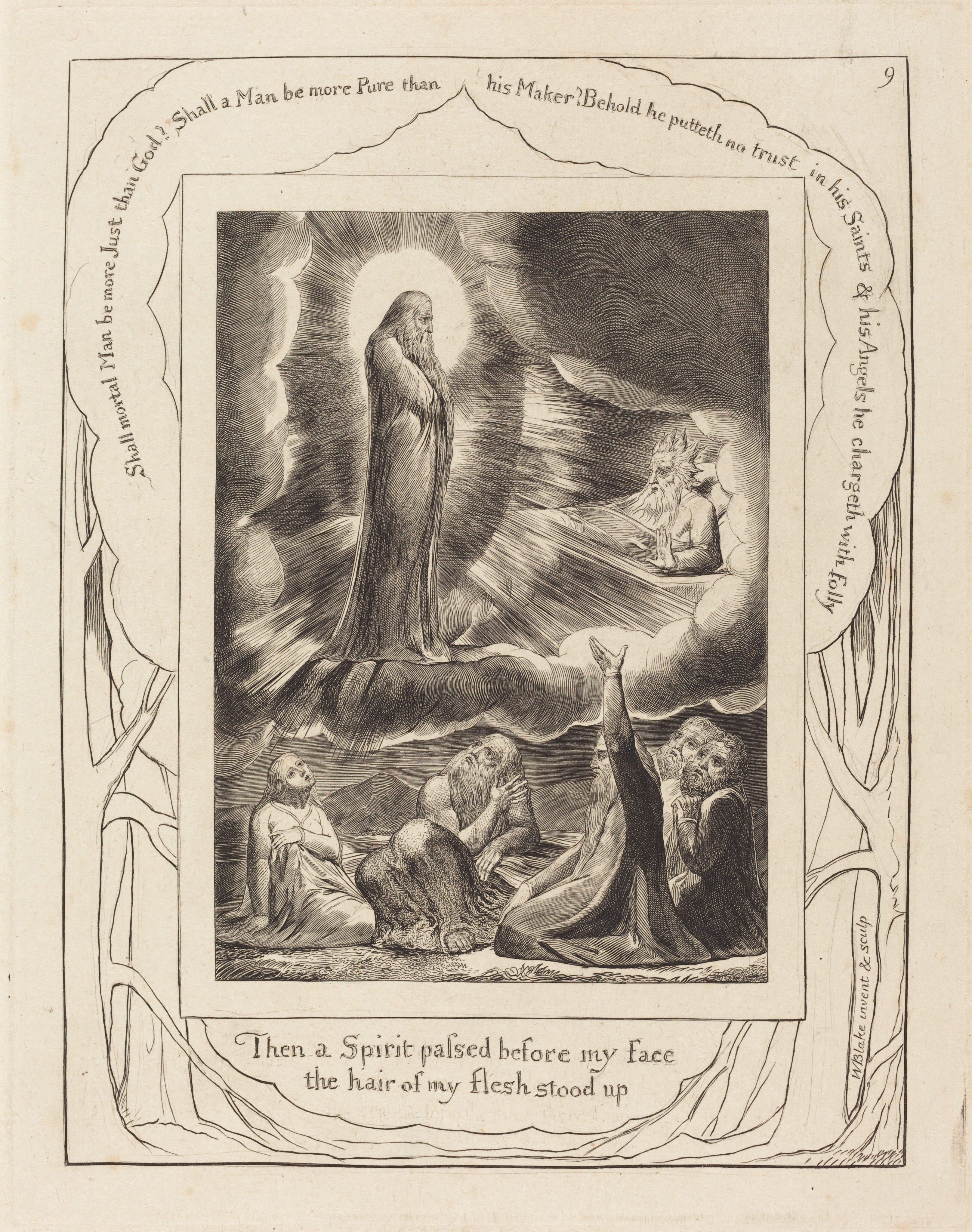
I want to share one example of this by pointing to the strange story of a rogue spirit in Job chapter 4.
The Spirit in the Night
The spirit’s revelation plays an important role in the dialogues; the speakers refer to it often (Job 4:17–19; 9:2; 14:4; 15:13–16; 25:4–6; 33:15).
Job 4:12–21, “A moaning and voice did I hear” (tr. Greenstein)
[4:12–14] Yet to me did a word come in stealth,
And my ear grasped a hint of it;
In shudders from visions in the night,
When slumber falls upon people.
Fear overcame me, and trembling;
As shivers set my bones to shaking.
[15–16] For a spirit passed across my face;
It set the hair of my flesh on end.
It stood still, but I could not discern its demeanor,
(Nor) the form in front of my eyes.
A moaning and voice did I hear:
[17–19] “Can a mortal be righteous before Eloah?
Can a man be pure before his Maker?
If in his servants he puts no trust,
And in his angels he finds fault,
Then all the more those who dwell in clay houses,
Whose foundation is in the dust.
They are quashed before twilight;
[20] From day-break till evening they are crushed;
When it is not even nightfall they forever disappear.
[21] Their tent-pin is pulled up on them;
They die without (ever finding) knowledge.”
These verses in Job are important, very important, because they challenge conventional wisdom, Job’s own wisdom, and ultimately underlie Job’s legal case against God.
9:2 “How can a mortal be righteous before God?”
In Job’s reply to Bildad, he begins to build his legal case against God for the injustice done to him. To do so, he quotes the words of the spirit in Job 4:17.
“I in fact know this is true:
‘How can a mortal be righteous before God?’”
But Job will take this question further, by affirming that, at one level, it does not matter if the righteous can stand before God:
“It is all the same.
And so I declare:
The innocent and the guilty he brings to (the same) end” (Job 9:22).
And a little later he again declares:
“If I am guilty—then woe be to me!
But even in the right, I could not hold up my head.
Be sated with (my) disgrace,
And regard my affliction” (Job 10:15).
Job, in agreement with the spirit, sees God as treating humans as dust. The righteous and unrighteous alike live hard lives and go down to Sheol.
14:4 “Who can produce pure out of tainted?”
In Job’s response to Zophar, he takes up his case against God and rejects much of traditional wisdom. Instead, he observes that the just do not always receive good rewards; and the evil sometimes live at ease. Job maintains his innocence, and he believes his suffering is not caused by his actions.
In a line in which he may speak better than he knows, Job declares:
“Either you summon, and I will respond;
Or I will speak, and you will answer me” (Job 13:22).
Well, God would speak to him after being summoned. And it does not go perfectly for Job! But that is another story.
Here, Job continues his exposition on the fragility of humans. Trees, Job says, at least have hope because they can regrow (Job 14:7–9), but not so humans. Agreeing with the spirit, Job says:
“Who can produce pure out of tainted?
No one can!” (Job 14:4).
15:13–16 “You (claim to) have a secret word?”
In Eliphaz’s second discourse, he accuses Job of relying on secret knowledge. And he quotes Job’s secret knowledge by parodying the earlier revelation made by the spirit in Job 4:17–19.
[11] Are the consolations of these (men) too few for you—
That you (claim to) have a secret word?
[12–13] How your heart carries you away,
And how haughty are your eyes,
That you answer El with your wind,
And out of your mouth put forth such words:
[14–16] “What is a mortal that he be rendered-pure?
That a man born of a woman be found-right?
If he puts no trust in his holy ones,
And the heavens are not pure in his eyes,
All the more one detested and depraved,
Who drinks corruption as though it were water!”
Notice how closely this parallels Job 4:17–19:
“Can a mortal be righteous before Eloah?
Can a man be pure before his Maker?
If in his servants he puts no trust,
And in his angels he finds fault,
etc.”
Eliphaz draws on similar ideas but repeats them back to Job, indicating that he thinks very little of Job’s secret insight.
It may be because Eliphaz knows that he in fact had received spiritual revelation, and he thus sees Job’s secret knowledge of his own righteousness to be ridiculous. Or perhaps Job claims Eliphaz’s revelation as his own. Or perhaps a scribal error moved Job 4:12–21 from the end of Job’s first discourse (after 3:26), since the passages could have been on facing pages in an ancient manuscript, making Job the one whom the spirit spoke to. That, at least, is Greenstein’s proposal.
For my part, I am not sure which solution fits best. But my purpose here is to note how dialogues regularly refer back to prior discourses in sophisticated and important ways.
25:4–6 “How can a mortal be righteous before El?”
Bildad also quotes nearly identical words in Job 25:4–6, although it is not clear exactly what he means:
[25:4–6] “How can a mortal be righteous before El?
How can a man born of woman be innocent?
If the moon cannot shine brightly enough,
And the stars are not pure in his eyes,
Then all the less a mortal, a maggot;
(All the less) a son of a human, a worm!”
Job responds mockingly, in any case:
[26:3] “How do you give counsel without wisdom,
Imparting so much sage knowledge?
[26:4] Whose words are you revealing?
Whose breath comes forth from you”
33:15 “When they’re lying down to sleep, then does he open people’s ears”
When the fourth friend Elihu begins speaking, he regularly refers back to Job’s earlier words. And as one might expect, he brings up the spiritual apparition from Job 4, saying:
[14–17] “For one time El will speak (and be heard),
But a second time he will not see it.
In a dream, a vision in the night,
When slumber falls upon people,
When they’re lying down to sleep,
Then does he open people’s ears,
Frightening them with (his) discipline;
To turn one away from one’s misdeeds
And remove the pride from a man.”
Elihu believes that a vision at night can be one way God (El) speaks. If he refers to the apparition in Job 4, he takes a position that has not yet been taken by the speakers: El sent the spirit. However, no one else so far has argued this happened. Readers of Job 1–2 might expect the spirit to be part of God’s divine assembly like the Satan is; but Elihu could not know this. So his position is interesting. It may fit with his overall overestimation of his own theology, which his discourses reveal.
Conclusion
I traced only one part of the story of Job, drawing out how later discourses quote, paraphrase, mock, or allude to prior events. But this is only one such example of many. My goal here was to show how important it is to trace the small connections across the dialogues, because when we do so for the whole book of Job, the richness of the book reveals itself.
It is a work of great art, asking a question we all must face: how can God let the (un)just suffer so? Does he care? And yet: the story concludes with Yahweh affirming Job’s truthful speech unlike that of his three friends (Job 42:7–8). We are left wondering what about Job’s case was correct and what God corrects in his theophany from the storm. And I suppose like all great literature, and here I am reminded of the Platonic dialogues, we must follow the line of questions beyond the text itself, so that we might seek answers by our philosophical and theological speculations.
Edward L. Greenstein, Job: A New Translation (Yale University Press, 2019), xxxiii.
Greenstein, Job, xxxiii.
Greenstein, Job, xxxiv.
Christianity teaches that children are replaceable and interchangeable through this story