


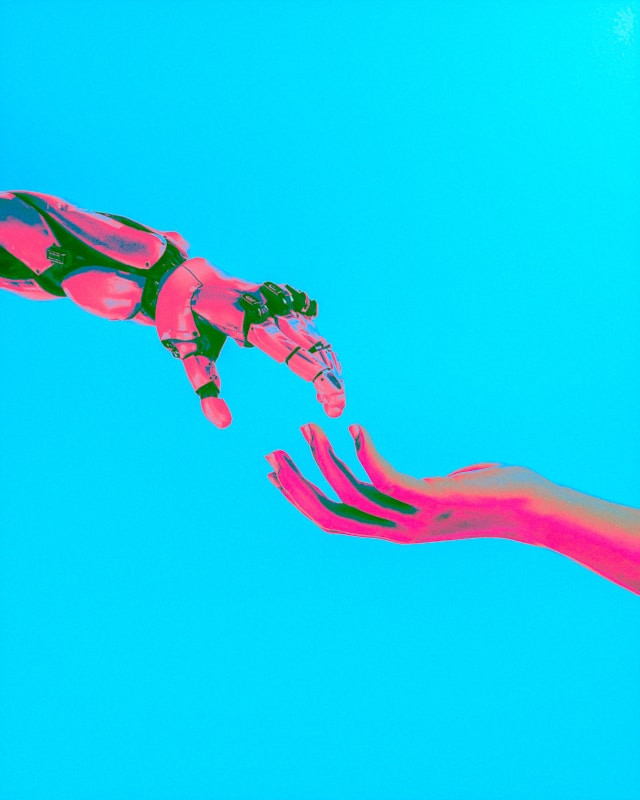
Transhumanism aims to transcend human limits and so improve the human condition. As a movement, it follows a Nietzschean axiom that humans are a bridge between animality and a new creation (Thus Spoke Zarathustra, §3–4). We are not animals, but we do not know what we will become as of yet. While Nietzsche thought about this at a cultural and moral level, his posthuman ideas have become normal within the transhumanist community.
Transhumanism and posthumanism promise a new kind of humanity, one that solves the problem of death (for example, Bryan Johnson) or merges with machine intelligence. Some of the notions of transhumanist ideology lie deep into the future, particularly the dream of uploading consciousness to machines or achieving digital immortality, yet we can see its precursors today.
Technological Precursors
We may not be able to upload our brains to a machine as of yet, but AI models today can capture the image and language of a deceased family member and reproduce them digitally. This prelude to more advanced versions of posthuman existence in the machine already feels like science fiction.
Christopher Ruocchio has advanced just such a future in his Sun Eater series. Here, humans and posthumans live side-by-side in the universe. The latter sometimes aim to live forever by transforming brain states into new bodies; or to extend their lives by living machine-modified existences; or even by being a brain in a machine, who lives in a dream world.
Our ability to select for certain gene types or characteristics in IVF suggests another precursor to a posthuman future. For example, NucleasIVF+ uses the IVF process to deselect traits of fetuses that are undesirable and select for traits that are (high IQ, height, etc.).
Currently, such IVF procedures belong to the rich. That said, mass society uses early-adopters with money to fund products, so that they might be mass-produced to scale with the whole population. So perhaps down the line, we will see such things becoming normal.
Medical Integration
Some of these advances may simply integrate into our larger technological age without transhumanist ends. For example, Harvard Researcher David Sinclair’s lab has demonstrated successful restoration of sight in mice after damage, using gene therapy to reverse cellular aging. His team delivered reprogramming factors that reset aged retinal cells to a more youthful state, allowing damaged vision to recover. While such technologies overlap with transhumanist dreams, they currently fit into specialized medical research rather than posthuman goals.
For this reason, I do not necessarily see the posthuman future as one that will or must occur. Some of the scientific pursuits may simply fall in line with mundane advancements in medical technology or otherwise.
Military Applications
Such techniques will likely apply to military ventures. If we can modify sight in the future, will we give soldiers night vision eyes? That sort of thing may not exactly reach the posthumanist fever dreams of many transhumanists, but it certainly should make us cautious about the future of transhumanist technology.
It may be that the very means by which some aim to overcome death will become an instrument of death.
While human modification may not be the future of war, I suspect drones and machines will make war in the future, as soldiers increasingly pair themselves with machines.
Integration with technology, like body modification, may promise a utopia but end up being an instrument for war.
Natural Limits
Transhuman technology will likely come sooner than we wish. We live in a world that feels like a prelude to a posthuman existence. And while I do think some these science fiction ideas may come to pass, I doubt that we truly will enter into a posthuman world.
Nature has a way of preserving itself. I mean human nature. While we can modify our bodies, can we change the soul? Do we have a design that makes us work best when we live within our human built-in limits? Does the pot have the right to say to its moulder, why have you made me this way? The sculptor may yet know better the shape the clay should form into.
I find the future fascinating, and I confess I geek out about the scientific achievements that we continue to attain. But I cannot find myself fully believing the progress story, the story that we must move from human to posthuman.
Nietzsche may have described a common assumption of the modern age, but has he missed something by denying metaphysical reality? Are we not more than biological machines? Might we find that our built-in limits preclude us from living in a prelude to a posthuman life?
I think so.
Great post, Wyatt. I do think much of the science fiction of the 80s and 90s is beginning to have its fulfilment today - particularly the cyberpunk genre.
I think the film Gattaca was very ahead on the curve in terms of IVF and gene editing. As soon as it becomes the case that a parent feels they are actively harming their child's chances in life by not genetically modifying them, it becomes a very difficult pressure to avoid it. And even in that film, whilst it is a stirring tour de force of the human spirit, you could say it seems as though the protagonist *shouldn't* be fulfilling his dreams. He does have a degenerative heart issue, that he wouldn't have had if his parents had genetically modified him, which would make him ill-suited even today.
I do feel these questions are going to be substantially more complex for Christians than we could possibly imagine. And brute responses of just 'don't do it' - As with all of modernity technology - are going to be increasingly untenable. Unless Christians as a whole become like the Amish and form a parallel society, you can't be in society and not participate in its technology.
This feels like something that is going to come up the curve very quickly and that almost nobody is really discussing in detail!