


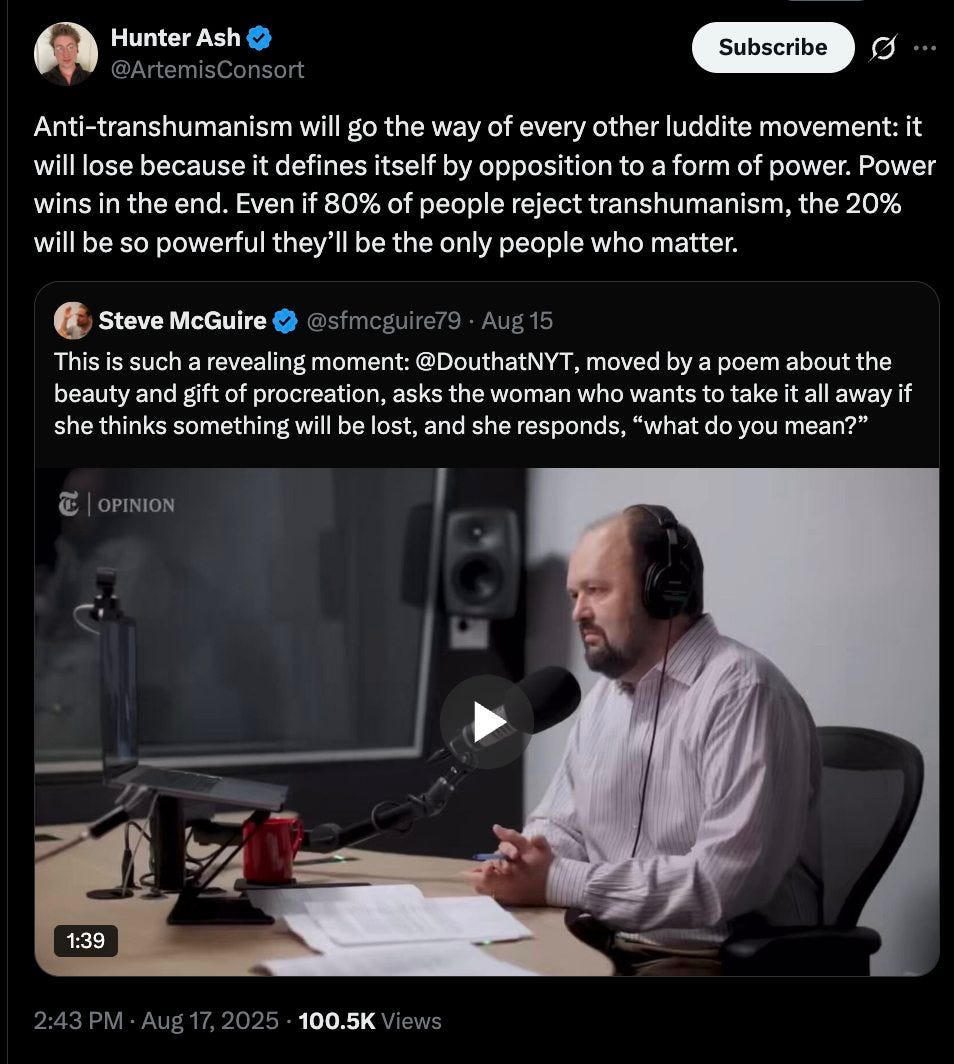
Transhumanism, I’m persuaded, has become the current mode by which the elite seek immortality. Once the techniques of transhumanism (gene editing, full biometrics, and so on) become mainstream, it will almost certainly become the dominant way people attempt to avoid death.
Why?
Because society has already been prepared to accept transhumanism as the inevitable fruit of technological progress, something as unavoidable as the internet or artificial intelligence.
We live, as Jacques Ellul observed, in a technological society, a society marked by the pursuit of technique to master nature. But such domination of nature always locates power in the hands of the “some” over the “many,” just as the Hunter Ash in the image above notes and as C. S. Lewis warned of in The Abolition of Man.
The future, I suspect, will be less outwardly vicious. Physical violence will not disappear, but psychological and economic violence will likely increase. The “some” (the haves) will come to dominate the have-nots through economic and technological power.
Even now, wealthy people enjoy advantages that open doors to good jobs, reliable healthcare, and a higher quality of life.
But what happens when gene therapy allows the wealthy or upper class to be smarter, live longer, and retain power for decades more than others? That is not science fiction; it is already here. Access to health services already allows those with money or status to receive superior care. Consider Canadians who cross the border to purchase boutique U.S. healthcare because of the slowness of the Canadian system. Or note those who see elite physicians offering detailed genetic testing and blood analysis to optimize health and longevity. The haves, once again, have more.
Let me make the point clearer. Orchid proposes that parents be allowed to engineer their own children via IVF and genetic selection. That means the “some” (parents, viable embryos) are chosen, while the “many” (less viable embryos) are abandoned, frozen, experimented upon, or destroyed.
Add to this the rise of transhumanist influencers like Bryan Johnson, who urges everyone to live by the creed: “Don’t die.” He believes that by applying transhumanist-style biological analysis, we can optimize our way toward immortality. Not that he denies death entirely, but he advocates a way of life where every decision is made by the principle: “Don’t die.”
Soon, technology may allow us to inject dormant genes into the body, genes that can be switched on upon injury to send RNA instructions that rebuild tissues. Already this is happening in mice with remarkable success. Blood transfusions, stem cell therapy, and more are real and increasingly common if you have access and money.
The only way to prevent the few from exercising power over the many is through a vibrant and energetic humanism, one that confesses God as Lord of Word and World, of grace and nature. Such a vision affirms that natural limits are good, and that healthcare has a purpose which may not align with transhumanist ethics. For instance, eliminating embryos with Down syndrome cannot fit within this understanding of natural law, since it ends a human life; technology makes that option possible. And so the “some” (here parents) exercise power over the “many” (the eliminated embryo).
Christians, therefore, should be on the front line. We are bound to believe that God has written both his Word and his World with meaning and substance, truths that can be discerned, known, and that establish the moral structure of the universe.
Thank you. This is the kind of analysis we need to hear.