


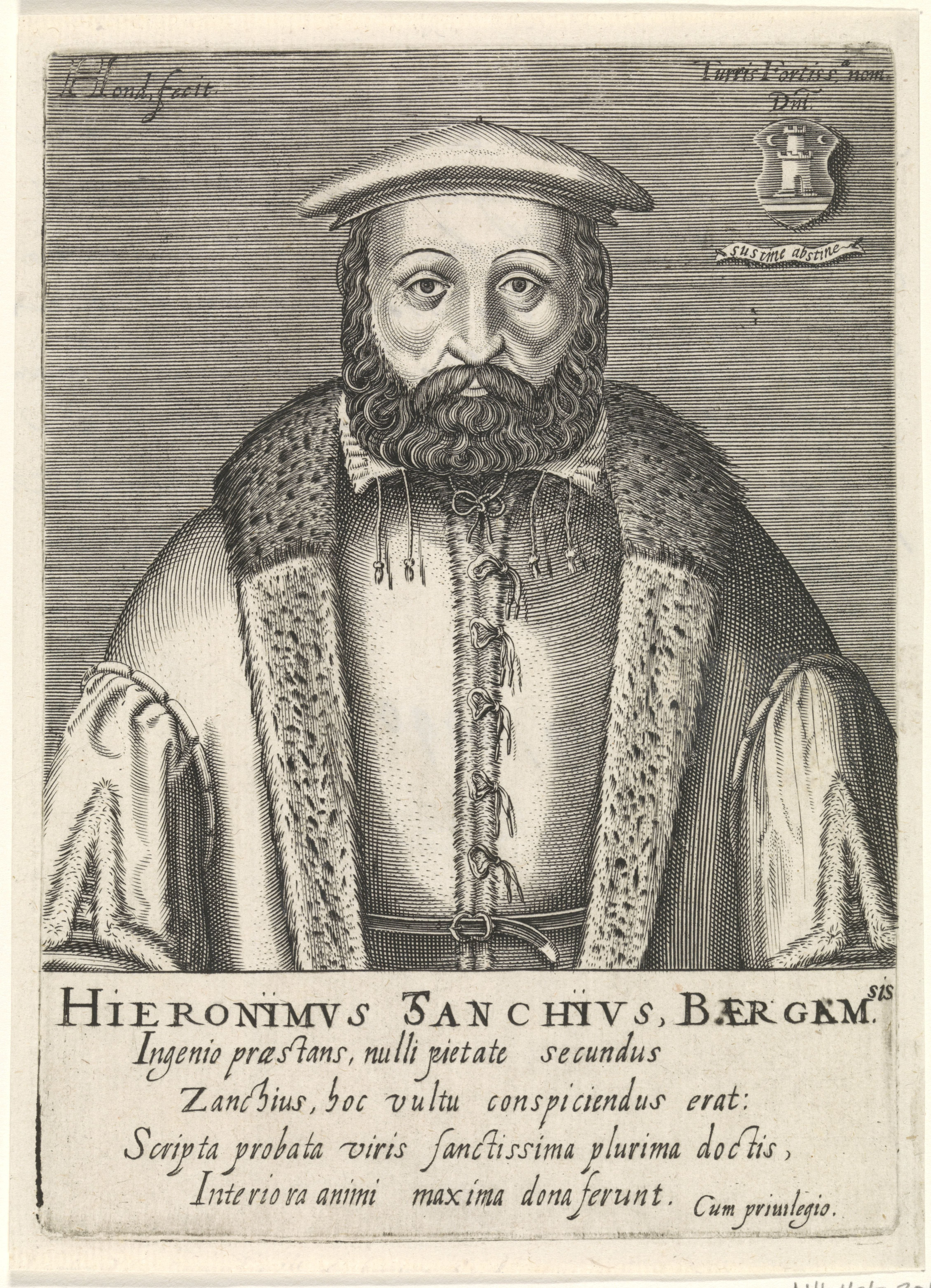
Protestants, like Christians before them, viewed natural law as a component of reality. Hence, Protestant Reformers wrote over fifty commentaries on Aristotle’s Nicomachean Ethics between 1529–1682.[1] Aristotle’s work had laid the foundation for all future work on virtue ethics in the West. The foundational nature of the Ethics explains why so many Protestants commented on the text.
Within the natural law tradition of Protestants, I tend to find useful the writings of Richard Hooker (1554–1600), Peter Martyr Vermigli (1499–1562), Niels Hemmingsen (1513–1600), and Girolamo Zanchi (1516–1590).
So for the purposes of this article, I would like to recount Zanchi’s view as a representative position on natural law amongst early Protestants (Confession of the Christian Religion 10, pp 83ff; On the Law in General, ch 2., pp 9ff). Afterwards, I will give three basic conclusions for Christian ethics.
Zanchi on Natural Law
First, Zanchi believes God created humans in his image, with an original holiness and righteousness.
Second, Zanchi argues that due to the Fall into sin, humans lost their original righteousness and holiness.
Third, Zanchi points out that God has not left himself without a witness, and so by his grace, communicates not only his divine nature but also his divine law in our hearts after the Fall.
Fourth, Zanchi maintains that this general grace comes in greater or lesser degrees to humans, and that our own sin and corruption can prevent us from fully realizing/acting on this gracious gift of natural law.
Fifth, Zanchi warns we must distinguish between natural desires for what is good and our sinful inclinations, citing Romans 7:23 in evidence (Law, 17): “I see another law at work in me, waging war against the law of my mind and making me a prisoner of the law of sin at work within me.”
Sixth, Zanchi identifies the Ten Commandments as an equivalent to natural law (usually called Moral Law).
Seventh, Christians have the law written on their hearts (Jer 31:31–34), and thus have a full or complete grasp of God’s law. Hence, Zanchi can conclude, “natural law is one and the same among all nations if we look at its presuppositions, not at its conclusions or applications” (Law, 22).
This point is the key: the basic presuppositions (central principles) remain consistent (e.g., “do no harm”) but the various conclusions drawn or applications of this principle can look quite different.
Proofs for Natural Law
Zanchi’s observations come both from Scripture and nature.
Scripturally speaking, Paul, for example, says that all people know God’s invisible attributes because God has shown it to them:
“For what can be known about God is plain to them, because God has shown it to them. For his invisible attributes, namely, his eternal power and divine nature, have been clearly perceived, ever since the creation of the world, in the things that have been made. So they are without excuse” (Rom 1:19–20).
First, what can be known about God is his invisible attributes, which include his eternal power and divine nature. Second, they are perceived “in the things that have been made” because “God has shown it to them” in those things. Third, Paul concludes that no human has an excuse for not worshipping God because God has actively revealed himself to all people. He will say something quite similar in Acts 17 as well.
When it comes to natural morality, Paul likewise affirms that those who sin among the Gentiles know the divine command of God when it comes to right and wrong: “Though they know God’s righteous decree that those who practice such things deserve to die, they not only do them but give approval to those who practice them” (Rom 1:32).
How do they know this righteous decree? Zanchi believes Romans 2:14–15 explains this natural morality in the same way that Romans 1 had explained our natural theology: God reveals not only his divine nature but also his moral law to the conscience by writing it upon our hearts. Thus, Paul writes:
“For when Gentiles, who do not have the law [of Moses], by nature do what the law [of Moses] requires, they are a law [i.e., a rule] to themselves, even though they do not have the law [of Moses]. They show that the work of the law [of Moses] is written on their hearts, while their conscience also bears witness, and their conflicting thoughts accuse or even excuse them” (Rom 2:14–15).
This law written on their hearts represents God’s moral demands. Here, law does not mean anything like legislative law, but something like a rule or a guide. Consider the ways Paul uses the word law in Romans 7:21–23:
“So I find it to be a law that when I want to do right, evil lies close at hand. For I delight in the law of God, in my inner being, but I see in my members another law waging war against the law of my mind and making me captive to the law of sin that dwells in my members.”
Law here means something more like inner impulse or desire. This natural desire for the good, which sin and ignorance corrupt, Zanchi believes is summarized by Jesus in places like Matthew 22:37–40 or in the golden rule of Matthew 7:12, “So whatever you wish that others would do to you, do also to them, for this is the Law and the Prophets.”
Now this rule, Zanchi notes, is common among the nations. As he notes of the golden rule, “In fact, it had also been a law among the Gentiles—the words of Emperor Severus were heard and inscribed everywhere, ‘Do not do to another what you do not wish to be done to you’” (Law, 19). He provides other examples, but what he demonstrates is that the moral demands of the law and prophets have their equivalent amongst the nations (see also Tobit 4:15).[2]
This is also the argument of C. S. Lewis (1898–1963) in his The Abolition of Man, where he shows that the moral commands of natural law are known across the globe in their basic premises. He calls it the Tao. And it really is hard to deny some sort of common standard at the premise level. But as Zanchi notes, the conclusions or applications vary across place and time.
Conclusions for Ethics
First, just because someone argues from natural law does not mean either their conclusions or applications are correct. As to the first, they may err in logical argument. As to the second, they may reject God’s clear commands or twist them to suit their passions and desires. Natural law says nothing about human ability or consistency; only that humans know God’s righteous decree (Rom 1:32).
Second, Christians nevertheless can draw upon common principles like the Golden Rule or “do no harm” to appeal to people in general. Given God’s general grace to all people to write on their hearts the law of God, we can reasonably expect people to desire the common good and sometimes achieve it. This explains why we have safe roads, schools, and plumbing. In principle, we do not want to harm our neighbours, but do good to them.
Third, we should expect those who believe in natural law to, through sin, corrupt good premises and make outlandish conclusions: sometimes this looks like racist or sexist claims of superiority; at other times, it can justify “might makes right.” But people abuse revealed truths in Scripture for evil ends; how much more should we expect them to abuse natural law?
[1] David S. Sytsma, “Aristotle’s Nicomachean Ethics and Protestantism,” Academia Letters, article 1650 (July 2021): 3, https://doi.org/10.20935/AL1650.
[2] Interestingly, Christopher Nolan too describes xenia in Homer’s Odyssey as fundamentally the same as the golden rule. See https://www.bilibili.com/video/BV1vdGK6GEQE/ or:
Shared this. Very helpful.
Really helpful.