


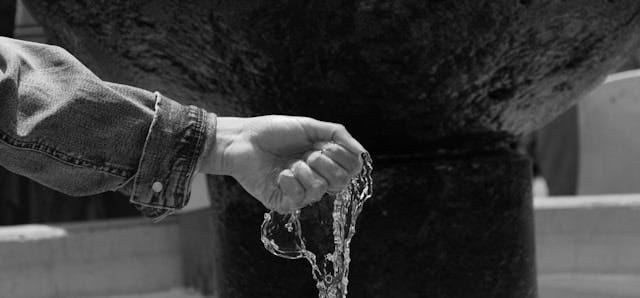
Life is uncontrollable.
Control is like trying to hold water in our hands. It moves, flows, and slips through our fingers. We cannot control it. It flows past.
But believing we must capture it amounts to an impossible desire, one frustrated and filled with the non-release of anxious energy.
Our pursuit of control follows from two causes, according to sociologist Hartmut Rosa. First, sociologically, we fear the lack of growth, progress, and control of all things. We grow GDP, become more efficient at work, and apply this machine-like thinking to all of life. We fear losing our jobs, our stuff, and our future if we do not control the world.
Second, personally, we live by a hope to grow our world, to gain more of it. We want a bigger house, more experiences, broader travels, and to gain as much as possible in life. We live by this hope of ever-increasing newness. This is how, Rosa points out, we conceive of the good life. His alternative is what he calls “resonance”—a mode of being in which we are touched and transformed by the world rather than seeking to master it.
Knowing this is one thing. Doing something about it is another.
We relate to the world in ways we do not choose. Being born in a modern economy means the need for ever-more growth in the economy, workplace, and life seems intuitive and common sense. Granted, everyone has to work and produce. But we do so with a sort of religious fervour. Expansion, exploitation, and capital growth mark our modern economies and lives.
So the world appears to us as just this way. Marilynne Robinson speaks of “the givenness of things,” the world as sheer gift. Martin Heidegger pointed to something similar decades ago, although with the theological meaning that Robinson. He noted how the world appears to us can be something of a given, and that changes the way we see and experience the world. But by recognizign this, Heidegger suggests we might discover a saving power.
Perhaps. But as Rosa points out, the way we relate to the world and the way it relates to us form a symbiotic or organic relation. They work in tandem. We cannot change how reality has been given to us.
Or can we?
I suggest we can at least try. We begin by recognizing the uncontrollability of the world and accepting that we cannot control the future. This is an old idea. The Roman Stoics pointed to fate and how happiness or the good life partly revolved around accepting that you cannot change external things but only our judgements about them.
And I suppose there is something to this. It eliminates the fear of loss through what we think we can control but cannot in fact control.
But more is needed. Stoic acceptance can tend toward resignation. We also need hope, something that orients us toward a future good.
Hope helps us to see that taking our piece of the world, attaining more and more experience and possessions, is not enough to make us happy. We need a hope that remains unshakeable.
We might say that hope is in us.
We could say that.
But we can also think of the hope as outside of us. If we accept what we cannot control, can we trust the uncontrollability of our lives to someone or something else?
The Christian tradition says yes.
But I am not making an argument from tradition primarily. I also think experience shows why it is a practical necessity to live by Providence, a word that derives from the Latin providentia, “to see beforehand.” If God sees all beforehand, then we can stick to what is in front of us. We can control our judgements, not others and the things around us because God sees for us.
For us, life is uncontrollable. Accept it. And hope in the Being who sees all beforehand. Or else, life might feel like a constantly hostile experience, one task that challenges forth after another.
So might there be a better way than this path of hostility?
Might we be the water that flows through the hand of God? Could we, like the water, simply flow?
I’d like to think so.
After all, he has the whole world in his hands.