


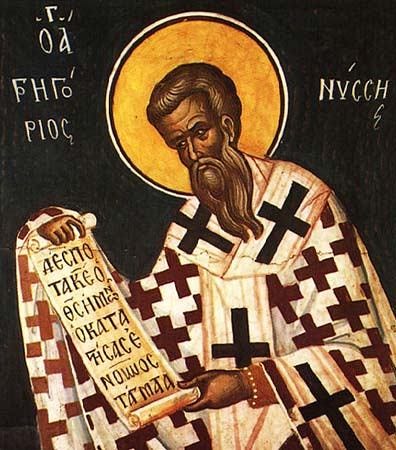
A common narrative is that Christianity slowly, over time, realized that slavery was wrong. Although it took centuries, it followed from the logic that we are all equal before God and created in his image. In the West, a key flashpoint centred on the abolition of the North Atlantic slave trade. This narrative, true in partial ways, has nevertheless strengthened arguments to the mistaken position that Christian morality progresses from worse to better, widening over time.
My argument here is that Christians did not need to progress far enough before they could realize that slavery was evil. Many knew. The example I want to give here is one of Gregory of Nyssa’s homilies on Ecclesiastes, in which he calls out the evils of slavery.
Gregory of Nyssa on the evils of slave owning
Gregory lays out four arguments against slavery:
Slavery usurps God’s domain over us as humans.
Slavery is contrary to human nature which is free.
Slavery gives a price for human life, which is impossible, since life is priceless.
Slavery has no real support, because its document of ownership is mere paper.
Slavery usurps God’s ownership
First, Gregory criticizes the opulence of the wealthy, pointing out that the rich even consider themselves masters over another human being. In the voice of the rich, Gregory proclaims, “I got me slaves and slave-girls, he says, and the homebrewed slaves were born for me” (Homily 4 on Ecclesiastes, §334.12–13). This attitude, Gregory avers, amounts to a boastful challenge to God. Why? Because “we hear from prophecy that all things are the slaves of the power that transcends all [Ps 119/118.91].” As the psalmist says, “all things are your slaves.” And if that is true, claiming that another human being is our slave divests God of his universal claim.
“So,” concludes Gregory, “when someone turns the property of God into his own property and arrogates dominion to his kind, so as to think himself the owner of men and women, what is he doing but overstepping his own nature through pride, regarding himself as something different from his subordinates?” (§334.15–18). In other words, Gregory’s first argument against owning slaves centres on taking what belongs to God as if it is our own. God owns all, not us.
Slavery is contrary to human nature
Second, Gregory points out that slavery contravenes human nature, which is naturally free:
“I got me slaves and slave-girls. What do you mean? You condemn man to slavery, when his nature is free and possesses free will, and you legislate in competition with God, overturning his law for the human species. The one made on the specific terms that he should be the owner of the earth, and appointed to government by the Creator – him you bring under the yoke of slavery, as though defying and fighting against the divine decree.” (335.5–10)
According to Gregory, God created humanity to rule over the earth. He cites Genesis 1:26 in evidence, “Let them rule over winged creatures and fishes and four-footed things and creeping things,” and concludes: “You have forgotten the limits of your authority, and that your rule is confined to control over things without reason” (335.12–13, 11–12). Due to God’s creation and mandate that humans have authority over non-rational creatures (i.e., not humans), Gregory finds slavery contrary to God’s original intent in creation.
He further cites Psalm 8:7–8 and 104:14 to show how humans in general have authority over creatures, but not each other. “But,” claims Gregory, “by dividing the human species in two with ‘slavery’ and ‘ownership’ you have caused it to be enslaved to itself, and to be the owner of itself” (336.4–5). And that does not agree with God’s creational intent for us.
Humans have no price because they bear God’s image
Third, Gregory reasons that humans have no price of purchase because they are made in God’s image (Gen 1:26). And this gift is irrevocable (Rom 11:29). “God would not therefore reduce the human race to slavery, since he himself, when we had been enslaved to sin, spontaneously recalled us to freedom. But if God does not enslave what is free, who is he that sets his own power above God’s?” (336.17–19).
Sir William Blackstone, refuting the Justinian (i.e. Roman) justifications for slavery,[1] provides similar reasoning when he writes:
“Every sale implies an equivalent given to the seller, in lieu of what he transfers to the buyer. But what equivalent can be given for life or liberty? His property likewise, with the very price which he seems to receive, devolves ipso facto to his master, the instant he becomes his slave: In this case, therefore, the buyer gives nothing, and the seller receives nothing. Of what validity then can a sale be, which destroys the very principle upon which all sales are founded?” (Commentaries on the Laws of England, bk. 1, ch. 14, 1765–1769)
Gregory goes beyond life and liberty and adds: “He who knew the nature of mankind rightly said that the whole was not worth giving in exchange for a human soul” (336.26–28). Citing the words of Jesus (Mark 8:36), Gregory presses the point even further by showing that buying another human would be the equivalent of buying God, since we are in his likeness and have authority over the earth. So there is a priceless quality to being human. We simply cannot afford each other due to being created in God’s image.
The legal document deceives the owner
Finally, Gregory points out that the legal document that says we own a slave deceives owners. He writes:
“But has the scrap of paper deceived you, and the written contract, and the counting out of obols? If the contract were lost, if the writing were eaten away by worms, if a drop of water should somehow seep in and obliterate it, what guarantee have you of your slavery? what have you to sustain your title as owner? I see no master of the image of God” (337.13–16).
The key here is that a piece of legal paper means nothing because God alone owns us: “I see no master of the image of God.” And after all, “Are not the two one dust after death? Is there not one judgment for them? – a common kingdom, and a common Gehenna?” (338.12–13).
And in Gregory’s conclusion to this argument, he points out how human slavery and chattel slavery differ, how it is proper for humans to own animals but not each other as animals:
“If you are equal in all these ways, therefore, in what respect have you something extra, tell me, that you who are human think yourself the master of a human being, and say, I got me slaves and slave-girls, like herds of goats or pigs. For when he said, I got me slaves and slave-girls, he added that abundance in flocks of sheep and cattle came to him. For he says, and much property in cattle and sheep became mine, as though both cattle and slaves were subject to his authority to an equal degree.” (338.14–19).
So what?
We should avoid a hermeneutical approach to Scripture that says God’s revelation progresses after the Bible to make us more just, more equitable, and more merciful than the Bible is itself. We may be more merciful than many other Christians—and that would be a great thing—but that argument differs from saying we are more merciful than the Bible is. I often see this distinction confounded.
The Bible frequently records humans doing human things, including sin and making mistakes. Paul even tells us that the Old Testament was written so that “we might not desire evil as they did” (1 Cor 10:6). When it comes to slavery, Solomon imposed forced labour on his subjects, and his son Rehoboam threatened to make it worse, and that led to the division of the kingdom of Israel and began the decline into sin and misery.
On the other hand, some forms of slavery were allowed in the Mosaic Law. In Israel, this meant serving a master for seven years under humane conditions, usually for economic reasons (Exod 21:2–6). And even if a slave was outside of Israel, there were careful laws and regulations for the ethical treatment of slaves.
We might find this objectionable, but it is worth noting how the Mosaic Law differed from the nations in its treatment of slaves. We might call this indentured servitude and not chattel slavery. Further, Jesus has told us that Moses allows for activities that God did not originally intend (Matt 19:8; Deut 24:1–4). We may feel justified in applying this to slavery, which the narrative of Kings (noted above) seems to confirm.
I know that I have bypassed many important distinctions, and my goal here is mostly to share the arguments of Gregory. But it is not as if his arguments have never been heard or repeated in Christianity. After all, John Wesley said, “Give liberty to whom liberty is due, that is, to every child of man, to every partaker of human nature. Let none serve you but by his own act and deed, by his own voluntary choice. Away with all whips, all chains, all compulsion! Be gentle toward all men; and see that you invariably do unto every one as you would he should do unto you” (“Thoughts Upon Slavery,” 1774).
Gregory, I think, presents to us a particularly Christian way to see others created in God’s image, as priceless. He knew about the evils of slave owning during the height of Christian influence in the Roman Empire whose economy relied on slave labour. He was not a man of his times. He was a man out of sync with his time because he was a man of the Bible. And that meant he dedicated his preaching to calling out the evils of social injustice, such as slavery.