


Data is quiet, has no voice. It gives no insights. It means nothing in and of itself. Insights only come from within us who have inner sight, and meaning is discovered only by judgment, which requires rational deliberation.
My claims might sound surprising, but consider these recent findings by the Institute for Family Studies:
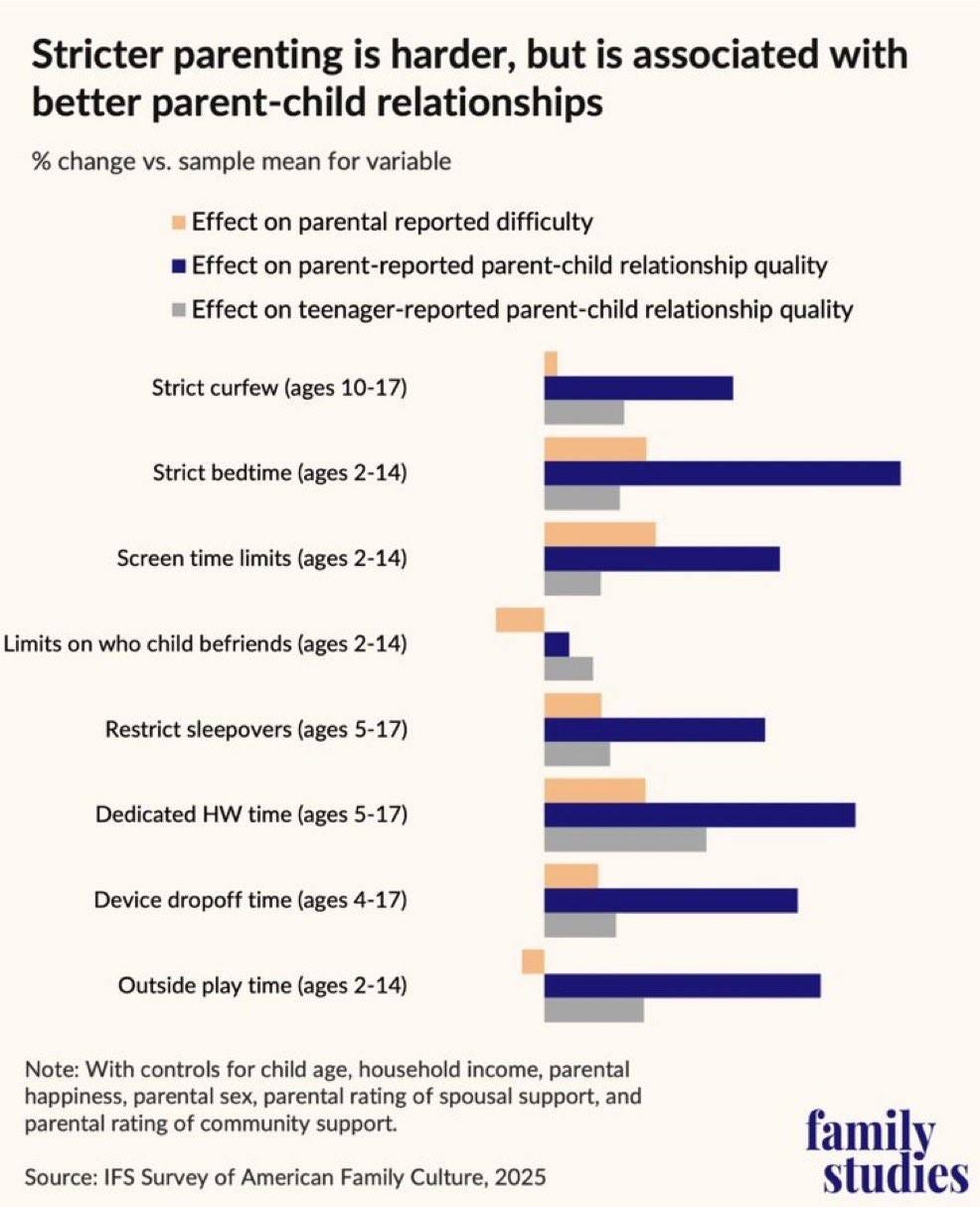
Now ask: what do the words “harder” and “better” mean? How can we measure “relationship quality” or the “effect on parental reported difficulty”? The only plausible answer is by using a scoring system based on subjective and objective criteria, defined by the Institute for Family Studies in their IFS Survey of American Family Culture, 2025.
While some of these criteria are transparent, the original study does not tell us the questions asked of respondents. So we are left partially in the dark.
But even if we did know, what would it mean for a teenager to say that they have a closer or better relationship with their parent when that parent’s parenting style is defined as “strict” due to curfews, bedtimes, and screen time?
We tend to jump to the conclusion that the meaning of this data is obvious. Be strict! Gentle parenting is bad! The data is clear! But it is not, and it never is.
The data above, like all data, has pre-interpreted categories of value—values that the data-makers defined already. Do we agree with them on strictness, on their scoring system based on questions, and their conclusion about the data in the graph’s title? Maybe. But we certainly are not gaining insight or discovering meaning.
We borrow meaning from the data-makers, and we assume that we have gained insight. We have not. We have heard a carefully curated data set, controlled by its questions and categories, to lead us to a conclusion. The conclusion may be correct, but the data itself cannot tell us whether it is or not.
Three reasons illustrate why data alone cannot furnish insight.
First, consider why politicians almost always rely on data and statistics to make political decisions. They do so in order to appear objective and to avoid making principled decisions that they might be wrong about. “The data say,” “the science is clear,” and “the polls tell us.” These phrases and others like them appear across the political spectrum, including in medical messaging and not just among federal politicians.
Second, data promises to make the world accessible to us. But for the data to be accessible, it must be simple, transferable, and able to be understood by many people. By definition, this means such data gets abstracted from concrete, high-context situations.
Can a metric count the inner transformation of a child transformed by the love of a father and mother over forty-five years? What sort of metric would count the inner resilience, the small acts of kindness, the feeling of security provided by a loving family? We could try, but we know that metrics abstract data at a simplified level to make it accessible. So such data, important as it is, often misses the most important and most valuable dimensions of human experience. It promises to make the world accessible to us, but it fails to deliver many of the most valuable things in life.
Third, metrics and statistics cannot cross the chasm between information and soul. What we can measure externally—change, percentages, effects, and other such data—cannot easily tell us about the slow formation of the soul. It may be that a runner over a ten-year period develops grit, appreciation of the outdoors, courage, and the capacity to see hardship as gain when endured; but how might we score that? Just what would tell us those inner experiences? And even if it could for one person, how would we create a questionnaire for a mass population to test such things?
In short, these reasons (and others like them) tell us about the limits of metrics in providing insight and meaning—something that only rational agents possess and can discover.
Even with the caveats aside, some measurable things are too sticky to ignore. Strictness may very well be good, presumably with love and compassion, since strictness with abuse would not accomplish better relationships in any real way, even if a metric captures it as doing so.
But would this data mean that strictness is good? At best—and I stress this is at best—the data might tell us how one thing follows another thing. It may tell us that curfews statistically precede, along with other factors, subjective feelings of affection in families.
But what if the measured items (curfew, screen time, etc.) are effects of something deeper: an intangible experience of a parent’s love for a child? I am not saying they are, but then what we might discover here are patterns of love. Yet I cannot discover that in the IFS data, for the reasons given above, although I may guess at it.
So what must I do? The answer is: use rational principles and follow models of good parenting. For example, here is a principle with my judgment: Be strict with your kids insofar as your guidelines and rules tend towards something good (respect, discipline, etc.). That is true no matter what the data say. I will not try to model anything here, since I believe that happens not so much in writing but through experience with others.
With all of that said, I am increasingly convinced that data is quiet, has no voice. We accept the categories of measurement and assume that it means what we hope it means. But can a metric count the inner transformation of a child transformed by the love of a father and mother? No. But does that mean data has no use? No, again.
Such data is useful for a great many things. I want 50,000 MRI scans to know how to spot a recurrent pattern of illness; I want metrics on water volume to ensure that I have running water at home. The technique or technology of metrical reasoning makes modern society possible. I am thankful for this gift.
But as Mary Midgley tells us in The Myths We Live By, just because mechanical reasoning works in one field of knowledge (science), it does not mean such reasoning can explain everything in other fields of knowledge. I believe we assume that metrics can make transparent and accessible the world to us. So we use data, thinking that through it, we might gain insight.
We cannot. Only we can have inner sight; only rational agents can discover meaning. We may do so through judgments made in connection to data. But the data has no meaning in itself; it cannot. It is not a rational agent. Nor can we find insights in it, since we alone have such sight.
So the more I think about it, the more I think that data cannot speak and provides no insights—that inner sight is ours alone. And the great danger, I think, is that such mechanical values will capture our minds, as C. Thi Nguyen argues in The Score. So captured, we will begin thinking that the categories of the data-makers are the most important values for us to consider. The Conditioners, as C.S. Lewis warned in The Abolition of Man, will have conditioned us to become calculators. And we will forget what we used to know: we were made for eternity.
My parents used to say when disciplining us, "This hurts me more than it hurts you". How would we measure that. I didn't realize what it meant until I became a parent.