


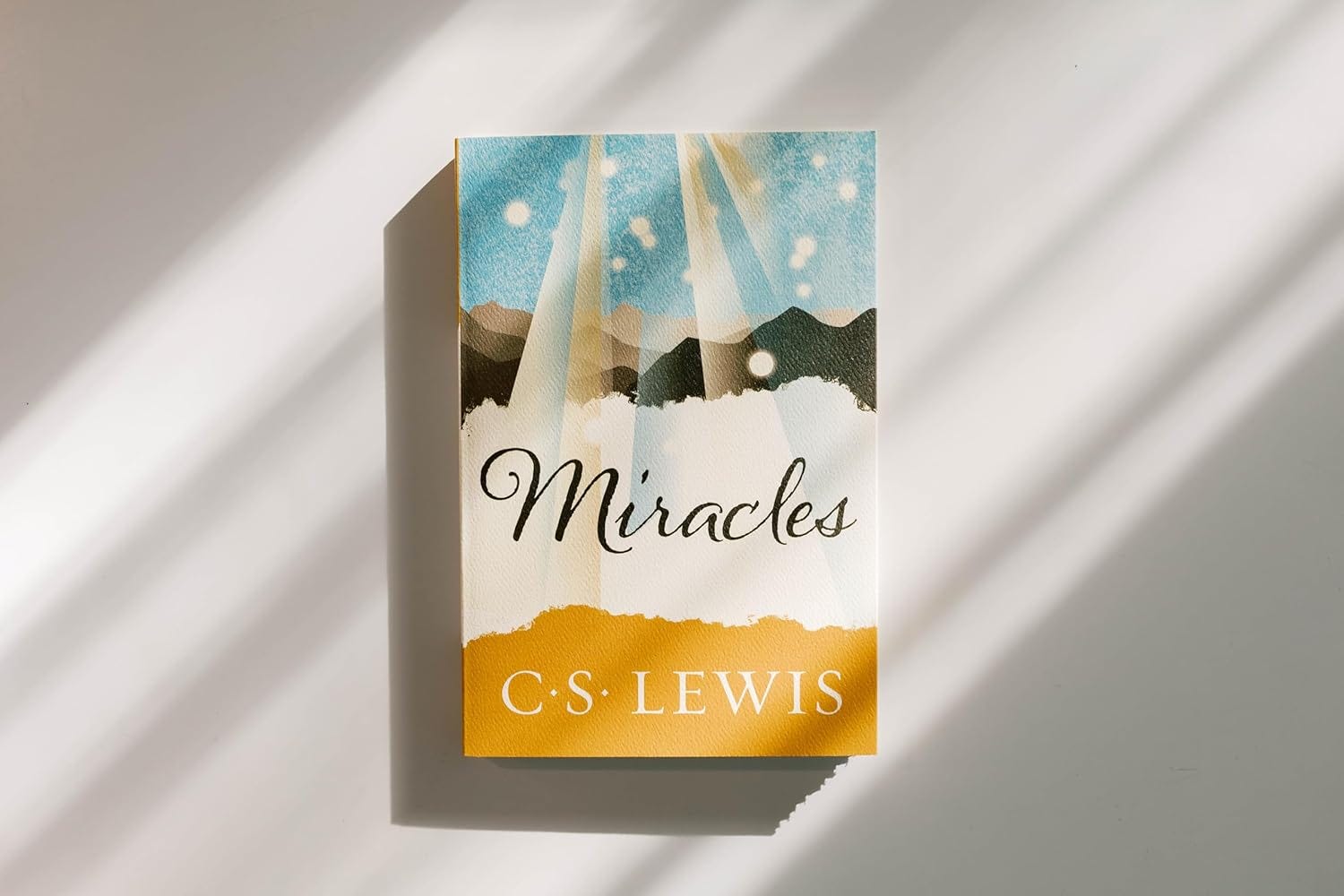
In Miracles, C. S. Lewis argues that Naturalism cannot explain reason without undermining the argument for Naturalism. He points out that Naturalism acts as a closed system because it assumes that everything can be explained within it.
But Lewis notes: if God or something like God does not exist (but only Nature does), then reason becomes an emergent property of Nature. And in Naturalism, Nature itself has no intentional direction, no rationality; the best we can say is that natural selection forms what we call reason or inferential reasoning.
If so, then prior causes led to the emergence of reason and inferential thinking. Yet that is different from saying we know the reason why something is true or false—what Lewis calls ground-to-consequent reasoning. If our reasoning is merely one effect after a long series of causes, it cannot reliably inform us whether something is true or false.
In other words, Naturalism cannot use inferential reason to validate its truthfulness, according to Lewis. It is that argument I want to recount here because I find its basic premises illuminating (but perhaps not persuasive).
Two kinds of causation
To make his case against Naturalism’s ability to use inferential reason to validate itself, Lewis points to two common patterns of causation. For example, consider these two ways to use the word because:
Grandfather is ill today because he ate lobster yesterday.
Grandfather must be ill today because he hasn’t got up yet.
If grandpa is sick because he ate lobster, then the lobster caused his sickness (cause to effect). But if grandpa must be sick because he got up late (and he always gets up early), I explain the reason or ground for why I believe him to be sick (ground to consequent).
Importantly, this second form of reasoning resembles what Aristotle meant by a cause: not merely that one event preceded another, but an explanation of why something is the way it is. By contrast, Lewis’s cause-and-effect ‘because’ is closer to Hume’s picture of causation as the regular succession of events, namely, that one thing follows another, but we never observe the reason it must. Lewis’s distinction between ground and cause maps, roughly, onto this older philosophical divide.
From there, Lewis observes how when we give reasons for something in the first sense, it generally means that our reasons are groundless. In other words, we say to a theist, “You only say that because you are a Christian!” or to a conservative, “You only say that because of your politics,” or to a man, “You only say that because you are a man,” and so on. When we say such things, we mean that these causes preclude a ground, or at least that the person’s opinion—while caused—is not established as true precisely because it is caused (in a cause to effect relationship).
Besides, Lewis notes, even a madman’s views are caused; being caused does not make a belief true or false but simply means that one or many events preceded another event in a great chain of causation that spans time backwards and forwards.
Yet this train of causation does not explain why something is the case through ground-to-consequent reasoning. Cause and effect do not give us a reason, and in fact citing such causes often implies that our reasons are groundless: “You only say that because you are a Christian!”
Psychological events
Now, we might think our reasoning works as a ground-to-consequent relation, at least as a psychological event. But if Naturalism is true, then what we perceive in our minds really amounts to a cause-and-effect relation, one that appears to be one of ground to consequent. But it cannot really be so, since reason emerges from natural means (say, natural selection). Its ability to determine what is true or false is a because only in the order of cause and effect; so much so that we could say, “You only believe that because of natural selection!”
And even if this seems absurd, remember that the madman and the liar both speak because something caused them to do so. Having a cause does not make something true or false; it is simply a cause that precedes an event in such a way that one leads to the other.
The difficulty of Naturalism
So, Lewis concludes, Naturalism as a closed system cannot account for inferential reasoning that can validly claim that something is true or false. That requires something outside of the total system to be able to judge whether Naturalism is valid or not.
If reason is within the system, it would be an effect of some cause (say, natural selection) and unable to be trusted as validly discerning true from false. And this means one cannot use inferential reasoning to validly conclude that Naturalism is true, for Naturalism itself has stripped reason of the capacity to do so.
As Lewis puts it, “[Naturalism] discredits our processes of reasoning or at least reduces their credit to such a humble level that it can no longer support Naturalism itself” (22).
Or, in longer form, Lewis puts his argument like this:
“Unless human reasoning is valid no science can be true. It follows that no account of the universe can be true unless that account leaves it possible for our thinking to be a real insight. A theory which explained everything else in the whole universe but which made it impossible to believe that our thinking was valid, would be utterly out of court. For that theory would itself have been reached by thinking, and if thinking is not valid that theory would, of course, be itself demolished. It would have destroyed its own credentials. It would be an argument which proved that no argument was sound—a proof that there are no such things as proofs—which is nonsense.” (21–22)
While he thinks this applies to strict materialism straightforwardly, the argument also applies to Naturalism in more subtle ways. Since Naturalism sees reason as within the total system, emerging from it, from some process like natural selection, then, according to Lewis, reason cannot be reliable in discovering truth.
“If, writes Lewis, “there is nothing but Nature, therefore, reason must have come into existence by a historical process. And of course, for the Naturalist, this process was not designed to produce mental behaviour that can find truth. There was no Designer; and indeed, until there were thinkers, there was no truth or falsehood” (27–8). So natural selection does not select for truth as such, but only for survival. And whatever other way we want to describe a total system like Naturalism, it is hard to justify the existence of morals or truth in ways beyond words like fittingness, natural selection, and other like terms. Put simply, arguing that Naturalism is all there is and thus God is not, for example, falls outside the possibilities of Naturalism itself.
In this context, Lewis cites Professor Haldane, who writes, “If my mental processes are determined wholly by the motions of atoms in my brain, I have no reason to suppose that my beliefs are true . . . and hence I have no reason for supposing my brain to be composed of atoms.” Lewis goes beyond Haldane’s argument, but the point remains similar. If our cognitive acts are mere events in a chain of cause and effect, due to atoms or otherwise, then they do not necessarily provide validity and cannot confirm what is true or false.
We may simply think something is true due to activities at an atomic level, or due to natural selection or some other set of causes, but such forms of determinism do not allow for anything like rational judgment; after all, this process follows cause and effect, not ground-and-consequent causality, due to the internal logic of Naturalism.
There is nothing outside of Naturalism, judging it to be true or false; indeed, truth and falseness only emerge as an effect of a series of causes within Naturalism. Restated, there is no way to use reason to validly rely on our ability to know truth or falsehood, since our opinions are mere effects of a chain of causation. That is, reason within Naturalism cannot validly conclude Naturalism.
The theist answer
If Naturalism cannot account for its truthfulness, could theism? Lewis answers in the affirmative. Theism is an open system, argues Lewis. So it allows for God to be above and prior to Nature, such that “the human mind in the act of knowing is illuminated by the Divine reason” (34). Importantly, we do not reason or make inferences due to only cause-and-effect processes; we can also judge the truth of things because of divine illumination from this perspective.
Theists can admit both kinds of causality (see above). Therefore, through divine illumination, the theist gets around the problem of Naturalism, and in this narrow sense, the act of knowing is supernatural:
“We mean only that it ‘won’t fit in’; that such an act, to be what it claims to be—and if it is not, all thinking is discredited—cannot be merely the exhibition at a particular place and time of that total, and largely mindless, system of events called ‘Nature.’ It must break sufficiently free from that universal chain in order to be determined by what it knows” (35).
In other words, our thoughts are not biologically, atomically, psychologically, or otherwise determined by prior causes as just one effect. Those causes play a role, of course, but we can also justify our vision of what is true or false because we believe that God illumines our mind (”the light of reason”) to be able to explain why something is true or not.
Is Lewis persuasive?
As long as someone says nothing outside of Nature itself can cause us to rationally perceive truth, then Lewis has a point. If atoms, hormones, events, traumas, biological states, and a trillion other causes mechanistically determine our choices, then our judgment is explained by prior causes. And we cannot be sure that we judge truly or falsely; only that we judge based on prior causes.
It may be that our judgment fits the data around us, that we can seemingly act in response to the world in such a way as to understand it. But again, that is hard to intellectually justify apart from thinking itself. But that thinking must give a reason for the truthfulness of our judgment about Nature. But could we truly trust that judgment, were it only one effect of many or one cause? Lewis claims no. And I tend to think he makes a good point. The judgment that Naturalism is true requires inferential reasoning, because that kind of reasoning can validly conclude truth from falseness, without being simply a mere event within a chain of causation.
With Augustine and the Christian tradition more broadly, I see the light of reason being the divine gift that allows one to make choices, choices that are genuinely free. And hence when John 1:9 says the Word illuminates every human being, I see this illumination as a universal act of grace to provide the intellectual capacity to think because we do not live in a closed system. The cosmos opens up to the grace of God. And divine light shines forth into our minds in the act of thinking. It is grace all the way down.
On the other hand, folks like Robin Bradley Kar are willing to bite the bullet and agree that what we take for knowledge is no more than an effective evolutionary capacity that enhances survival. Book chapter here: https://academic.oup.com/nyu-press-scholarship-online/book/15095/chapter-abstract/169530350?redirectedFrom=fulltext