


Why do Romans and Philemon feel so different? A distinction given by Adolf Deissmann helps make sense of this and sharpens our ability to read the NT well.
Deissmann distinguishes between letters and epistles (public writing). He points out that “A letter is something non-literary, a means of communication between persons who are separated from each other” (Light from the Ancient East, 228). And he distinguishes it from the epistle: “An epistle is an artistic literary form, a species of literature, just like the dialogue, the oration, or the drama” (229).
In fuller form, Deissmann writes:
“The epistle differs from a letter as the dialogue from a conversation, as the historical drama does from history, as the carefully turned funeral oration does from the halting words of consolation spoken by a father to his motherless child — as art differs from nature. The letter is a piece of life, the epistle is a product of literary art” (230).
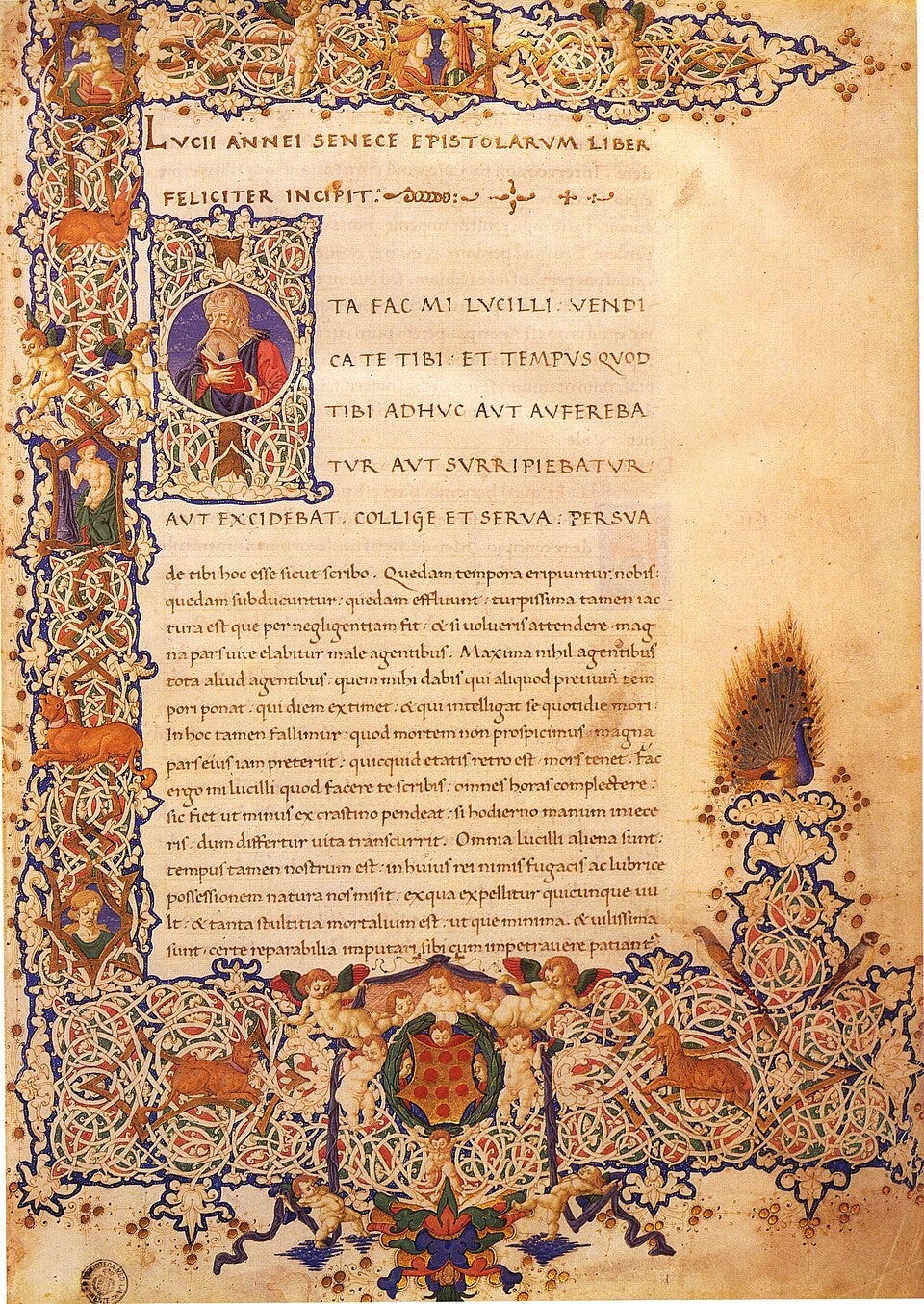
One can see this distinction fairly easily in the ancient world. Short, personal letters tend to approximate our e-mails today. But there are a literary class of epistles such as those written by Seneca.
Seneca clearly wrote not only to a person but also to an audience of other hearers. This would be a public letter (epistle). While Deissmann was too strict in his distinction between a letter and an epistle, the general idea that some letters were written for the public and some were written to individuals (or groups) is sound.
And this distinction explains why we might read epistles like Romans as a public writing, while a work like Philemon feels more like a personal letter. They are the same form (a letter) but with different expectations for readership. Paul expected the various Roman congregations to read his letter and presumably many more Christians, and so he wrote Romans like a public epistle; by contrast, when he wrote to Philemon about Onesimus, he likely had a personal audience in mind (Philemon and the Colossae circle of Christians).
Both letters, however, are occasional in that they are written for specific occasions. With all that said, there is no reason to believe that Paul or others only expected local Christians to read their occasional letters.
While Paul’s letter to the Colossians was indeed written to a specific church or set of churches, its content (the supremacy of Christ) surely impacts all believers. Paul must have known his letters would be read by many. Even if not, the Spirit intended them to be read by the Church, and so we do so today.
Exegetical implications
There are both exegetical (principles for interpretation) and hermeneutical (what it means today) implications of ancient letter writing for reading the New Testament epistles.
First, authors wrote occasional letters in the New Testament for a reason, due to a specific occasion. Paul wrote Romans to gather support for his Spanish mission (Rom 15:24). In so doing, he lays out his missionary theology that centres on how both Jews and Gentiles are saved by the same Gospel via justification. Discerning this occasion for writing is really the first step in reading an ancient letter well.
Second, by recognizing the occasion, we can discern more closely the author’s intent in writing. In Romans, Paul demonstrates his Gospel to the Romans to ensure that they knew it before he arrived and sought financial support for his Spanish mission.
Third, by discerning the occasion (and so the audience) and then the author’s intent in writing, we can begin the work of uncovering the author’s argument. In Romans, Paul for instance develops an argument that begins with the Gospel as redeeming both Jew and Gentile who together are under sin. He then moves to justification, sanctification, glorification, and more besides these before turning to practical implications of his Gospel (Rom 12–16). The epistle begins and ends with a call to the obedience of faith to the nations (Rom 1:5; 16:26), which is in line with his missionary purpose.
Fourth, we can then discern the principles underlying Paul’s argument in Romans (i.e., his Gospel) such as: all sin, all need to be justified before God, etc. This helps us move from the “then” of the text to the “now” of today. We all stand before God under sin and are in need of justifying work in us. And much more than this.
These four steps show a movement from interpretation to today’s meaning, which shows the beginning stages of what it looks like to preach or teach the ancient text of the Bible to the church today.
When the occasion is harder to discern
It is worth noting that some epistles are much tougher to grasp. Galatians, for example, resists simple interpretation. First, there were two areas called Galatia in ancient Rome. Second, we don’t really know who the opponents were that Paul wrote against and what exactly they taught.
We get general ideas, but we need to be cautious here. The same thing is true, for example, in 1 John. And some letters like 2 John are written so un-specifically that we may well assume they were written as public letters for many Christians.
But lest I leave the point too vague, let me give an example of how I might approach a letter whose background seems difficult to reconstruct—1 John.
To begin with, I’d start with what the letter itself says. Some opponents had apparently challenged John and the church to which he writes. From the letter itself, we can discern these things about these opponents:
They denied that Jesus was the Christ (1 John 2:22) — specifically denying that the human Jesus really was the Christ/Son (1 John 2:23; 4:15, 2 John 9)
They denied that Christ had come in the flesh (1 John 4:2; 2 John 7)
They claimed to be naturally without sin (1 John 1:6–10)
Their conduct was haughty, loveless, and schismatic, which contradicted the gospel they claimed only they understood, causing others to question if they had the Spirit (1 John 2:26-27)
Now, we know that historically in the second century, a number of groups did deny Christ came in the flesh. They were known as gnostics (not the most useful term today). Perhaps John dealt with some earlier versions of this teaching. Particularly, he may have been writing against those associated with the likes of Cerinthus.
As I wrote elsewhere:
“Early evidence from John’s disciple Polycarp verifies that John himself had a direct conflict with Cerinthus. According to Irenaeus, who was himself Polycarp’s student, John once encountered Cerinthus at a bathhouse in Ephesus:
‘There are also those who heard from him [Polycarp] that John, the disciple of the Lord, going to bathe at Ephesus, and perceiving Cerinthus within, rushed out of the bath-house without bathing, exclaiming, “Let us fly, lest even the bath-house fall down, because Cerinthus, the enemy of the truth, is within.”’ (Against Heresies 3.3.4)
We can be reasonably confident in this account’s reliability. Irenaeus notes that Polycarp ‘was not only instructed by apostles, and conversed with many who had seen Christ, but was also, by apostles in Asia, appointed bishop of the Church in Smyrna... [and] always taught the things which he had learned from the apostles, and which the Church has handed down, and which alone are true’ (Against Heresies 3.3.4).”
Actually, Irenaeus points out that John wrote his Gospel against Cerinthus:
“John, the disciple of the Lord, preaches this faith, and seeks, by the proclamation of the Gospel, to remove that error which by Cerinthus had been disseminated among men... declaring that there is one Almighty God, who made all things by His Word, both visible and invisible; showing at the same time, that by the Word, through whom God made the world, He also bestowed salvation upon the men included in the creation.” (Against Heresies 3.11.1)
And as I noted elsewhere, Irenaeus sums up Cerinthus’s teaching as:
The world was not made by the supreme God but by a lesser power
Jesus was not born of a virgin but was the natural son of Joseph and Mary
Christ descended upon the human Jesus at his baptism in the form of a dove
Christ departed from Jesus before the crucifixion, leaving the human Jesus to suffer alone
Christ could not suffer because he was a spiritual being (impassible)
I explained, “Cerinthus evidently believed that Jesus was human (fleshly and passible) while Christ was spirit (spiritual and impassible).”
Now, if this is the case, it would make sense that John argues the following:
“Every spirit that confesses that Jesus Christ has come in the flesh is from God, and every spirit that does not confess Jesus is not from God. This is the spirit of the antichrist.” (1 John 4:2-3)
“Who is the liar but he who denies that Jesus is the Christ? This is the antichrist, he who denies the Father and the Son.” (1 John 2:22-23)
“For many deceivers have gone out into the world, those who do not confess the coming of Jesus Christ in the flesh. Such a one is the deceiver and the antichrist.” (2 John 7)
Notice the emphasis that Jesus is the Christ, or that Jesus Christ (the single subject) became flesh? That would directly contradict Cerinthus, who argued that Jesus was in the flesh but a second subject, Christ, was spirit.
So here, we might say that we can better understand John, 1 John, and even 2 John, not through background information as such; but rather through foreground information. That is, by listening to those among the original audiences that John wrote to, such as Polycarp.
Were I to summarize my point here: we can’t always reliably understand a text’s historical context from background information; yet even here, foreground information — what the earliest hearers of these letters tell us — can help fill the gap. And alongside both, we still have enough in the letters themselves to get at their meaning.
Further Reading
Who Was the Apostle John Writing Against in His Letters?

In two of the Johannine epistles (1 and 2 John), we encounter a strong polemic against certain opponents who were threatening the early Christian community. But who exactly were these adversaries that the elderly apostle was so concerned about?
Excellent. I love how our faith is based on historical evidence. The NT documents are truly amazing. Great attention to detail here, thank you.