


As of today, you can spot AI writing fairly easily.
I suspect this will remain the case for some time, because much AI-assisted writing is produced in pursuit of maximal reach. That pursuit requires a flattening of creativity, and AI writing begins to sound alike.
Sameness will increasingly mark public writing. And it will be clear who is responsible for it.
Consider the long threads on X that read like this: THE TEN THINGS YOU NEED TO KNOW TO NOT DIE TODAY. IT WILL CHANGE YOUR LIFE.
Each of these follows the same pattern. It catches attention; in this narrow sense, it excites the passions. Yet on reflection, it offers little. The attention-grabbing form overpowers any substance.
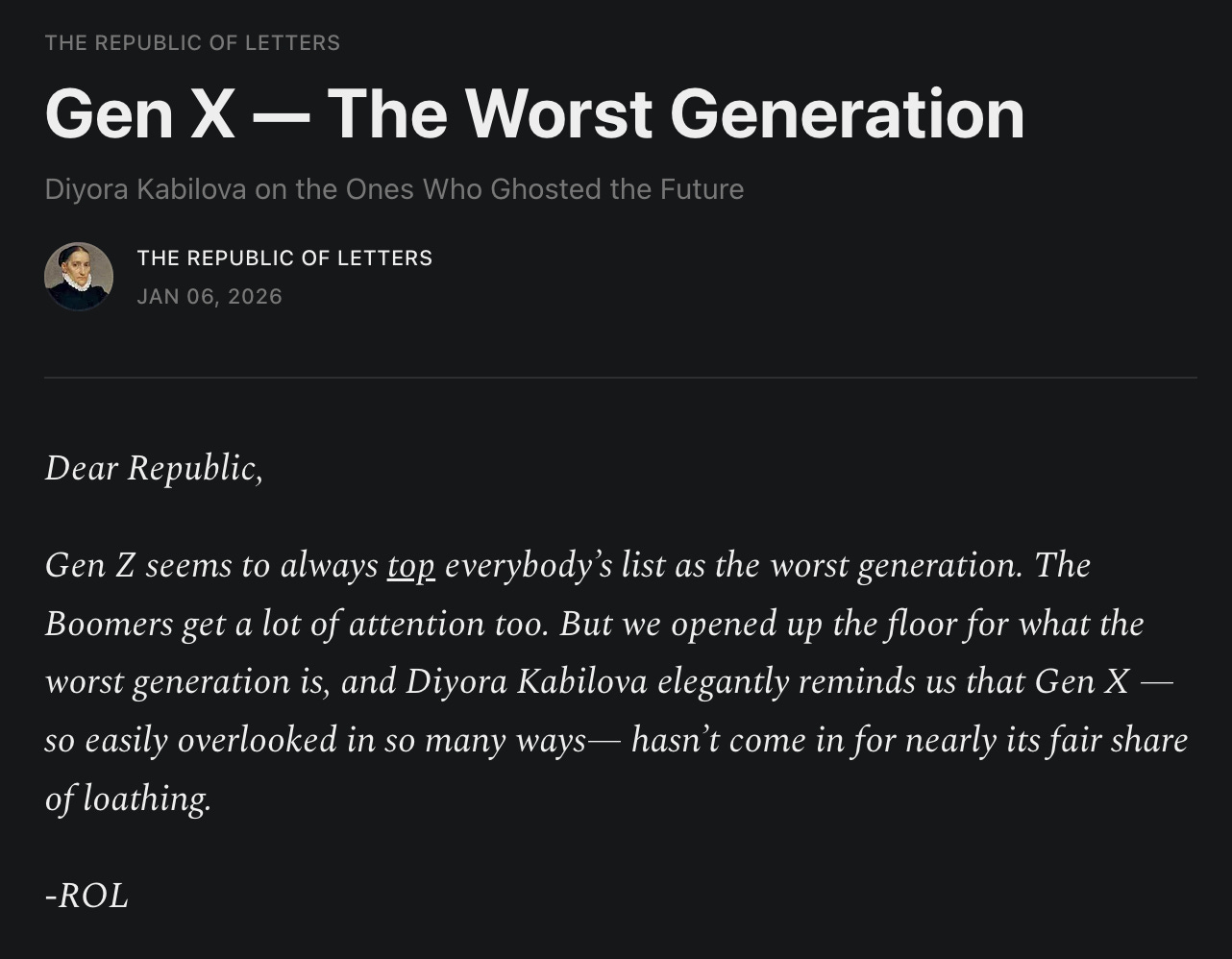
This same dynamic now appears in longer-form writing. Recently, I came across an article on Substack titled Gen X — The Worst Generation. It had a catchy title and a confident tone. Gen Z is blamed. Millennials too. Boomers are named. But the argument points to Gen X as the real problem. The piece attracted attention. It felt new, fresh, and novel.
When I read it, however, the argument fell flat. It felt like a new Marvel movie: flippant, fun, and quirky—and therefore forgettable. There was no sustained argument and little evidence. It relied on assertion, delivered as quips. It read less like an essay than an extended post on X.
This is what AI-assisted influencer writing often does well. It imitates seriousness and borrows the tone of moral judgment and cultural insight. But the result is largely superficial.
AI writing, when used primarily to scale attention rather than to pursue truth, tends toward sameness. It may engage quickly, but it rarely endures in the mind.
If this pattern continues, the danger is not that writing will disappear, but that it will lose its capacity to form judgment, invite reflection, or cultivate understanding. We will no longer write to inform and challenge the few; we will write for everyone, and in doing so, say nothing. Writing for all loses any sense of particularity.
This is why political speech sounds so bland. It is addressed to everyone and therefore to no one in particular. It lacks specificity. It avoids exacting claims. It must remain generic, because it speaks to a demographic rather than to persons.
Good writing does the opposite. It writes for specific people. Authors know their audience, understand their concerns, and address real problems with concrete claims. Ideally, that audience overlaps with the author himself.
With AI-generated content, everything begins to sound the same. Writing is measured for maximal retention and attention. Audiences are treated as data to be analyzed and exploited for the longest possible engagement.
This is machine writing for machines.
It is not human writing for humans.
Very nice. You write well, and I'm pretty sure I can tell by now that it's you. I've been using AI a lot recently to help me with my research, but not with my writing.
Great point Wyatt.
Hopefully this makes your point bright as day. I've taken a paragraph from Marylin Robinson, got an AI to tell me what its about, then got another one to "write me a paragraph about this". I think you can pretty easily tell which one is which!
----
It seems we have been altogether too eager to shrink the vastness of God to fit the small, cramped architecture of a clockwork universe, making damaging concessions to a physics of nuts and bolts that the scientists themselves have long since discarded. We treated the material world as a closed and sullen machine, stripping our theology of its native mystery to appease a mechanical worldview, only to discover that the very floor of reality is, in fact, volatile, intricate, and deeply elusive. There is a profound irony in realizing that the "modern" skepticism we feared was based on an understanding of matter that is now obsolete, and that the strange, shimmering indeterminacy of the new physics does not demand a new religion, but rather permits us to return to the ancient, robust confidence of Colossians; for if the cosmos is indeed a fluid interplay of time and presence, we are free to accept as ontological fact that Christ is before all things, and that in this bewildering, beautiful strangeness, all things do hold together.
-----
The debate between science and religion has been fundamentally misdirected. Physics has shown us a volatile, intricate, elusive substratum of reality that makes the great usefulness of the old nuts-and-bolts physics seem uncanny rather than obvious and inevitable. This new view of the cosmos does not supply or support a new Christian metaphysics, but it entirely discredits the antimetaphysics that has prevailed in Christian thought for some time, the huge and damaging concessions made to a crudely restricted notion of the possible. The basis for a new metaphysics is ready to hand in biblical and traditional theology. The terms that will make it Christian are established in passages like Colossians 1:15–20, notable for the collapsing of time and locus, which modern physics permits or requires us to respect as an ontological fact to be reckoned with.