



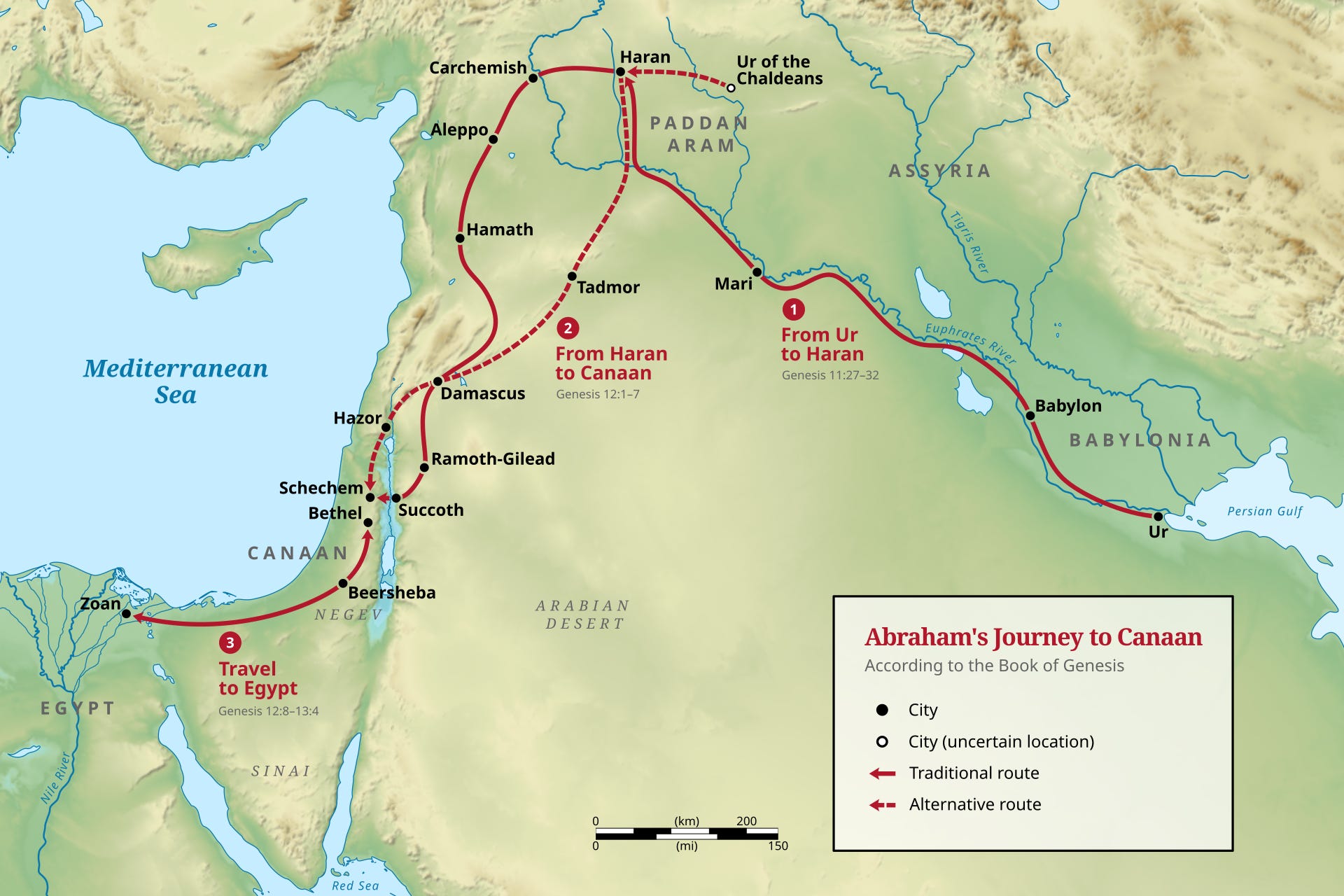
Abram and his family lived in the city of Ur of the Chaldeans (Gen 11:31). Later, he migrated north to the city of Haran. This means that Abram came from a city environment and only later became a nomadic herder.
According to Joshua 24:2, Abram and his family worshipped the gods of Ur, Haran, and presumably of the Old Babylonian pantheon, a region of the world then dominated by Amorite rulers and culture.
Interestingly, both Ur and Haran are associated with worship of the moon god, Sin. Genesis does not tell exactly why Terah and Abram moved to Haran, but Haran was a trade city connected to Ur and focused on the same worship of Sin. It could have simply been an economic move, or it was because Abram’s family already knew they needed to go to Canaan (Acts 7:2–3). In any case, God calls Abram from the cities of Ur and Haran in Genesis 12:1 and summons him to Canaan.
Abram, the Wandering Aramean
Because of Abram’s migration from Ur to Haran, Moses remembers him as a wandering Aramean (Deut 26:5). The region of Aram comprises a large area of northern Mesopotamia, and the term Aramean points to the Hebrew phrase Aram-Naharaim, meaning Aram of Two Rivers. That is what Mesopotamia means: between Two Rivers: Euphrates and Tigris (See Gen 24:10, Deut 23:4, Judges 3:8–10). The Aram area thus refers to Mesopotamia, which includes Syria.
Both Isaac and Jacob will find wives in Haran, which is situated in the plains of Aram or Paddan-Aram. In other words, both Rebekah (Isaac’s wife) and Jacob’s wives are Aramean or Mesopotamian. When Jacob flees Esau to Aram, he goes to Rebekah’s family household in Paddan-Aram, “the house of Bethuel” (Gen 28:2). There, he marries two daughters of Laban: Leah and Rachel. Jacob stays in Aram for twenty years until God calls him, like Abram, to Canaan (Gen 31:3).
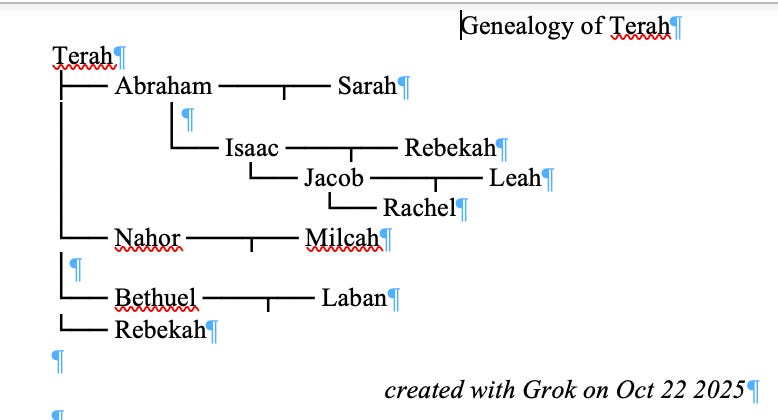
So Abram and his family have deep ties to Mesopotamia. Ethnically, he is a Semite (Gen 11:10–26). In terms of country (city-state), he comes from Ur and Haran. Linguistically, he likely spoke Akkadian, which at this time would have been influenced by Amorite. Culturally, he came from an area ruled by Amorite kings. Both Abram and Terah have names that sound Akkadian or Amorite, for example. So he likely has an Amorite cultural upbringing, which would explain why he lived alongside and allied himself with Mamre the Amorite in Genesis 13 and 14 (Gen 13:18; 14:13, 24).
Abram’s Past Catches Up with Him
So here we have Abram, a wandering Aramean who left city, god(s), and people when God called him to leave Haran in Genesis 12:1. But his sojourn does not mean a clean break from his past.
The Amorite kings and peoples surround him. In Canaan, he lives with Amorites (Gen 13:18). And in Genesis 14, three out of the four kings that invade Canaan are tied to the Amorite people. These kings kidnap his nephew Lot, and Abram goes to war against them (Gen 14:14–16). This would be a decisive break with his past, and it would lead to the clearest expression of Abram’s new faith in the one God of heaven and earth, when Abram meets Melchizedek, the king of righteousness and priest of the Most High God.
Finally, Abram confesses that Yahweh is “God Most High, Possessor of heaven and earth” (Gen 14:22). Importantly, this confession of Yahweh as the most high God, the one who owns all the universe, precedes Abram’s justification by faith in Genesis 15:6 when he is said to have “believed the LORD” and the LORD in turn “counted it to him as righteousness.”
And now Abram will forever see the Amorites as enemies of the true God—if they do not trust Yahweh as Abram did. For in Genesis 15:16 God declares that, some centuries later, Abram’s people would return to Canaan when “the iniquity of the Amorites is … complete.” There, Abram’s offsprsing would meet great kings like Og, king of Bashan, and Sihon, the king of the Amorites, both of whom are Amorites (Deut 3:8), that would war against Israel as she entered the Promised Land (Num 21:21–30; 33–35; Deut 2:24–37; 3:1–11).
The psalms celebrate these victories over the Amorites, showing God can once again bring his kingdom by defeating great kings of the earth:
Psalm 135:10–11 (ESV): “10 He struck down many nations and killed mighty kings— 11 Sihon, king of the Amorites, and Og, king of Bashan, and all the kingdoms of Canaan.”
Psalm 136:17–20 (ESV): “17 to him who struck down great kings, for his steadfast love endures forever; 18 and killed mighty kings, for his steadfast love endures forever; 19 Sihon, king of the Amorites, for his steadfast love endures forever; 20 and Og, king of Bashan, for his steadfast love endures forever.”
In conclusion, Abram left city, kindred, and gods to follow Yahweh. So he was justified by faith. This is exactly what we should learn from the story today. Jesus once again commands us to leave family for his sake (e.g, Matt 19:29). Paul tells us that God justified Abraham by faith (Rom 4:2–3, 22–24; Gal 3:6–7). So we should trust in Christ by faith.